


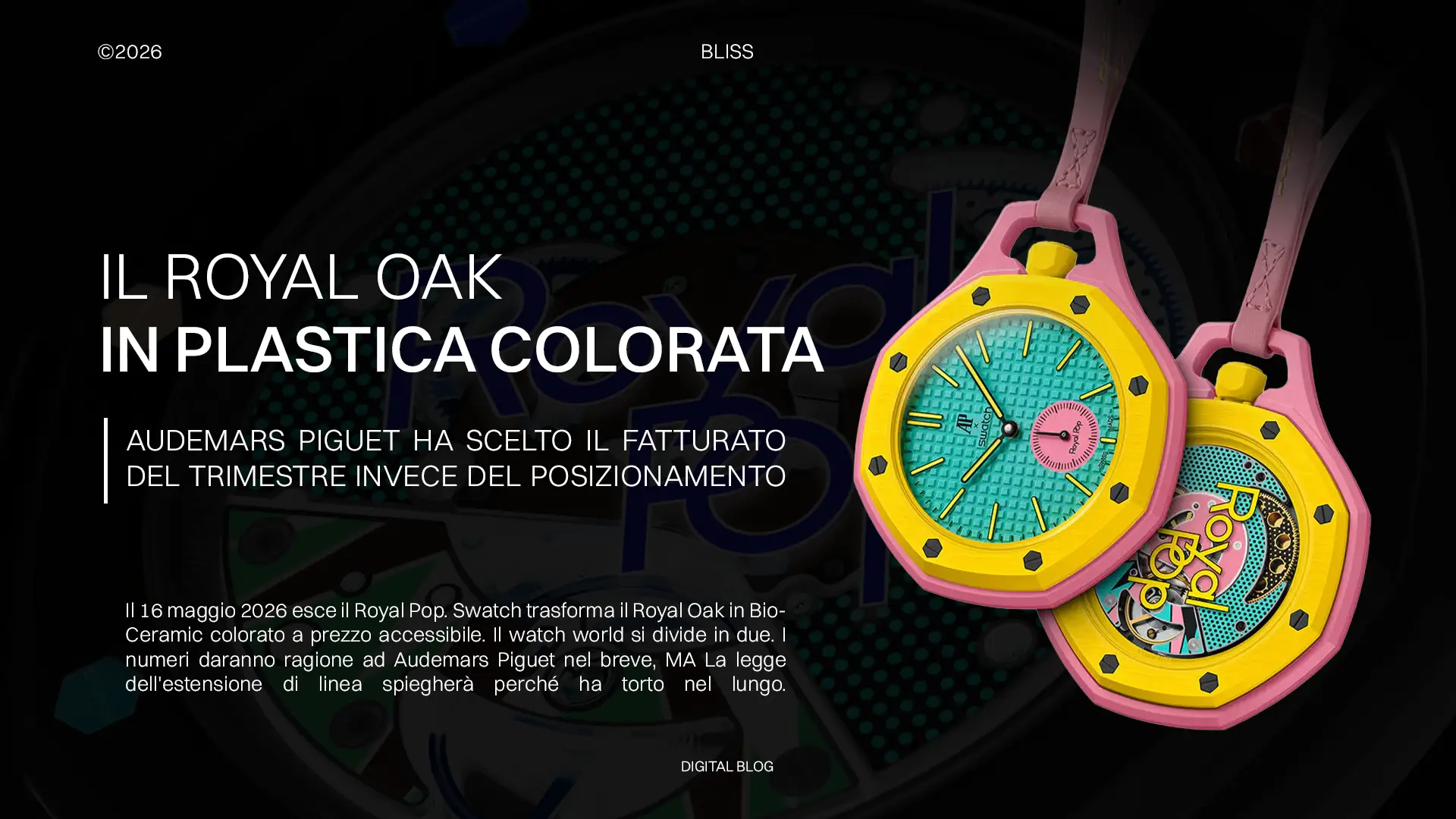
On 16 May 2026 the Royal Pop is released: after the success of the 2022 Moonswatch, Swatch is about to turn the Royal Oak into colourful BioCeramic at an accessible price.
And yet, the watch world has already split in two.
The numbers will prove Audemars Piguet right in the short term. The law of line extension, however, will soon explain why it is wrong in the long term.
The facts
On 16 May 2026, the Royal Pop will debut, distributed exclusively through Swatch’s physical stores in 21 countries.
Audemars Piguet, the Le Brassus maison founded in 1875, is working with Swatch to produce a BioCeramic pocket-watch version of its iconic timepiece in eight colourways. The price will follow Swatch’s logic, ranging between €385 and €400, against an original Royal Oak that starts at around 60,000 dollars and that waiting lists make effectively unattainable.
The official press release speaks of a “disruptive collaboration that fuses joyful audacity with the art of haute horlogerie.” Yet the watch world had already split within the first twenty-four hours. On one side, the collectors, who cried sacrilege. On the other, the marketing analysts, who cited the MoonSwatch as a precedent of industrial success.
Both are right about something. Both are wrong about something else. The distinction is exactly where the real strategic point lies.

What we are really looking at
To understand the impact of this move, we need to look at the players involved.
The Royal Oak is not just any watch. It is the piece that in 1972 defined an entire category (the steel luxury sports watch), and that for fifty years has been one of the absolute benchmarks of haute horlogerie worldwide.
Octagonal case, hand-finished guilloché dial, waiting lists running for years, secondary-market prices starting at $60,000. The Royal Oak represents a system of meanings meticulously assembled over fifty years of fine craftsmanship: rarity, social status, deep watchmaking culture. It is what brand strategy calls a positional good: a product whose value lies in the distance it allows its owner to put between themselves and those who cannot own it.
Precisely for this reason, putting such an object in colourful plastic at an accessible price means removing, even if only symbolically, any distance. And in brand strategy, this is one of the most debated moves of the past forty years.

The law of line extension
In their book The 22 Immutable Laws of Marketing, Al Ries and Jack Trout set out a principle that is still taught in every business school today: when you extend your brand name to a product with a lower positioning, you inexorably weaken the perception of your core product.
The mechanism is cognitive. The brain organises brands into precise mental categories. Until yesterday, Audemars Piguet occupied the box marked “extreme, unattainable watchmaking luxury.” From 16 May, however, it will also occupy the box of the €300 plastic Royal Pop. This is because the rule of perceptual consistency holds that when a brand occupies contradictory positions, the cognitive system reduces the dissonance by shifting the positioning towards the less prestigious point.
The Royal Pop does not elevate Swatch. It dilutes Audemars Piguet.
Not straight away. Not among the current generation of collectors, who already own a real Royal Oak and will keep buying them. But among those who are now 20-30 years old and are forming their patterns of association today, the Royal Oak will start to be associated with the Royal Pop as well. And that cognitive contamination will be impossible to remove.
It will remain a stain on the aura of a luxury brand.

Why it worked for Omega and may not work for Audemars Piguet
When Swatch launched the MoonSwatch in 2022 (the BioCeramic version of the Omega Speedmaster Moonwatch), it sold over a million pieces in the first year. At the same time, sales of the original watch exploded.
As a result, media coverage was massive, and the case entered business schools as an example of smart brand extension.
All true. But Omega occupies a different position from Audemars Piguet.
The original Speedmaster starts at around 6,000-8,000 dollars: a significant sum, but realistically within reach of a broad band of consumers. That is why the 260-dollar MoonSwatch did not destroy Omega’s positioning: Omega was already positioned as an accessible premium brand. If anything, it worked as educational marketing. It introduced a generation of young consumers to the brand, and a significant share of them went on to trade up and buy a real Speedmaster.
Audemars Piguet, however, sits in an entirely different category.
It belongs to the inner circle of haute horlogerie’s “Big Three”, alongside Patek Philippe and Vacheron Constantin. We are talking about absolute luxury. And absolute luxury cannot democratise without losing what makes it absolute. Hermès does not make plastic Birkins. Ferrari does not make €30,000 Ferraris. Patek Philippe does not collaborate with Swatch and never will. This is because those who operate in true luxury know that the law of line extension governs the perception of value.

A short-sighted calculation
Audemars Piguet made this choice on the basis of a rational calculation that is entirely correct, in the short term.
The Royal Pop will probably achieve numbers similar to (if not higher than) those of the MoonSwatch. Assuming a royalty of 15-25% on the retail price, we are talking about tens of millions of dollars in extra revenue in a year, with no industrial investment. Add to this the awareness effect on tens of millions of people who never talk about watchmaking.
The problem is that this calculation ignores the hidden cost of positioning dilution.
A cost that does not appear in the accounts for the first two quarters, but that shows up over the following five to ten years as an erosion of the premium price and a loss of perceived exclusivity among younger collectors.
The companies that followed this logic in luxury (Pierre Cardin, Halston, Yves Saint Laurent before Tom Ford’s rebuild) all cashed in over the short term: all of them, however, also destroyed brand value over the long term.

The price no one will see on Saturday
The Royal Pop is a perfect clinical case for anyone working in brand strategy in the premium segment.
It shows that short-term financial pressure can bend even the most historically disciplined brands. That the temptation to ride a successful trend becomes irresistible even when the conditions for applying it are not the same. That management has incentives to optimise the results of its own tenure, even at the cost of eroding assets built over decades. And it then shows something even more important: that luxury brand discipline has become rare even among those who should be its structural custodians.
The brands that will endure over the next twenty years will be those that govern positioning as a strategic asset, not as a variable to optimise for the next earnings call.
And Audemars Piguet has just announced that it is not in that group.
The price will not be seen on Saturday 16 May, when Swatch boutiques fill up with queues. It will be seen over the next ten years, when a new thirty-year-old collector looks at a real Royal Oak on someone’s wrist and thinks, even if only for a moment: “Ah, like the plastic one Swatch made.”
That thought is the price.
And no press release can cancel that price.
New Connections (FAQ)
The MoonSwatch did not damage Omega. Why should the Royal Pop damage Audemars Piguet?
Because Omega and Audemars Piguet do not occupy the same position in the luxury market. Omega is accessible premium luxury: the original Speedmaster starts at 6,000-8,000 dollars, a significant but attainable sum. The MoonSwatch worked as educational marketing towards an audience that was already potentially aligned. Audemars Piguet is absolute luxury: its value lies in being unattainable. Democratising a brand that lives on exclusivity has the opposite effect to democratising a brand that lives on accessible premium.
Could Audemars Piguet recover its positioning in the future?
In theory, yes; in practice, it is very difficult. Cognitive contamination in a generation’s collective memory cannot be removed with repositioning campaigns. The historical cases of luxury brands that recovered after aggressive extensions, Gucci in the 1990s with Tom Ford, Saint Laurent with Hedi Slimane, required decades of discipline, clean cuts to existing licences and a creative direction capable of redefining the brand’s imagery from within. It is possible. It is expensive. And it is always harder than never having done it.
Who really gains from the Royal Pop?
Swatch Group. In the short term, Audemars Piguet gains in royalties and awareness. In the medium to long term, Swatch Group capitalises on the brand’s prestige without paying its reputational cost. The Swatch collaborative model offloads the dilution risk onto the partner brand and retains the industrial profit. It is a smart architecture for Swatch. It is a risky architecture for anyone with something to protect.
BLISS®
© 2026. ALL RIGHTS RESERVED