


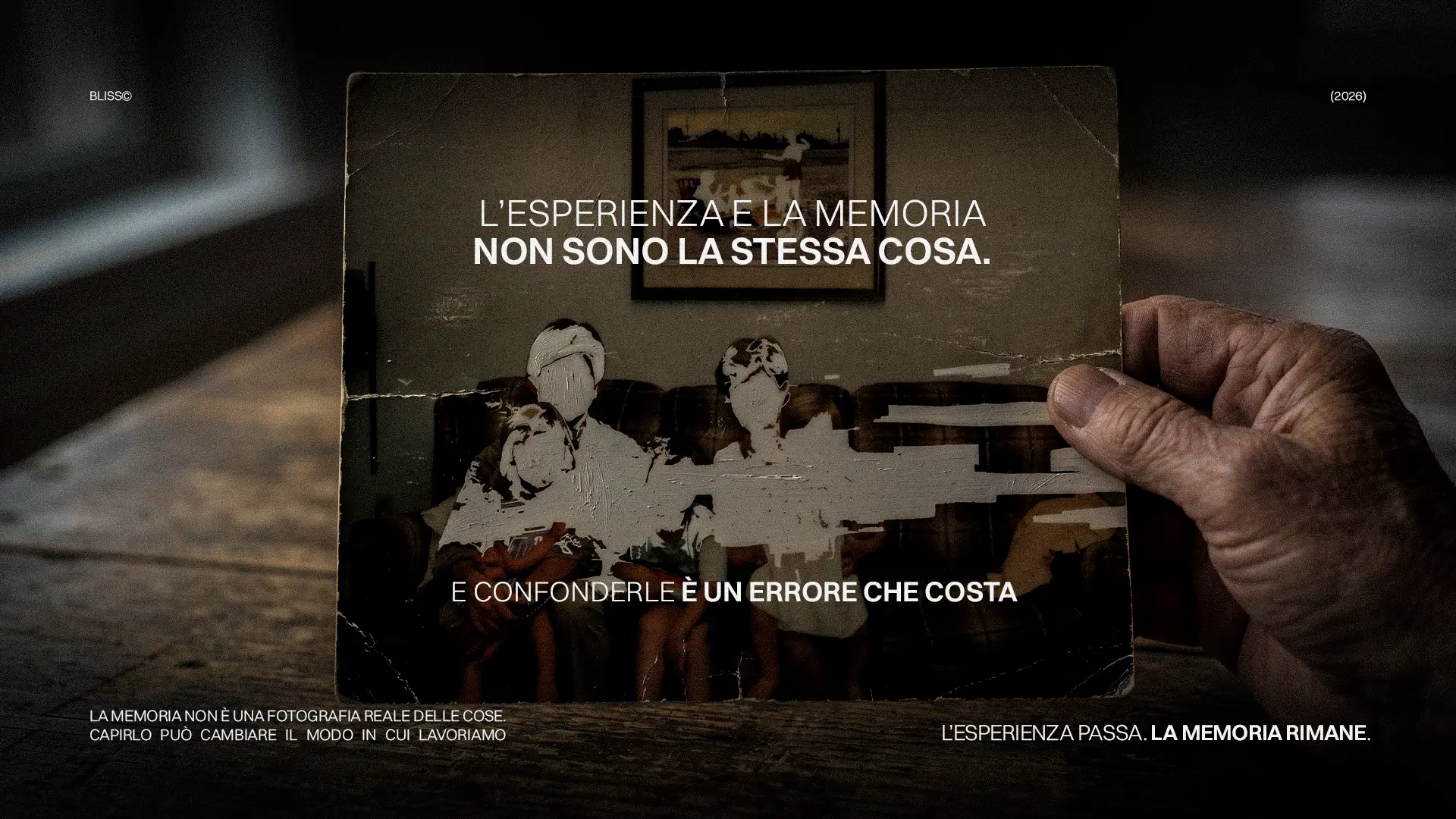
What we remember is not what happened.
It may be hard to accept, but that is how it is. Memory is always a reconstruction. Experience, by contrast, is what is lived. The actual sequence of what happened, moment by moment, in all its irreducible complexity.
The trace of that lived experience (memory) is not a true photograph of things. Understanding this can radically change the way we work, make decisions and build a brand.
How memory works (and why it is not an archive)
Over the years, cognitive neuroscience has dismantled the idea of memory as a faithful record of events. Daniel Kahneman, Nobel laureate in economics, in his book “Thinking, Fast and Slow”, drew a profound distinction between the “experiencing self” and the “remembering self”: two systems with different logics, often in conflict. The experiencing self lives through duration, intensity and sequence. The remembering self mostly retains the peaks, the most intense moment and the end.
The peak-end rule describes a measurable phenomenon: our judgement of an experience depends almost entirely on how it went at its most intense moment and on how it ended. Duration matters little. A long, mediocre experience with an excellent ending can be remembered more favourably than a short, positive experience with a neutral ending.
Memory is also reconstructive: every time we recall it, we alter it. We reinterpret it in light of what we know now, think now, want now. And so we simplify it, or perhaps fill it in with inferences.
Memory works more like a Wikipedia page: you can edit it, but so can others
What we believe we remember stays the same.
What we remember changes.
How memory affects our work
When we ask a client how the collaboration went, we are not gathering data on their actual experience. And this is a factor not to be underestimated.
Memory is therefore conservative: it tends to preserve interpretations already formed, even when the data contradict them.
This means that evaluating a project or a professional relationship requires more than a memory. It requires data gathered during the experience, not only afterwards.
What this means for a brand
For brands, this distinction is critical. Consumers do not buy on the basis of the actual experience, but on the basis of their memory of that experience.
This explains why brands with technically inferior products can dominate the market for decades.
As Byron Sharp shows in “How Brands Grow”, a brand’s success does not necessarily come from functional superiority, but from building strong memory structures (so-called mental availability).
The winning brand is the one that manages to occupy a selective space in the consumer’s memory, working on distinctive cues and not only on product use.
The distortion no one monitors: Hindsight Bias
Strategic decisions are made on the basis of how things went.
Yet the way “things went” is almost always a collective memory filtered through what is known as Hindsight Bias, the tendency to be “wise after the event”.
This cognitive distortion leads us to see past events as if they had been predictable from the start.
Once we know the outcome of a choice, our memory rewrites the decision-making process: successes are attributed to supposed “foresight” (even when they were down to chance), while failures are seen as mistakes “we should have avoided”.
That memory has already been interpreted, simplified and aligned with the dominant narratives. The worst risk an organisation runs is learning from this distortion rather than from experience.
The illusion of having understood the past stops us from seeing how uncertain the future really is, leading us to repeat models that no longer work.
How to work with this awareness
Memory, like so much else, is a tool.
There are no right or wrong forms of memory, only correct or incorrect applications. Good governance builds systems that compensate for its natural distortions, putting it to the right use.
The right approach is always to gather data during the experience, not only after the fact. Documenting decisions at the moment they are made (including the reasoning) helps keep track of the experience. Overseeing the peaks of attention and intensity (of a launch, a crisis, a campaign) makes it possible to retain for longer what truly matters most.
Experience passes. Memory remains.
Relying on the first alone, without attending to the second, means leaving the most important thing of all to chance: what people will take away with them when it is all over.
New Connections (FAQ)
Why do customers misremember their experience with a brand even when it went well?
Because memory records the peaks and the end of an experience. Kahneman’s Peak-End Rule, documented in dozens of studies, shows that the duration of an experience has minimal bearing on the final memory. A long, good interaction with a flat ending is remembered less favourably than a short one with an excellent ending. Designing for average satisfaction is not wrong, but it does not produce the loyalty that comes from designing for memory.
How is the Peak-End Rule applied in customer experience design practice?
By identifying the moments of greatest emotional intensity in the customer journey and investing disproportionately in how each interaction ends. Not everything needs to be perfect: the peak needs to be memorable and the ending needs to leave a positive feeling. A complaint handled brilliantly produces a better memory than a trouble-free purchase. Seen this way, crisis management is one of the highest-return investments in customer experience.
What is the difference between a satisfied customer and a loyal one?
Satisfaction is a rational assessment of the present: I received what I paid for. Loyalty is an emotional bond based on memory: I remember how this brand made me feel. A satisfied customer has no reason to leave. A loyal customer has reasons to stay and to tell others about it. Satisfaction is achieved by keeping promises. Loyalty is built by creating moments the brain chooses to retain.
How does communications strategy change when you design for memory rather than for conversion?
The focus shifts from the click to the memory. Communication designed for immediate conversion optimises every element to reduce friction towards action. Communication designed for memory invests in stimuli that are emotionally charged, distinctive and consistent over time. The two goals are not incompatible, but they call for different weightings. Those who optimise only for conversion build customers. Those who also optimise for memory build brands.
BLISS®
© 2026. ALL RIGHTS RESERVED