




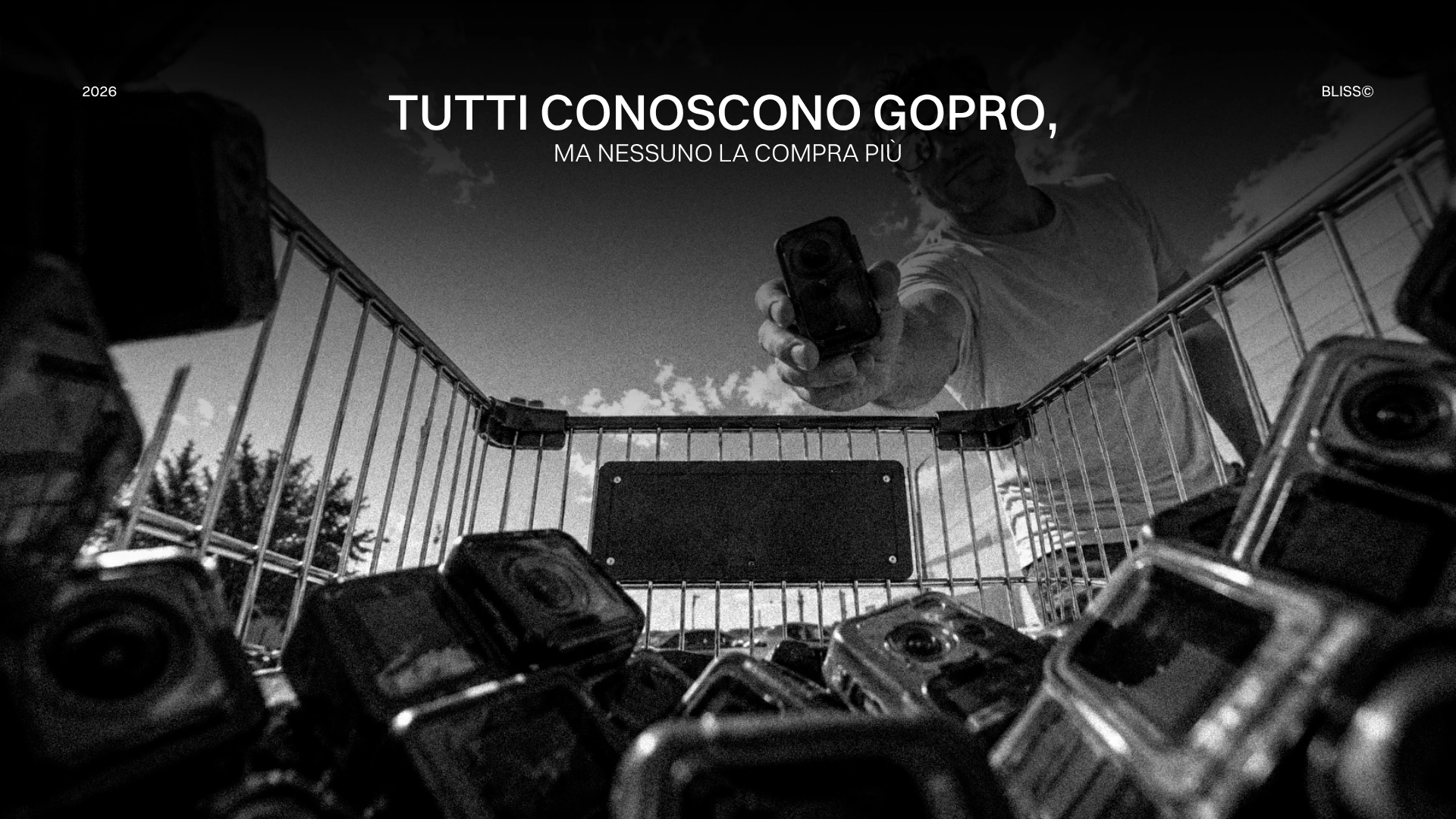
For any brand designer, genericisation is the pinnacle of the discipline.
What is it? Let’s describe it as the moment a proper name stops being a trademark and becomes the name of the category itself. Aspirin. Scotch. Post-it.
Well, GoPro got there.
When we hear someone say “Pass me the GoPro”, most of the time the message is “pass me the action camera”. And so, over the years, the brand became the vocabulary of the category it invented.
Except that on 8 July this year its founder, Nicholas Woodman, lent twenty million dollars of his own money to his company to keep it from closing. Perhaps because genericisation offers no protection against failure. And GoPro is the most telling case of the last twenty years for understanding why.

The July 2026 numbers
Since our last article on GoPro, things have got even worse for the brand.
Woodman structured the loan as senior secured notes at 6.5% a year, with interest accruing on the debt rather than being paid in cash. The attached warrants allow him to buy 25.7 million shares at $0.778 each. At the time of the deal, the stock was trading at $0.731: in short, a genuine bet.
A clause prevents him from exercising those warrants for six months, unless an acquisition is announced in the meantime. The agreement is written as if a sale were expected.
The numbers behind the move are those of a company in structural crisis. Gross margin for the first quarter of 2026 was 4.3%. A year earlier it stood at 32.3%. In twelve months, the economics of the business collapsed.
The direct cause is twofold: (i) falling sales and (ii) memory chip costs up 80-110% as demand from AI data centres diverted production capacity away from the consumer market.
The board has already approved a 23% cut to the global workforce. In May 2026 it hired the investment bank Houlihan Lokey to find a buyer. Woodman’s loan is the only bridge keeping the company alive during this search.
| Year | Event |
| 2014 | IPO: $93.85/share in October, 11.8 billion valuation. Woodman America’s highest-paid CEO. |
| 2016 | Launch and disastrous recall of the Karma drone. The erosion begins. |
| 2019 | DJI enters the action camera market with Osmo Action. Insta360 already established. |
| 2023 | Market share in Japan: 75.5% (May). Annual net loss: 53 million. |
| Nov 2025 | Market share in Japan collapses to 9.6%. $50M loan from Farallon Capital. |
| May 2026 | Board engages Houlihan Lokey. Formal start of the search for a buyer. |
| Jul 2026 | Woodman lends $20M of his own money. Q1 2026 gross margin: 4.3% (32.3% a year earlier). |
A trajectory worth analysing
In October 2014, GoPro shares reached $93.85 and its market capitalisation exceeded eleven billion. Woodman was America’s highest-paid CEO. Today the stock is worth less than a dollar. That gap is the sum of choices that piled up over time.
The brand mistaken for the product
GoPro has always been two things: a hardware company and a cultural system that tied its name to filmed adventure. Users produced content that drew billions of views on YouTube. The brand had entered the language before it had even entered the purchasing department. But that power of identity was never governed as a structure independent of the product. When the product stopped being differentiated, the brand had not built the foundations to outlive it.

The wrong pivots
Between 2014 and 2017 GoPro tried to turn itself into a media company, burning resources on content and rights that were not part of its DNA. In 2016 it launched the Karma drone, recalled it over technical problems within two months, and abandoned it for good in 2018. Meanwhile DJI, which had proposed a joint venture to GoPro in 2013 (GoPro cameras on DJI drones), had become the most dangerous competitor in the market. The rejected alliance had turned into a rivalry that was hard to manage.
The market share that tells the whole story
In Japan, where BCN Retail data allow precise measurement, GoPro held 75.5% of the action camera market in May 2023. By November 2025 that share had fallen to 9.6%. Twenty-nine months.
Meanwhile, the action camera market kept growing. GoPro was dropping out of it. DJI and Insta360 had captured the segment with lower prices, a faster pace of innovation and features that GoPro chased without ever managing to anticipate.
The category-creator trap
GoPro clearly illustrates the difference between two concepts that marketing often confuses.
Brand awareness is how many people know the name. GoPro has a level that few brands in the world can match: the name is in the vocabulary of anyone who has ever heard of action cameras. Brand equity is how much value that name generates over time. How much resistance to substitution it builds.
GoPro saw its brand equity erode while its brand awareness remained intact. People know GoPro and buy DJI. Hoover is still the word the British use for a vacuum cleaner. Yet it lost the market all the same.
Creating a category is the finest achievement a brand can aspire to. But it is not a permanent advantage. It is a starting point towards a different challenge: governing identity over time, redrawing the boundaries of the category as the market expands, deciding what stays fixed and what must evolve.
For decades, GoPro owned its identity without governing it. And the difference between these two postures is exactly what separates brands that endure from those that stay in the language but drop out of the market.
The name survives. The value disappears. Building a brand that people use to describe a category is an extraordinary achievement. Keeping it relevant, however, is the work that should always come next.
New Connections (FAQ)
Can GoPro survive as an independent brand, or does its future lie in an acquisition?
The 2026 numbers make it hard to build a credible scenario of independence in the short term. A formal sale process is under way, debt is mounting and the founder is using his own capital as a bridge. An acquisition is the most likely scenario. The relevant question is who buys and with what intent: an industrial buyer that wants the name and the technology to integrate them, or a financial player betting on a repositioning. The pivot towards defence and aerospace announced by management would radically change the profile of the ideal buyer.
Is the parallel with Roomba relevant? What does it teach those who create a category?
The parallel is exact: iRobot created the robot vacuum category, dominated it for a decade, steadily lost share to lower-cost Chinese manufacturers, and was acquired by a Chinese group in January 2026. The Roomba brand still exists on the packaging. The technology and the margin belong to others. The shared lesson is that inventing a category does not mean owning it indefinitely. It means having a window of time, longer or shorter, to build the barriers that make that position defensible. GoPro and iRobot did not build those barriers in time.
Does the GoPro lesson apply to Italian brands that lead their categories?
Directly. The Italian market has a concentration of brands that have created or defined categories, from food to design, from fashion to specialist craftsmanship. Many share one trait with GoPro: they built their identity in a period of little direct international competition and now find themselves defending that position in a market where competition is global and product cycles are getting shorter. A leadership position is not defended with the strength of a historical identity. It is defended through active governance of that identity in the present. Those who stop building, even when they have already won, are not preserving their advantage. They are consuming it.