



B2B Marketing Agency
Strategic partner for companies that sell to other companies. Bliss works alongside CEOs, Sales Directors and Boards in complex B2B markets: from positioning strategy to funnel architecture, from brand governance to the acquisition of qualified accounts.
Definition
What a B2B marketing agency is
And why most of those that call themselves such are not really.


Selling to a person and selling to an organisation are two completely different processes.B2B markets are characterised by long buying cycles (6–18 months), multiple decision-making processes (buying committees, not individual consumers), long-term relationships and a buying logic that is predominantly rational and risk-averse. This is why a B2B marketing agency must be a partner specialised in supporting companies in complex markets. Looking not at the customer, but at the stakeholder ecosystem. The difference is not between those who “know how to do B2B” and those who do not. It is between those who treat B2B marketing as a set of tools to activate and those who govern it as an integrated system that drives corporate strategy. A B2B marketing agency worthy of the name does not simply activate channels. It enters the room where decisions are made, develops the strategy, builds the positioning and then governs execution.
This is exactly what Bliss does.
Definition
Companies that sell to professional buyers, not consumers
Objective
Qualified pipeline, lower CAC, higher account LTV
Certified Agency
Certifications

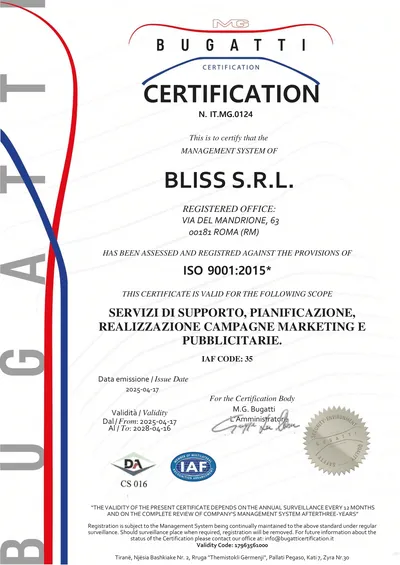
ISO 9001 – Process quality and work organisation.

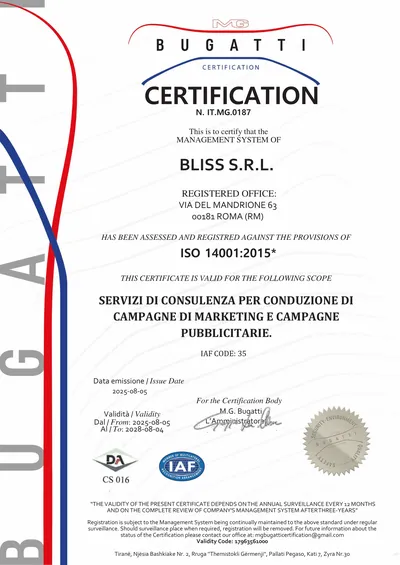
ISO 14001:2015 – Managing the environmental impact of business activities.

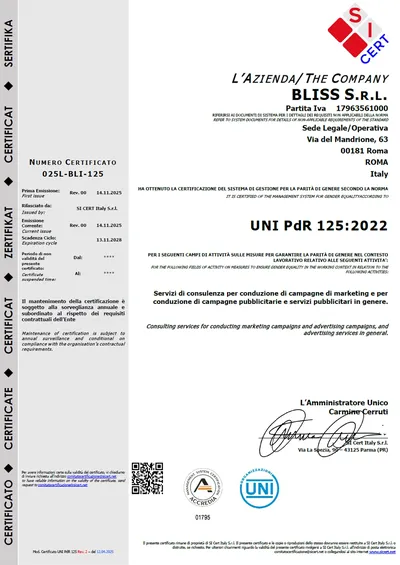
UNI PDR 125:2022 – Gender equality in processes, policies and organisation

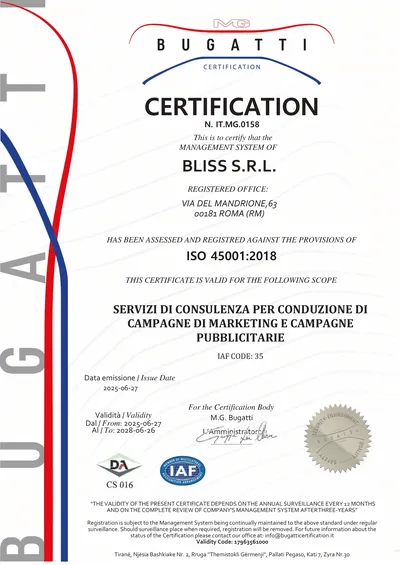
ISO 45001:2018 – Occupational health and safety.

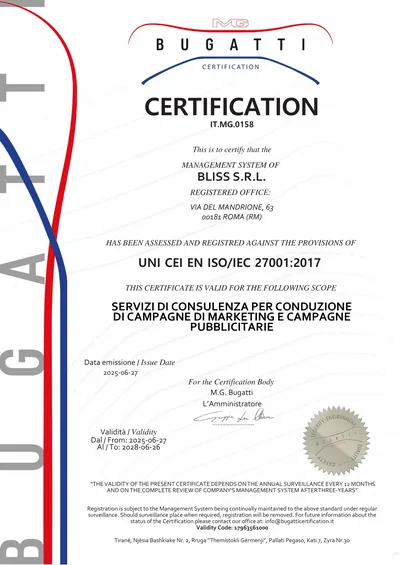
ISO/IEC 27001:2022 – Information, data and access security.
The choice that matters most
B2B vs B2C marketing
why they are not the same
Not all marketing is the same, and how it differs when it really matters
The distinction between B2B marketing and B2C marketing is not just a question of target audience. It is a structural difference that affects the customer’s decision-making logic, the length of the buying cycle, the number of stakeholders involved and the type of lever that drives conversion.
In B2C, marketing works on emotion, immediacy and individual desire. One click, one purchase. In B2B, marketing works on trust, on demonstrated expertise and on reducing the risk an organisation perceives. No corporate decision maker buys a €400,000 CRM system on impulse.1
Buying cycle
6–18 months (enterprise)
Hours / days
Decision maker
Committee (3–8 people)
Single individual
Primary lever
ROI, risk, trust, expertise
Emotion, convenience, desire
Deal volume
Low, high unit value
High, low unit value
Primary channels
LinkedIn, SEO, events, direct
Meta, TikTok, TV, retail
Effective content
Case studies, white papers, demos
UGC, short videos, promotional offers
Primary KPI
MQL → SQL → revenue
ROAS, CPA, CTR
Decision-making complexity
The B2B buying committee
who really decides
B2B marketing does not speak to one person. It speaks to an ecosystem of stakeholders with different interests.
One of the most costly misconceptions in B2B marketing is believing that the “customer” is a single person. In an enterprise context, the purchasing decision involves on average 5–8 stakeholders with radically different roles, objectives and languages. Marketing that speaks to everyone in the same way speaks to no one.
A competent B2B marketing agency builds different messages for each member of the buying committee, while maintaining a brand consistency that unifies them under a single narrative. Communication with the CFO differs from communication with the technical lead — which in turn differs from communication with the CEO. This is not a tactical detail: it is strategic architecture.

CEO / MD
How does this supplier contribute to the company’s strategic growth? What risks does it introduce? What is the return over the medium to long term?
CFO / Finance
What is the measurable ROI? How is the budget justified? Are there cheaper alternatives with equivalent results?
CMO / Marketing Director
Does this agency truly understand our market? Can it build an integrated strategy? Does it have verifiable sector experience?
Sales Director
Do marketing activities generate genuinely qualified leads? Do they support the sales network or get in its way? Is the funnel aligned with the real sales cycle?
IT / Operations
Do the proposed solutions integrate with existing systems? Are there technical, security or compliance implications to manage?
Procurement
Is the supplier sound, qualified and reliable over time? Are the contractual terms clear? Are there comparable market benchmarks?
Digital in B2B
B2B Digital Marketing
SEO, Performance, Automation, GEO&AIO
B2B digital marketing is not simply “digital marketing applied to B2B”. It is a discipline with its own logic, where every channel must be calibrated to the long decision cycle, the buyer’s professional intent and the need to build authority before generating leads.
01.
B2B SEO
02.
LinkedIn Ads
03.
B2B Google Ads
04.
Marketing Automation
05.
GEO & AIO in B2B
06.
Analytics & Revenue Attribution
The methods
B2B marketing strategies
Inbound, Outbound, ABM
There are no strategies that are right in absolute terms. There are strategies that are right for a given stage, a given market, a given objective.

The inbound versus outbound debate in B2B marketing is now obsolete. Companies that grow in a structured way do not choose one approach: they build a system that integrates every available lever according to the sales cycle and the type of target account. The key word is orchestration — not selection.
/01. Inbound Marketing B2B
Attract — Convert — Close — Retain
Content marketing, SEO, webinars, white papers, technical blogs. It generates qualified traffic by building authority in the sector. Ideal for medium-to-long sales cycles where the buyer researches solutions independently before contacting a supplier. B2B markets with high technical complexity (enterprise software, industrial machinery, professional services) benefit enormously from inbound because the buyer spends a great deal of time in the research and evaluation phase.
/02. Outbound Marketing B2B
Identify — Contact — Qualify — Convert
Cold outreach, LinkedIn prospecting, email sequences, direct mail, industry events, qualified telemarketing. It accelerates the sales cycle by proactively reaching target accounts before they start searching on their own. Essential for markets with low organic search volume, for new product launches and for entering untapped markets. It requires a precise definition of the ICP (Ideal Customer Profile) to avoid wasting budget on the wrong accounts.
/03. Account Based Marketing (ABM)
Identify — Personalise — Penetrate — Expand
ABM is the most effective strategy for enterprise B2B companies with high-value targets. Instead of generating lead volume, it concentrates resources on a select number of strategic accounts, creating personalised campaigns and content for each individual target company. The result: larger deals, shorter cycles, higher close rates. According to industry data, 86% of professionals using ABM report higher close rates. ABM does not replace traditional marketing — it complements it with a layer of surgical precision on the most important targets.
The funnel
B2B Lead Generation
from MQL to SQL to customer
97% of visitors to a B2B website never leave their details. What you do with the other 3% determines growth.
B2B lead generation is the process of identifying and acquiring qualified contacts (prospects) with the potential to become customers. It is not about generating volume: it is about building a predictable sales pipeline fed by contacts who match the company’s ideal customer profile.
The distinction between MQL (Marketing Qualified Lead) and SQL (Sales Qualified Lead) is the dividing line between marketing and sales — and also the point where most opportunities are lost in unstructured B2B companies. Marketing generates MQLs: contacts who have shown interest. Sales works SQLs: contacts who have demonstrated purchase intent. Nurturing is the bridge between the two.
01.
Awareness
02.
Lead → MQL
03.
Nurturing
04.
MQL → SQL
05.
Close & Expand
Sector specifics
B2B marketing by sector
not every market works
the same way
Strategy changes radically depending on the type of product, the decision-making cycle and the purchasing culture of the sector.
A B2B marketing agency that treats every sector the same way has not understood B2B. Industrial B2B marketing is radically different from SaaS B2B marketing, which in turn differs from professional services marketing. Channels, content, cycles, KPIs, decision makers: everything changes according to the sector.
Manufacturing industry

SaaS and B2B technology

Professional services

Distribution and supply chain

The enterprise channel
B2B LinkedIn Marketing
And why most of those that call themselves such are not really.
LinkedIn is the B2B channel par excellence in enterprise markets. With more than 1 billion professional users and targeting by role, sector, company size and seniority, it is the only platform that can reach, with surgical precision, the decision makers who make up a target company’s buying committee.
But LinkedIn is also the most wasted platform in the Italian B2B landscape. Most companies use it as an institutional broadcasting channel — corporate-looking posts, generic content, zero strategic engagement. The result is a profile that exists without producing anything.
Company Page Strategy
Company page architecture as a marketing asset: clear positioning, showcase pages for product lines, a content calendar to build sector authority over time.
LinkedIn Ads & ABM
Sponsored Content, Message Ads and Lead Gen Forms campaigns. Targeting by job title, seniority, industry and lists of specific companies. The most precise channel for reaching enterprise buying committees with personalised messages.
Executive Personal Branding
Social Selling
b2b lead generation
Google Ads for B2B
Demand Capture for the buyer who is already searching
LinkedIn reaches the buyer who does not yet know your solution exists. Google Ads captures the buyer who already knows what they are looking for and is evaluating suppliers. In B2B markets, these two moments correspond to distinct stages of the buying cycle, and ignoring one means leaving opportunities on the table.
Google Ads campaigns in B2B do not work on the same logic as B2C. Search volumes are low, CPC is high and the conversion cycle is long. The lever is not ad volume but precision: high-intent transactional keywords, segmented in-market audiences, landing pages aligned with the funnel stage the buyer is in. A 15-euro click that leads to a demo with a qualified prospect delivers a far higher return than a thousand 0.15-euro clicks on generic queries.
At Bliss, B2B Google Ads campaigns are designed around the client company’s sales cycle: keyword mapping by stage (awareness, consideration, decision), A/B testing of ads, alignment between CPC and CRM to track the revenue generated beyond the click. The objective is not CTR; it is a qualified sales pipeline.
B2B Search campaigns
Capture high-intent queries from decision makers in the evaluation phase. Keyword mapping by funnel stage, differentiated bid strategy for strategic accounts, weekly cost-per-qualified-lead report.
B2B Display and Retargeting
Keep the brand visible throughout the long B2B evaluation cycle. The decision maker who did not convert today will search again within the next 3–6 months. Intelligent retargeting reduces the risk of being forgotten during the comparison phase.
b2b seo
B2B SEO and Content Marketing
67% of the B2B buying cycle takes place before the buyer contacts a supplier. In this window, the decision-maker reads content, compares solutions and builds their shortlist. If your company does not appear in the searches they carry out during this phase, it simply is not considered.
High-Intent B2B Keywords
Mapping of the queries that decision-makers in your sector use in the evaluation and decision stages. B2B SEO is not about traffic: it is about organic MQLs.
Content Architecture for B2B Funnels
Content calibrated to every stage of the buyer journey — from informational top-of-funnel material to bottom-of-funnel assets (case studies, white papers, comparisons) that support deal closure. Every piece of content has a role in the buying journey, not just in Google rankings.
We turned SEO
into an asset worth €782,376 a year
In less than a year, Bliss Agency has built an organic traffic stream whose equivalent value on Google Ads amounts to €65,198 every month, €782,376 a year. A case study that illustrates the method applied and the principles transferable to other business contexts.












Authority that sells
B2B Content Marketing
thought leadership
that generates pipeline
Effective B2B content marketing is not content production. It is the systematic building of authority on topics that matter to the ideal buyer. Every piece of content must answer a real question the decision maker asks during the evaluation process, and must position the company as the most reliable source of the answer.
In B2B, buyers complete 70–80% of the decision-making process on their own, before contacting any supplier. Content marketing must own this stage: be available, authoritative and useful at the moment the prospect is weighing up options — even before they know you exist.
White papers & Reports
Case Study
SEO Content & Blog
Webinars & Video
B2B Newsletter
Executive Thought Leadership
The structural problem
Marketing-Sales Alignment
the root of 90% of B2B inefficiencies
Marketing says the leads are not being worked. Sales says the leads are not qualified. Both are right, and the problem is structural.
Alignment between marketing and sales in B2B is the issue every agency should address before even talking about channels. The silo between the two departments is the most common cause of ineffective marketing investment: marketing generates contacts that sales does not work, sales does not feed marketing with feedback on real customers, and the KPIs of the two teams are disconnected or even in conflict.
HubSpot research estimates that companies with strong marketing-sales alignment achieve 3 times higher revenue growth. The reason is simple: the funnel stops being two parallel pipelines and becomes a single system with shared objectives, definitions and metrics.
Problem
Solution
The real problem
How to choose
a B2B marketing agency
Digital channels work differently in B2B. The optimisation logic is different. The KPIs are different. The timescales are different.
Choosing a B2B marketing agency is one of the most consequential decisions a company can make. The wrong partner consumes budget, slows growth and can damage positioning built up over years. The right partner is a multiplier of the organisation’s commercial capacity. The selection criteria should not be “how big are they” or “how much do they cost”. They should be: do they understand my market? Do they have demonstrable experience in my sectors? Can they measure results rigorously? Do they speak to my board or only to the marketing manager?
⬜Verifiable B2B experience — declaring that you “do B2B” is not enough. Ask for specific case studies with pipeline and revenue metrics, not just awareness or engagement. A 40% increase in organic traffic means nothing if it does not translate into qualified MQLs.
⬜A board-level counterpart: enterprise B2B marketing must answer to the board’s objectives, not only to the head of marketing. Check whether the agency can talk to the CEO and CFO, not just to whoever manages the digital channels.
⬜Marketing-sales integration capability — an agency that works only on marketing without ever engaging with sales does not understand how B2B works. The two systems must be integrated from the outset.
⬜A rigorous measurement framework: KPIs defined up front, not after the fact. Revenue attribution, customer acquisition cost, customer lifetime value, pipeline velocity. If an agency cannot measure its impact on revenue, it is not a partner: it is a supplier.
⬜Strategic vision before tactics — if they are already talking about channels and budgets on the first call, walk away. A serious partner first wants to understand your positioning, ICP, sales cycle and the real commercial problem.
⬜Understanding of your sector and ICP — an agency that has already worked with companies in your sector brings benchmarks, mapped buyer journeys and tested messaging. One starting from scratch will learn at your expense.
SUCCESS STORIES
Results Delivered for Our Clients
Growth is a consequence. Coherence is a choice. These case studies show how organisations can align people, decisions and objectives, turning brand identity into a lasting competitive advantage.

Oro elite
Rebranding · Governance · SEO · Content · Website
For Oro Elite, Bliss designed the entire governance infrastructure: Brand Platform, Brand Book, Decision Framework and campaign validation system, so as to set the brand apart from every other player in the sector. As a result, revenue grew from 29 to over 36.7 million euros in twelve months.


profvmvm rome
Governance · Performance Ads · E-commerce · Branding
Profumum Roma faced the challenge of heritage luxury: preserving its premium positioning while scaling digital channels across six international markets. The Tone of Voice Document built by Bliss governed communication with no loss of perceived consistency. The positioning did not give way during growth.


Risivi & Co
Advisory · Governance · Operations · Content · Performance · PR
Risivi & Co already had identity, product quality and authentic relationships with the Italian urban scene. What it lacked was the structure to govern that capital. Bliss took on full governance for twenty-four months: positioning, content, campaigns, events, collaborations. Revenue rose from 206,000 to 556,850 euros in twelve months.


DORECA
Brand Strategy · Paid Media · Content · Social · Advisory
Doreca Italia was already one of the leading operators in the Italian Ho.Re.Ca. channel. The problem it faced concerned growth: a model built entirely on offline, with no digital presence capable of supporting its physical expansion. Bliss governed the omnichannel transition: brand strategy, digital presence, paid media. In nine months revenue grew from 207 to 214.92 million euros and five new stores opened. Digital did not replace retail, of course, but it made it scalable.

Beyond borders
B2B Marketing
Worldwide
Entering a new B2B market is not a matter of translating the website. It means repositioning the brand for an entirely different buying culture.
International B2B marketing amplifies every complexity already present in domestic B2B: different languages, different buying cultures, channels with varying penetration by market, local regulations, established local competitors. An Italian company entering the DACH, Spanish or UK market cannot simply “translate” its strategy: it has to rebuild it for each context.
Multilingual SEO and GEO
Channel adaptation
Localisation
of positioning
A positioning that wins in Italy may be irrelevant in Germany. Before activating any channel, you need to understand how local competitors are positioned and where there is room for a differentiating value proposition.
Go-to-market strategy
THE TEAM
Our voices
leading the way
Bliss’s SEO is managed by a team with experience of organisations with complex sales cycles in tech, manufacturing and professional services: sectors where the buyer is a decision maker with structured evaluation processes and long purchasing timelines.

Francesco Acri
ceo & founder
Bliss Agency was created in his image and likeness. Founder and CEO, he coordinates the strategic vision and creates visions designed to last.

Ginevra De Filippis
Chief Operating Officer (COO)
COO, Ginevra is the company’s true metronome: she sets the pace of operations, coordinates partner relationships and drives the efficiency of internal processes.

Mario Antonini
chief design officer (cdo)

Andrea Maso
HEAD OF SEO
International background, a data-driven mind and no intention of slowing down.

Luca Maletta
Head of Copywriting

Sajjad Mazaherizaveh
Full stack developer
Integrates front-end and back-end development with technical SEO and AI.
FAQ
Frequently Asked Questions
What is a B2B marketing agency?
What does a B2B marketing agency actually do?
What is the difference between B2B and B2C marketing?
How much does a B2B marketing strategy cost?
What is the difference between a B2B marketing agency and a generalist one?
A generalist agency can do marketing in the broad sense: campaigns, content, social, SEO. A specialist B2B agency understands the specific dynamics of business-to-business markets: long decision cycles, buying committees, rational purchasing logic, KPIs tied to pipeline and revenue. The difference shows above all in the quality of the leads generated and in the ability to align marketing activity with the company’s real commercial objectives.
What is Account Based Marketing (ABM) and when is it worth using?
ABM is a B2B strategy that concentrates marketing efforts on a select number of high-potential accounts, treating them as individual markets with personalised campaigns and content. It pays off when ACV (average contract value) is high (typically >€50K), when specific target accounts have been identified, and when the sales force is aligned. 86% of ABM professionals report higher close rates than with traditional volume marketing.
What are the most important KPIs for measuring B2B marketing?
The core KPIs in B2B marketing are: MQLs generated (volume and quality of marketing-qualified leads), MQL→SQL rate (percentage of leads that sales accepts as qualified), marketing-sourced pipeline (value of open opportunities attributable to marketing), CAC (Customer Acquisition Cost by channel), LTV/CAC ratio, time-to-close by source channel. ROAS and CTR are secondary KPIs — the ultimate KPI is always revenue generated.
Is LinkedIn really the most effective channel in B2B?
It depends on the objective and the market. For enterprise account acquisition and for brand awareness campaigns aimed at specific decision makers (by job title, seniority, sector), LinkedIn is irreplaceable. For capturing active intent (someone actively looking for a solution), Google Search is more efficient. The optimal B2B strategy combines LinkedIn (to build demand and reach target accounts) with Google (to capture existing demand).
How long does it take to see results from a B2B marketing strategy?
The truth nobody likes to hear: in enterprise B2B, structural results take 9–18 months. The first qualified MQLs may arrive within 3–6 months. The first closed deals attributable to marketing rarely arrive before 6–12 months. This stems from the nature of the B2B sales cycle, not from the effectiveness of the strategy. Anyone promising quick results in B2B is selling something they cannot deliver.
How does GEO (Generative Engine Optimization) work for B2B companies?
GEO optimises the brand’s presence for AI answer engines (ChatGPT, Perplexity, Gemini, Claude). In B2B, decision makers increasingly use these tools to research solutions, compare suppliers and prepare for negotiations. If your brand is not cited as a relevant solution in these conversations, you do not exist at a critical stage of the buyer journey. GEO works on content authority, structured data, digital PR on authoritative sources and brand entity optimisation for AI systems.
How do you measure the ROI of a B2B marketing agency?
The ROI of a B2B marketing agency is measured by comparing the value of the pipeline generated (and of the closed deals attributable to marketing) with the total cost of the investment (agency fee + media budget). The correct calculation must use multi-touch attribution models and take into account the LTV of the customers acquired, not just the value of the first contract. A healthy benchmark is an LTV/CAC ratio ≥3. An agency that does not help you build this calculation is not working towards your objectives: it is working towards its own.