





There is strength in numbers, they say. But up to what point? It certainly cannot go on forever. In all things there is a point at which the balance is perfect. Before it, something is missing. Beyond it, something starts to give way.
Giovanni Tamburi explained it very well in a recent interview.
At the end of 2025, Tamburi Investment Partners had thirteen employees. Thirteen. Value? Six billion euros in investments made directly and through club deals.

An extraordinary result, one that few could replicate.
So the formula is right there, isn’t it? Simply double the headcount to (at least) double the company’s value. Twenty-six employees would mean twelve billion, surely?
Not quite. Giovanni Tamburi has already told the opposite of the story we would expect to hear from someone who built an organisation of that kind. In the same interview on the growth of TIP, he recalled a period when the company had set its mind on doing too many things at once. More delegated investments, more staff. A mistake. The result was the opposite of what was expected: more complexity, poorer decisions. One card too many, and the carefully built house threatened to collapse. More staff was not serving the purpose: less was more.
Hence the decision to go back to looking at fewer deals, more closely. Thirteen people were enough.
And do you know what? The same goes for us.
The Bliss Point
Few people know it, but the name Bliss comes from a scientific concept, the bliss point.
The bliss point is the balance reached when the quantity of ingredients hits the ideal level. Adding more brings no benefit: beyond that threshold, the taste gets worse.
When we created Bliss Agency, we thought that organisations, all things considered, work in much the same way. Companies, too, have their own Bliss Point: a point at which the people are right, the skills fit together and the capacity to carry the load is ideal. Beyond it lies only instability.
Before that point, one more person can mean more efficiency, more speed, more opportunity. Close to that point, however, every hire must be assessed far more carefully. We believed it from the start, but today we are more certain of it than ever.
The bliss point
Growth, yes, but with judgement
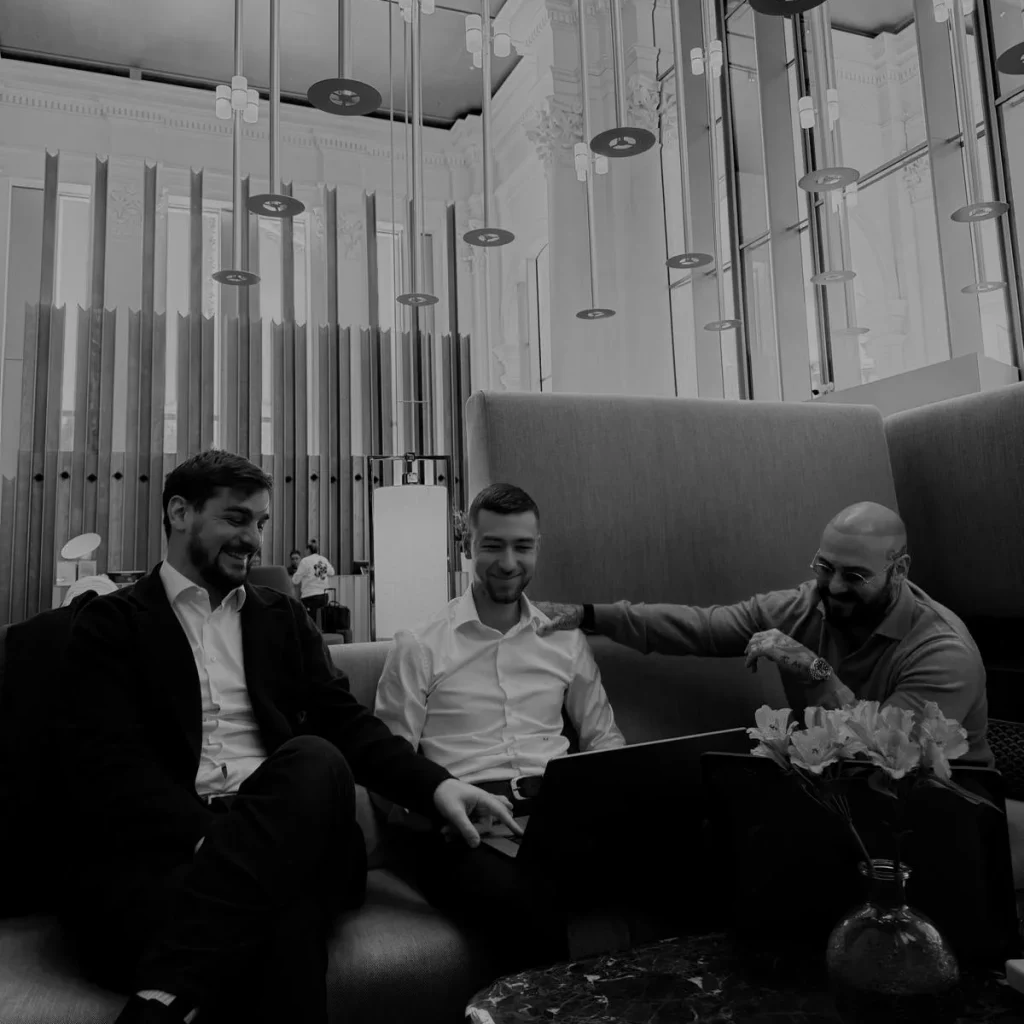
The decision-making core that makes up Bliss has been the same for years. It is the Bliss Point we started from, and the one that has brought us this far. We are six fucking bastards, and that suits us perfectly.
Around this core work collaborators, professionals and a range of skills that join projects when needed. But the people who hold direction, responsibility and decisions together remain six.
Every time we tried to increase this number without a genuine need, something in the balance cracked. That is why we believe a company can and should be able both to afford to hire and to choose not to.
Giovanni Tamburi’s example demonstrates exactly this principle: not that thirteen people are better than a hundred, but that thirteen people can generate more value than a hundred. And there is a real difference there.
Headcount growth is not an indicator of success. The only indicator of success is, quite simply, success. And that truth is worth more than a thousand theories on scalability.
The right size is not small
Celebrating the Bliss Point does not mean praising mediocrity or a lack of ambition. Believing that being few is the same as being the right size is a mistake. Six incompetent people remain incompetent even if there are only six of them. If, however, the right number of top performers for a given structure is a hundred, the system will hold up to that number.
Mine, then, is not a romantic tribute to tiny companies. There are organisations that need thousands of people to produce what they produce. Scale allows for specialisation, geographic reach, redundancy, research, infrastructure and investment power that a small team will never be able to replicate.
What matters, then, is the mission the company has set itself, not the organisational chart it uses to organise itself.
Every organisation has its Bliss Point: the difficult task of those who govern is to recognise it before it is too late. And we are glad we did.
The Bliss Point moves
The Bliss Point, of course, is not set in stone. It changes when what the company has to do changes. A new market, a new product, an expansion of some kind: all factors that can end up moving this number forwards or backwards. That is why defending it out of nostalgia is pointless. What is essential is a commitment to reviewing it constantly.
It is a dynamic equilibrium: it captures the moment when capacity, people and complexity stand in the most useful proportion at a specific stage.
The risk is turning a choice of discipline into a form of rigidity. Staying at six because ‘it has always worked’ would be as foolish as hiring ten more people simply because revenue allows it, or just to show on LinkedIn that the company is growing. No: that is how companies fail and projects founder.
The right number exists in relation to the load and the value the organisation has to produce. For Tamburi Investment Partners, that number is thirteen, and for now that works. Tomorrow, we shall see.
The same rule applies to Bliss. Launching our digital magazine required new skills: to run it, the Bliss Point changed. And the same was true for every element of our AGO model (Advisory, Governance, Operations). If tomorrow a new skill became essential to doing what we do better, our Bliss Point would change. And rightly so.
Discipline means learning not to confuse growth with movement. We learnt this the hard way. We will never forget it.
Three questions for those who lead an organisation
Tamburi’s lesson and the Bliss Point principle raise three questions for anyone leading an organisation.
The first: of the people added over the last two years, how many have increased the capacity to decide, and how many have only increased the need to coordinate?
The second is: which activities do you carry out today because the client genuinely needs them, and which exist only because the structure has grown large enough to require them?
And finally, the last one: if tomorrow you had to forgo your next hire, would any problem remain unsolved?
The answers will not necessarily point to hiring fewer people. But one thing is certain: they will establish whether what you are accumulating is capacity or mass.
For our part, we are fine as we are. All six of us fucking bastards.
Domande frequenti
Does a small team limit an organisation’s growth?
It can limit productive capacity when demand exceeds what the team can sustain. Size, however, is not a sufficient indicator of the value created: activities intensive in judgement, capital or intellectual property can deliver very high results with lean structures.
Is there an ideal size for a decision-making team?
There is no universal number. Research on social networks suggests recurring layers of proximity, while organisational theory shows that growing interdependencies create coordination costs. The useful size depends on the type of decisions, the degree of autonomy and the architecture of the organisation.
How can you tell whether a new hire genuinely adds capacity?
It is worth looking at the unit of value that person makes possible: a better decision, a new output, a reduced risk, greater speed or a skill that was previously missing. If the main effect is managing complexity created by the structure itself, the organisational design deserves a rethink.
Fonti e riferimenti
- Bliss Agency, Organigramma aziendale: definizione, tipologie e come crearlo
- Bliss Agency, Management Consulting: guida completa
- Bliss Agency, Brand Governance
- Tamburi Investment Partners, Relazione finanziaria annuale 2025
- Rao, Rodriguez, Shoemaker, Addressing the sugar, salt, and fat issue the science of food way
- Tamburi Investment Partners, Team
- Tamburi Investment Partners, Annual Financial Report 2025
- Corriere della Sera / 10 Minutes to Inspire, Giovanni Tamburi, la ricetta di TIP per investire sul Made in Italy d'eccellenza
- Frederick P. Brooks Jr., The Mythical Man-Month
- Robin Dunbar, Why friendship and loneliness affect our health
- Alan G. Ingham, George Levinger, James Graves, Vaughn Peckham, The Ringelmann effect: Studies of group size and group performance