




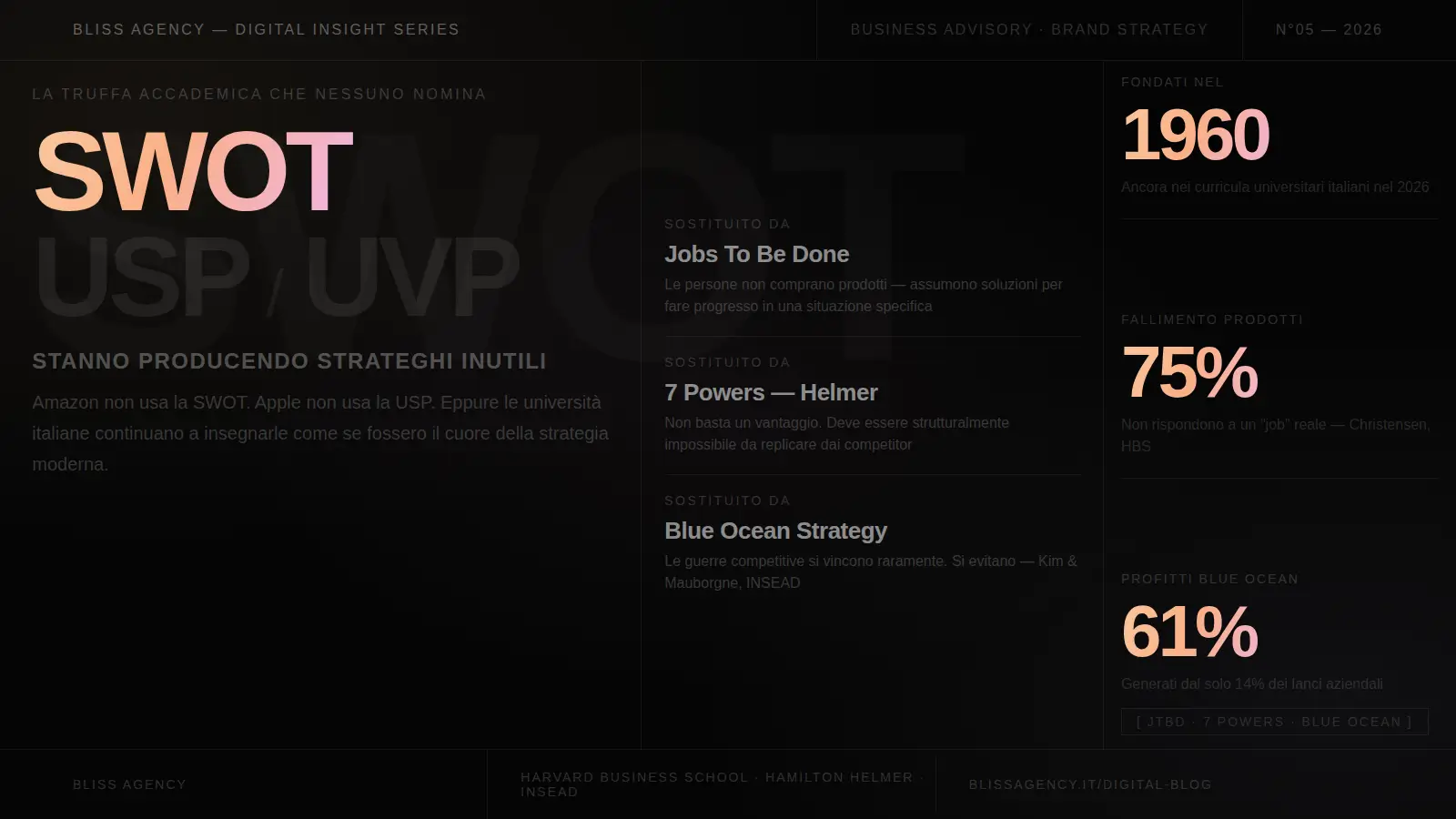
Amazon doesn’t use SWOT.
Apple doesn’t use the USP.
Airbnb has never produced a UVP in the sense you were taught.
Yet Italian universities keep teaching them as if they were the heart of modern strategy.
The scene that repeats itself every day
A new graduate joins a company — Luiss, IED, SDA Bocconi, it makes little difference — with a neatly organised toolbox. They can do a SWOT. They can formulate a USP. They have learnt the structure of a Value Proposition Canvas. They have filled in Business Model Canvases in dozens of university exercises.
They arrive convinced they have a methodology.
And that methodology produces something that resembles strategy, has the format of strategy, uses the language of strategy — but is not strategy. Because none of those tools answers the question that really matters: why should a customer choose you consistently, repeatedly and in a way your competitors find hard to replicate?
The answer to that question does not lie in any quadrant of a SWOT matrix. It does not lie in the wording of a USP. It does not lie in any of the frameworks that Italian academic training still considers central.
It lies in models that universities do not teach — because they are too recent, too operational, too far from academic tradition to find room in the curricula. Meanwhile, companies worth billions have been using them for years.
Why the old models are still there
Before explaining what works, it is worth understanding why what doesn’t work persists so stubbornly.
The answer isn’t negligence. It’s institutional neurobiology.
Academic curricula are subject to the same cognitive mechanism that governs any system in equilibrium: status quo bias. Changing a syllabus takes energy, generates internal resistance, and academic assessment criteria reward depth of literature — not speed of updating relative to the market.
SWOT has sixty-six years of citations behind it. Jobs To Be Done has twenty. Helmer’s 7 Powers has eight. In the university system, this asymmetry automatically translates into a preference for established models — regardless of their effectiveness in today’s competitive context.
The result is a market split in two: the world’s most advanced organisations using powerful, operational frameworks, and young Italian professionals arriving with tools from the 1960s.
The structural problem with SWOT: it is a snapshot, not a map
The SWOT matrix was developed between 1960 and 1970, when a Stanford Research Institute team led by Albert Humphrey conducted a research project on more than 500 Fortune 500 companies to identify the critical success factors. Sixty-six years ago. At a time when competition was predominantly local, market cycles lasted decades, and the pace of change in the competitive landscape was structurally incomparable with today’s.
But the problem with SWOT is not its age. It is its category.
SWOT is essentially a snapshot: it describes where you are, not where to go. The main risk is that the various elements end up disconnected from one another, with no common thread, producing long lists of generic statements. You can complete it flawlessly and still not know what to do.
It isn’t strategy. It’s inventory.
The structural problem with USP and UVP: they treat differentiation as a claim
The Unique Selling Proposition was formulated by Rosser Reeves in the 1950s for television advertising — at a time when companies communicated in a system with little media competition and consumers had no tools to verify brand promises. The Unique Value Proposition is its evolution from the 1980s and 1990s: more sophisticated in form, identical in premise — that differentiation is a matter of messaging.
Find the right claim. Formulate the correct proposition. Communicate it to the appropriate target.
The problem is that a claim can be copied in twenty-four hours. A value proposition can be reworded by any competitor with a good copywriter. A USP creates no barriers — it only creates an expectation that the market tests continuously.
Real differentiation is not what you say you are. It is what makes it structurally costly for your competitors to replicate you. And this distinction — between claim and system — is exactly what classic academic models do not teach you to build.
What Amazon, Apple, Netflix and Airbnb actually use
Three frameworks have replaced the classic models in the world’s most advanced organisations. Not because of fashion — because of measurable results.
Jobs To Be Done — Christensen, Harvard Business School
The premise: people do not buy products. They hire solutions to make progress in a specific situation.
Christensen showed that between 75 and 85% of all new products launched on the market fail financially. The reason is that they do not respond to a “job” — a problem or an opportunity the customer is trying to resolve. Companies that develop job-centred offerings manage to excel in the market and avoid disruption. The book is required reading at Netflix, as co-founder Reed Hastings has stated. The CEO of Coca-Cola called it “revolutionary thinking on how to truly understand customers”.
The best-known case: a fast-food company discovers that most of its milkshakes are sold before 8.30 am. No customer is buying a milkshake — they are hiring a product to keep them awake during the commute, manageable with one hand while driving. This insight opens up a territory of innovation that is completely invisible to any SWOT analysis.
Apple did not design the iPhone by asking consumers what they wanted in a mobile phone. It identified the job — having the world in your pocket in a radically simple way — and designed by removing everything else. Cordis Corporation, by applying JTBD logic to its angioplasty balloon line, went from 1% to 20% market share and quadrupled its share price.
7 Powers — Hamilton Helmer
The premise: having an advantage is not enough. It must be structurally impossible to replicate.
Hamilton Helmer has provided strategic advisory to more than 200 companies — including Adobe, HP and Netflix. His framework identifies seven sources of persistent competitive advantage: Scale Economies, Network Effects, Counter Positioning, Switching Costs, Branding, Cornered Resource and Process Power. Each “Power” generates a benefit for whoever holds it and creates a barrier that makes it costly for competitors to compete head-on.
Counter Positioning is when a new company adopts a superior business model that incumbents cannot imitate without damaging their existing business. It is why Netflix destroyed Blockbuster: Blockbuster could have copied the streaming model, but doing so would have cannibalised its still-profitable physical rental business. The trap was structural, not technological.
This is not positioning in the academic sense. It is competitive architecture. The difference is the same as that between claiming to be the best and building a system in which being the best becomes the inevitable consequence of your own operating structure.
Blue Ocean Strategy — Kim & Mauborgne, INSEAD
The premise: competitive wars are rarely won. They are avoided.
In a study of 108 companies, Kim and Mauborgne found that only 14% of new business launches created new markets. Yet these moves generated 38% of total revenue and 61% of profits. The 86% of launches that competed in existing markets produced the majority of revenue but only 39% of profits.
The 14% of companies that create new markets capture 61% of profits. This figure alone should be enough to rewrite any business strategy curriculum.
Cirque du Soleil eliminated animals and star performers — cutting costs — and introduced theatrical storytelling aimed at adult audiences who had never considered going to the circus. With the Wii, Nintendo did not compete with Sony and Microsoft on computing power. It eliminated HD graphics and introduced motion control, creating a market of families and casual gamers that did not exist.
In both cases, the question was not “how do we beat the competition?” but “which of the variables everyone competes on can we eliminate, reduce, raise or create?” The right question produces radically different answers. And that question appears in no SWOT.
The real cost of continuing to teach the old models
There is a concrete consequence of this gap between education and the market that almost nobody names explicitly.
Italian companies that hire young professionals with standard academic training spend months realising that the tools they bring do not produce strategic decisions. Meanwhile, these hires build convincing documents that are presented to boards as strategy and treated as such — until the results fail to materialise and responsibility is pushed downwards without ever reaching the real cause: the wrong tool applied to the wrong question.
This is not a problem of individual competence. The young people leaving Luiss or IED are often brilliant. The problem is systemic — a system that teaches snapshots when the market needs maps.
What to do now
The solution is not to ignore academic training. It is to add what is missing.
SWOT as a descriptive starting point still makes sense — provided it is followed by more powerful tools. The correct process is a sequence of four different questions, none of which produces a list to be filled into a quadrant.
First: use SWOT to map the context. Know where you are.
Then: use Jobs To Be Done to understand what you are really selling — not the product, but the job you do better than anyone else.
Then: use the 7 Powers to identify which structural advantage you are building — not the best claim, but the barrier hardest to replicate.
Then: use Blue Ocean to ask whether you are competing in the right market — or whether there are variables that nobody has yet thought to eliminate or create.
Because real strategy isn’t something you fill in. It is built — with tools designed for the market you operate in, not the one the world operated in sixty-six years ago.
Frequently Asked Questions
15. The academic con in marketing
Why is what you study at university useless in real-world marketing?
Because academic programmes follow update cycles that last years, while marketing changes every month. The frameworks taught (such as SWOT or the 4Ps) describe a market that no longer exists. They may be useful as a conceptual foundation, but they are useless as operational tools.
How do you become genuinely competent in marketing today?
With a solid grounding in psychology, statistics and economics, combined with constant practice in the field. Updating must be daily and based on those who actually operate in the market. Theory without practice produces analysts. Practice without theory produces executors.
How can you tell whether a marketing consultant is genuinely competent?
From the quality of the reasoning. A competent consultant can explain why a choice produces a result, and can connect brand, numbers and market behaviour. Those who rely solely on certificates often conceal the absence of genuine strategic thinking.