




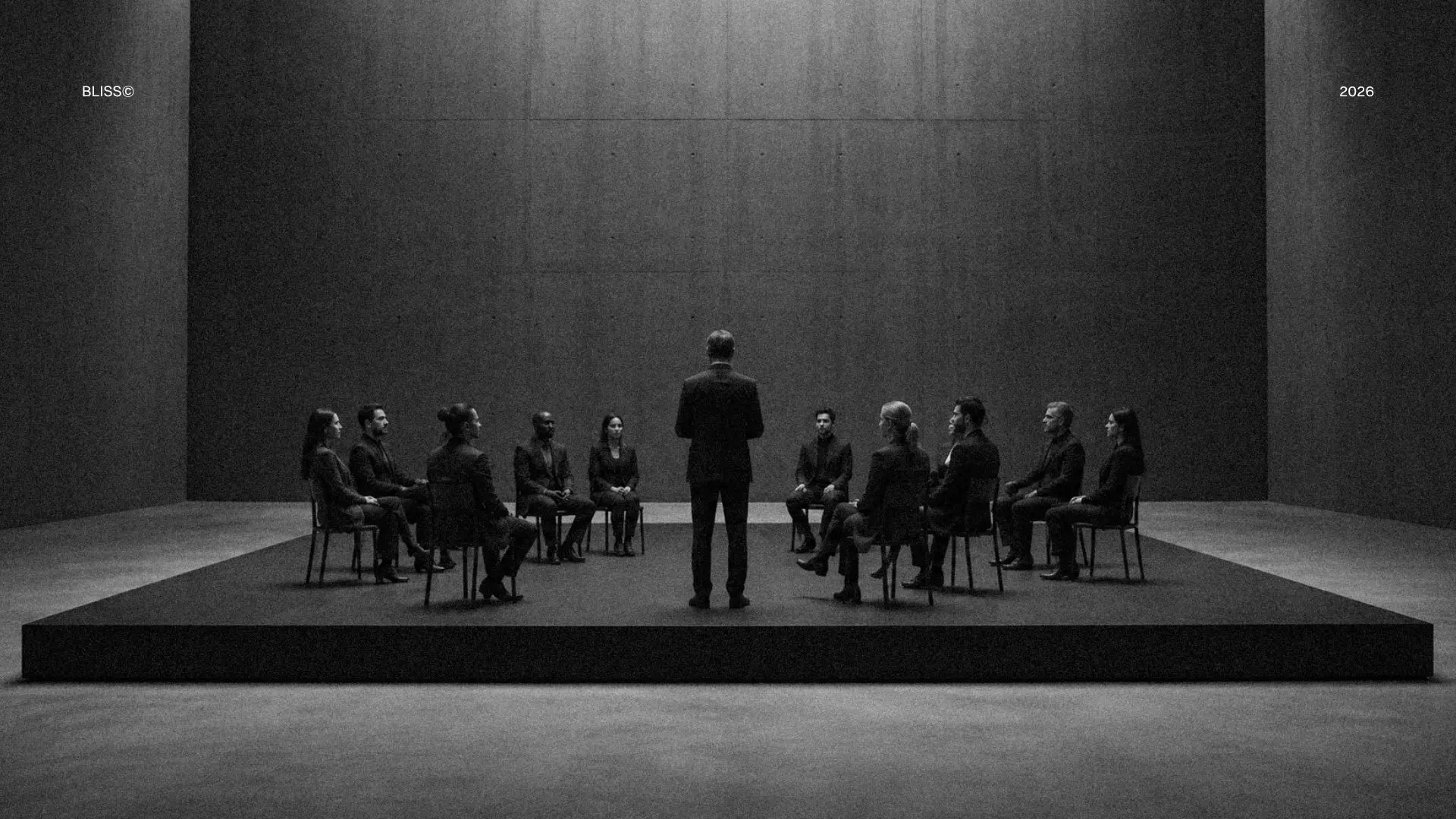
Yes. Bliss only considers enquiries in which the CEO, the founder, the owners or a board member with full decision-making authority take part from the earliest stages of the discussion.
This is a precise practice, developed over time, that applies to every project capable of affecting the direction of the brand, investments or the organisation’s growth priorities.
An enquiry may, of course, come from a Marketing Manager, a Communication Manager or an internal head of function. They are valuable figures, often the first to recognise a problem and sense the need for change. Their contribution remains central throughout the work. Before opening the project, however, we need the person with the authority to set the direction, approve the choices and stand behind their consequences to be at the table as well.
Operational activities are fully part of Bliss: editorial strategy, content, advertising, design and development can all be entrusted to our teams. Yet, in our model, each activity stems from a precise strategic choice, which must first be shared by leadership. It must first be established which problem to address, which result to make possible and which value to create. Then, and only then, comes execution: when there is a direction clear enough to guide it.
Experience in the field has taught us what happens when senior leadership only comes in at the end. The discussion gradually narrows to quantities, deliverables, presentations and quotes. The project becomes comparable to any other, and selection often ends up measuring the price of activities rather than the value of the decision. Within that frame, Bliss’s value cannot emerge, because our work begins exactly where standard comparison stops being useful.
Speaking with senior leadership therefore protects the quality of the discussion even before it protects Bliss. It allows the company to understand quickly whether it is looking for an executor, a specialist supplier or a partner able to work alongside those who decide.
We have chosen the latter. And we have built a consistent method, and a proprietary framework, precisely on that choice.
A decision shaped by experience in the field
For years we worked in operations. We created identities, campaigns, platforms, content and digital strategies. Project after project, we observed that the best results took shape long before production. They depended on the quality of the initial questions, the clarity of the priorities and the opportunity to engage with those who truly had the power to decide.
We saw accurate briefs stall before a decision that had never been shared. Strategies approved by one department and rejected a few weeks later by senior management. Proposals built on stated objectives that the leadership did not consider a priority. From the summit, as we always say, the view changes: it is not the same as the one seen from the valley. That is why what the board wants differs from what the operational departments want.
Every intermediate step only widened the distance between these two perspectives.
The current structure of Bliss grew out of this realisation.
When the discussion is reduced to a tender
Choosing a partner carefully is legitimate.
A company needs to understand the method, verify the experience, examine the cases and grasp the structure of the team it is evaluating. Selection becomes impoverished when very different firms are placed in the same grid and measured against an inventory of activities and costs.
At that point the question changes. The search is no longer for someone who can understand the problem, but for someone who promises to execute the list on the most favourable terms. Even strategy is treated as a line item, interchangeable from one proposal to the next. Price becomes the simplest criterion because the substantive differences have been eliminated before they could even emerge.
Bliss does not take part in tenders structured in this way, nor in processes that require free strategic work to prove the ability to deliver it. It is a principle that protects both parties. It safeguards the intellectual work of those asked to think, and it prevents the company from choosing on the basis of material produced without sufficient knowledge of the context. A good presentation can win a pitch. A good decision must hold up once the presentation is over.
The real brief starts at the top
An operational brief can set out channels, objectives, timelines and expected results. The real brief also contains what rarely makes it into a document: the risk the company is willing to take, the priorities that can change, the balances to be preserved, the time horizon and what growth is meant to signify.
These are questions that belong to leadership. Only those who lead the organisation can clarify which decisions have already been made, which remain open and what transformation the company is ready to sustain. Without these answers, any proposal risks being precise in detail and fragile in direction.
The presence of the CEO, the founder or the board also makes it possible to tackle the difficult questions straight away. Why must this project start now? What business problem will it need to solve? What must change for the investment to have been worthwhile? What choice will the work make possible? The quality of the engagement depends on the freedom with which these questions can be asked and the responsibility with which they are addressed.
The role of managers remains central
A clarification is needed. Asking for leadership to be present does not diminish the importance of Marketing Managers, Communication Managers and heads of function. On the contrary, it gives them an approved direction, a clear mandate and criteria for making decisions without having to reopen the internal debate every time.
After the initial alignment, it is often the managers themselves who run the day-to-day work, coordinate workflows, provide information and ensure the strategy is applied. The difference lies in the starting point. Whoever holds ultimate responsibility defines the direction together with Bliss. Whoever knows how the company works allows that direction to run through it.
We do not ask the CEO to attend every meeting or approve every piece of content. We ask that they be present when objectives, priorities, criteria and the boundaries of the mandate are set. Operational delegation works when it stems from an explicit choice. Without that choice, the manager remains exposed to decisions that could be called into question once the project is already well advanced.
What this means in practice
In practice, this principle unfolds through a precise sequence: that of our proprietary “Problem, solution, value, action” framework. First, we clarify what truly deserves to be solved, looking beyond the initial request. The need for new content may reveal a positioning problem, greater advertising pressure may stem from an offer that is hard to understand, and a rebrand may accompany a broader corporate transformation. Only once the problem has been defined is the solution built, its value assessed and the whole translated into activities, responsibilities and measurable results.
This process involves different levels of the organisation. The Advisory phase defines priorities and decision-making criteria; Brand Governance turns them into rules, processes and control tools; Operations apply them through design, content, technology, advertising and production. Senior leadership steers the early phases and assigns the mandate, while internal teams give concrete form to the chosen direction.
As decisions follow one another over time, the work can continue through Executive Advisory and Business Advisory. Continuity makes it possible to approach new markets, partnerships, investments, acquisitions and repositionings from an established understanding of the company, its history and the criteria that guide its choices.
What starting a conversation with Bliss involves
The first meeting serves to understand whether the conditions exist to work together. We do not ask for an immediate decision. We ask for clarity on who will make it, on the problem that prompted the conversation and on the value the organisation expects to build.
For our part, we bring senior leadership, the necessary questions and the willingness to state transparently whether the project falls within our scope. Even a no can protect time, resources and reputation. Selectivity only makes sense when it works in both directions.
This is why the presence of senior leadership is a threshold for new partnerships. It does not stem from hierarchical distance. It stems from the responsibility we demand of ourselves when we agree to act on the value of an organisation. If we are to contribute to an important choice, we want to meet those who will bear its weight.
It is from that conversation that an Advisory, Governance or Operations engagement can begin. And it is from there that a request stops being a list of activities and becomes a shared direction.
Those who wish to open this conversation can tell us where to start.
Domande frequenti
Can a Marketing Manager contact Bliss?
Yes. Many enquiries come from managers who know the brand in depth and are the first to identify the need for intervention. Before opening the project, we ask that the discussion also involve the CEO, the founder, the owners or a board member with full decision-making authority. The manager remains a central point of contact in defining requirements and in subsequent coordination.
Does the CEO need to attend every meeting?
No. The presence of senior leadership is required at the stages where the problem, objectives, priorities and decision-making criteria are defined. Once the direction has been agreed, day-to-day work can be coordinated by internal managers according to roles and levels of delegation established together.
Can the CEO delegate to someone else?
Yes, when the delegation is explicit and grants full decision-making authority over the project. This may be a board member, a senior executive or someone appointed by the owners. What matters is the ability to take strategic decisions without having to reopen the discussion at every step.
Does Bliss take part in agency pitches?
Bliss does not take part in tenders based on unpaid strategic work, standardised comparisons or price undercutting. An organisation can assess us through our method, case studies, references, team and a conversation with senior leadership. Where compatibility needs to be tested in practice, a first, clearly scoped and paid engagement can be agreed.
Why doesn’t Bliss define the investment straight away?
The investment is defined on the basis of the problem, the depth of the intervention, the responsibilities required and the value the project is expected to generate. Putting forward a figure before these elements have been clarified would mean pricing activities that still lack a real scope. The financial proposal comes when there is enough information to build it with precision and accountability.