




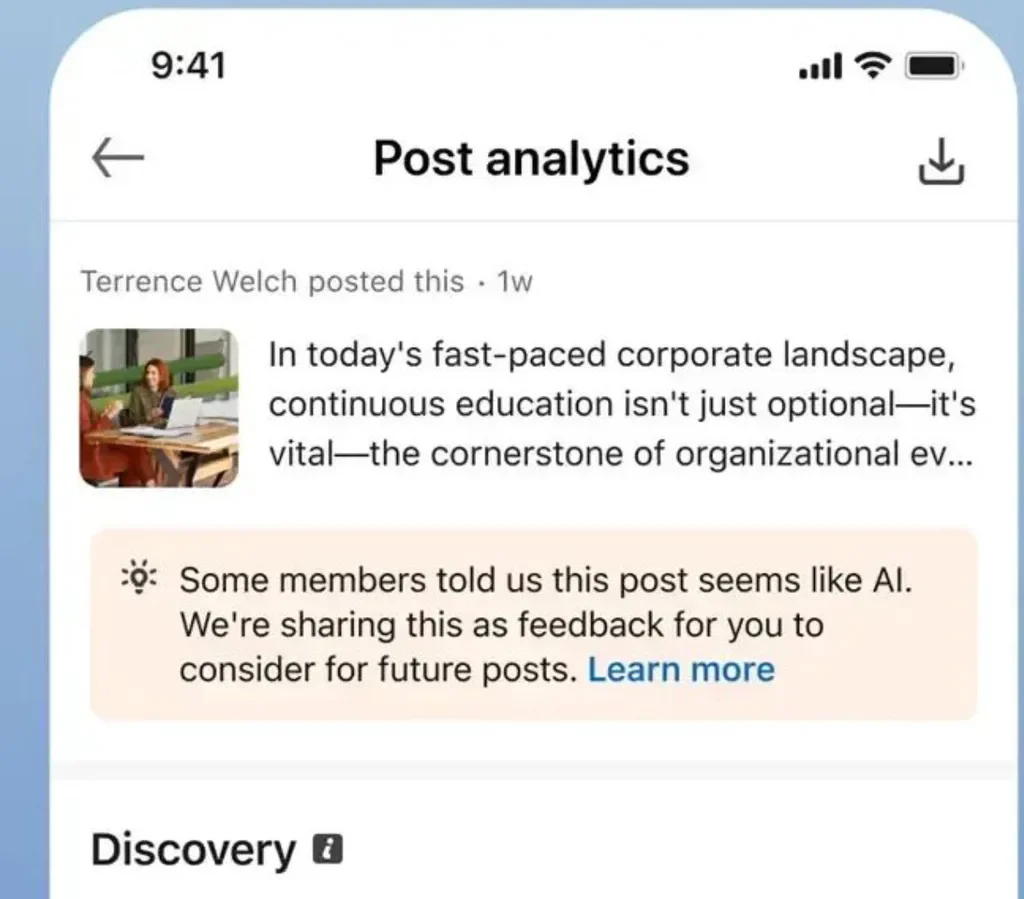
Take a LinkedIn post at random. Any one will do. They are often identical anyway. Let’s say… yes, the one that appeared in your feed this morning. Now hide the author’s name, and try to tell me who wrote it.
Hard, isn’t it? The fact is that the post did not really belong to anyone in particular. It had no timbre, no tone. It had no personality of any kind (even an unpleasant one, perhaps). No, it simply belonged to a category: the professional who wants to seem thoughtful.
Language calibrated to sound human without taking any risk, conclusions general enough that they cannot be wrong. That is the format.
Who wrote it? A person? An AI? A person using an AI? An AI using a person? You can’t tell. The result gives nothing away.
And the fault lies not with Claude or GPT, but with people.
The disease came before the tool
LinkedIn has always had a problem with positioning without substance.
Since the algorithm rewards engagement and regularity, there is no real advantage in pursuing depth or complexity. Immediacy wins over consistency over time: and so (though this is well known), those who post regularly are rewarded regardless of what they say.
That is why professionals now write for the algorithm more than for the reader. The problem is not so much the use of AI as the target of the texts: designed not so much to attract people or speak to a specific audience, but to make noise. To position, in other words.
OK, granted, AI is not innocent (we have already analysed the phenomenon of AI slop on LinkedIn), but it has only accelerated the phenomenon. It has made it more evident. But enough of pointing the finger at machines: the cause is purely structural. When writing is a means of positioning rather than reflection, the content of the thought becomes irrelevant compared with its form.
The consequences are paradoxical. Anyone with something genuine to say now has an advantage: in a feed saturated with homogeneous text, specificity and a recognisable voice become rare signals that the brain recognises and retains. The attention market is moving in the opposite direction to the one that rising volume had suggested until now.
How to recognise those who have something to say
There is no foolproof test for telling those who have something to say from those who don’t (particularly those who, having nothing, have borrowed an opinion from AI). My advice, nonetheless, is to look for the signals.
The first is specificity. AI generalises by definition: it is the opposite of Shackleton and his advertisement. It produces the most probable version of a concept: the one that works for the most readers and excludes the fewest. But anyone with direct experience does the opposite. They immerse themselves in the text and write names, dates, numbers, details. They cannot help it.
The second is contradiction. Human beings contradict themselves. They change their minds. They love conflict. AI does not. Nor does anyone without a genuine opinion. An author who has never contradicted themselves, never changed position and always keeps the same tone and the same conclusions reveals shallow thinking.
The third is failure. Those who write from real experience also write about what did not work. LinkedIn posts almost always recount successes, but life is mostly made of failures. And those who have truly lived through them are not ashamed to talk about them. Machines have no failures. Real humans do, and this (this more than anything else) makes them credible.
The fourth is what is at stake. When someone writes something that could cost them, you can feel it. A position on a divisive issue or a critique carries weight as it is being expressed. That weight comes through in the tone and settles on the words. People with something to lose write differently from those optimising their visibility. The risk shines through in the text.
What authors need to do
The obvious answer is to write less and think more. But I know it is hard to do in this optimisation-driven society. Yet that is where the whole difference lies: in the ability (or rather, the willingness) to take bold positions. Even when they are wrong. Because if everything you write meets only with approval, you are writing things no one could possibly disagree with. And therefore, things no one needs to read.
It is also important to write before a topic becomes popular. AI, by definition, cannot do this: it only produces what has already been written. Those who spot a topic before the algorithm amplifies it demonstrate thought. A rare quality these days.

Everyone writes on LinkedIn. But who actually has something to say?
The problem does not lie only with authors. It also lies with readers, and with how they read. In a saturated feed, the dominant mode of reading is pattern recognition: you scroll until something triggers a quick emotional response. This mode of reading is exactly what algorithm-optimised text tries to trigger. But it is also what makes it impossible to tell signal from noise.
Slow reading is now an act of resistance. Not because it is more virtuous, but because it is the only kind that produces real information. Research on memory and attention shows that superficial reading produces recognition without understanding: you remember having read something, but not what it said. An optimised text survives in this mode. A text that is worth something does not.
In short, if we want to add value (here on LinkedIn but elsewhere too) we all need to make an effort. Both when we write and when we read. Because access to information is now guaranteed to everyone: the ability to filter that information, in either direction, is not.
Domande frequenti
How can I tell whether a text was written by AI?
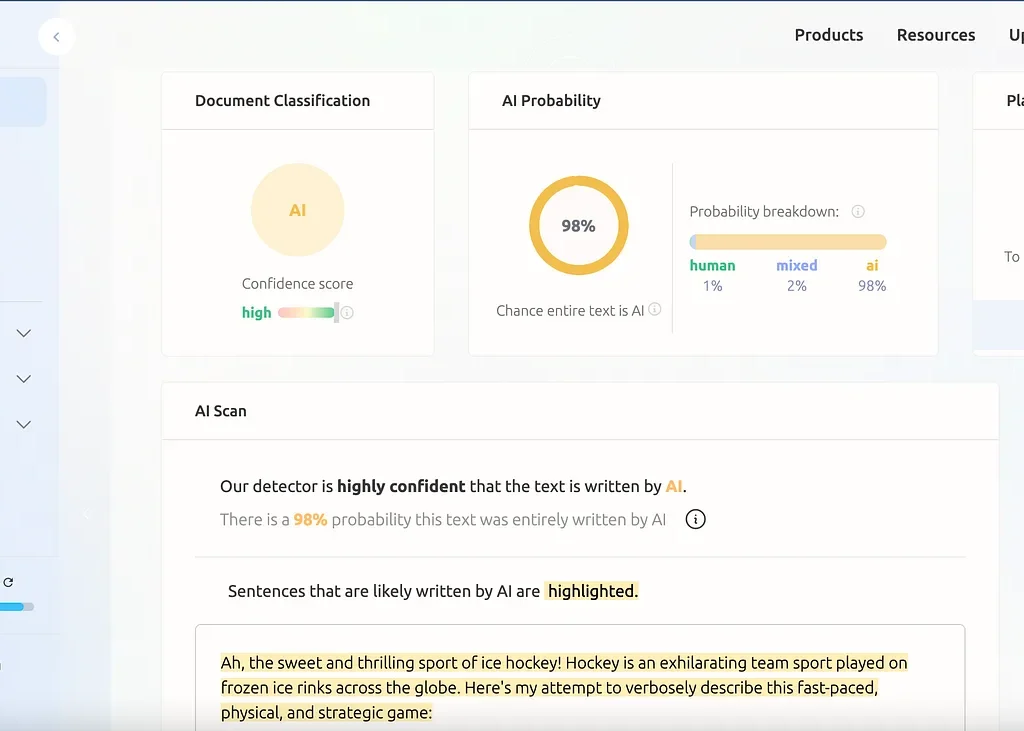
There is no foolproof test, and automated detectors have false-positive rates that make them unreliable as a sole tool. The most useful signals concern not grammatical structure but content: specificity of detail, contradictions or changes of position over time, willingness to talk about failures, exposure to real risk. A text can be written entirely by a human and still seem AI-generated if it is generic enough. The more useful question is not whether a machine wrote it, but whether the person signing it is thinking or positioning themselves.
Does using AI to write cancel out the value of what you publish?
It depends on how it is used. Anyone who uses AI to rephrase a thought of their own, refine the form of reasoning they have already done, or expand an idea that already has a clear direction is not giving up their own voice: they are using a tool. Anyone who uses AI to produce a text on a subject about which they have nothing specific to say, with the sole aim of being present in the feed, is producing noise. The distinction does not lie in the tool. It lies in the starting point: do you begin with a thought of your own, or with the intention of looking like someone who has one?
Is it still worth writing on LinkedIn?
Yes, precisely because most of what gets published is not worth reading. In a feed saturated with homogeneous text, those who write with specificity, with real positions and with a willingness to be wrong stand out, with an advantage proportional to the surrounding noise. The difficulty is not being visible. It is being remembered. And you are remembered only when you say something that nobody else could have said.
Fonti e riferimenti
- Laura Lorenzetti, Keeping conversations real on LinkedIn
- Hristo Danchev, Engineering the next generation of LinkedIn’s Feed
- LinkedIn, LinkedIn relevance - Optimizing the member experience
- Debora Weber-Wulff et al., Testing of detection tools for AI-generated text
- Ahmed M. Elkhatat, Khaled Elsaid, Saeed Almeer, Evaluating the efficacy of AI content detection tools in differentiating between human and AI-generated text
- Fergus I. M. Craik, Robert S. Lockhart, Levels of processing: A framework for memory research
- Colin Schultz, Sarah Kuta, Ernest Shackleton’s Famous Job Ad, ‘Men Wanted for Hazardous Journey,’ Is Probably a Myth