



What Brand Management is
The meaning of brand management corresponds to the continuous management of the brand as a corporate asset. The discipline is traced back to 1931, when Neil McElroy wrote a memorandum at Procter & Gamble assigning the development of each individual brand to a dedicated manager. That idea transformed the brand into a managerial object: someone had to know its market, defend its positioning, coordinate activities and answer for results. The history is also reconstructed by P&G, the company where that model took shape. Today the scope is broader. Brand management observes public perception, builds annual plans, governs the life cycle of products and lines, coordinates campaigns and touchpoints, and measures awareness, consideration, reputation, loyalty and brand equity. Its strength lies in continuity: it connects many different activities to a recognizable promise and verifies that investments create value over time.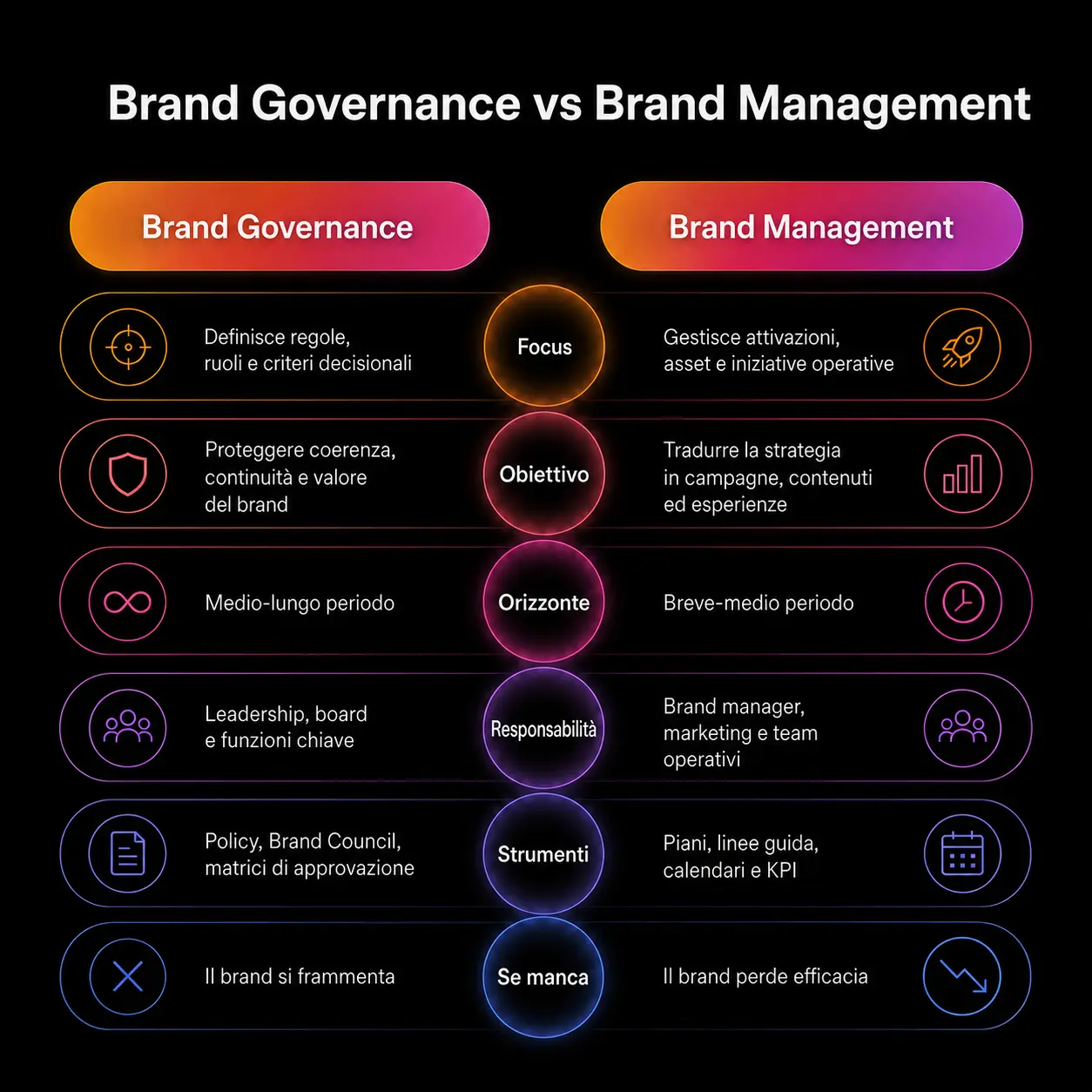
The difference lies in decisions
It is therefore clear that Brand Management has the task of deciding how to activate positioning during the quarter, which campaigns to support, how to distribute the budget, which audiences to reach and which results to monitor, while Brand Governance has the task of deciding which principles must remain valid in every quarter, who may deviate from standards, how a decision should be documented and what happens when a project puts the brand’s overall value at risk. The distinction becomes evident in front of a new product. Management builds the launch plan, coordinates packaging, prepares channels and measures the market response. Governance verifies that the operation is coherent with the portfolio, with Brand Architecture, with positioning and with the expectations the name has already created. The same applies to a collaboration, an aggressive promotion or a change of tone: execution can be effective and, at the same time, erode something that took years to build.Roles and tools: who does what
The Brand Manager is the day-to-day steward. They read data and research, maintain the brand plan, prepare briefs, coordinate functions and agencies, control outputs and follow metrics. In SMEs this role is often hybrid and includes a significant part of operational marketing. In more complex organizations it may be distributed among Brand Managers, Marketing Managers, Product Marketing, communication and local managers. Governance requires a recognizable owner and a shared perimeter. It can reside in marketing management, in a Head of Brand, in a cross-functional committee or in an advisor working alongside the top management. The tools change accordingly: decision frameworks, Brand Council, RACI or approval matrix, modular brand guidelines, asset repository, protocols for partnerships and crises, compliance dashboards and periodic Brand Audits. The document is useful, but it creates value only when it enters workflows.When Brand Management needs Governance
The transition occurs when complexity exceeds the capacity for direct supervision. The signs are often: (i) materials approved differently by different departments, (ii) agencies receiving incompatible briefs, (iii) local markets changing tone, (iv) partnerships decided without a reputational check, (v) new products using the brand name without a shared criterion. Dependence on the founder is also a sign: if every choice requires their presence, the organization has personal guidance, not yet a transferable system. At this stage, increasing manual control slows work down and concentrates even more decisions in a few people. Governance reduces the need for interpretation because it makes the criteria for deciding available in advance. People gain autonomy and the brand maintains a readable direction.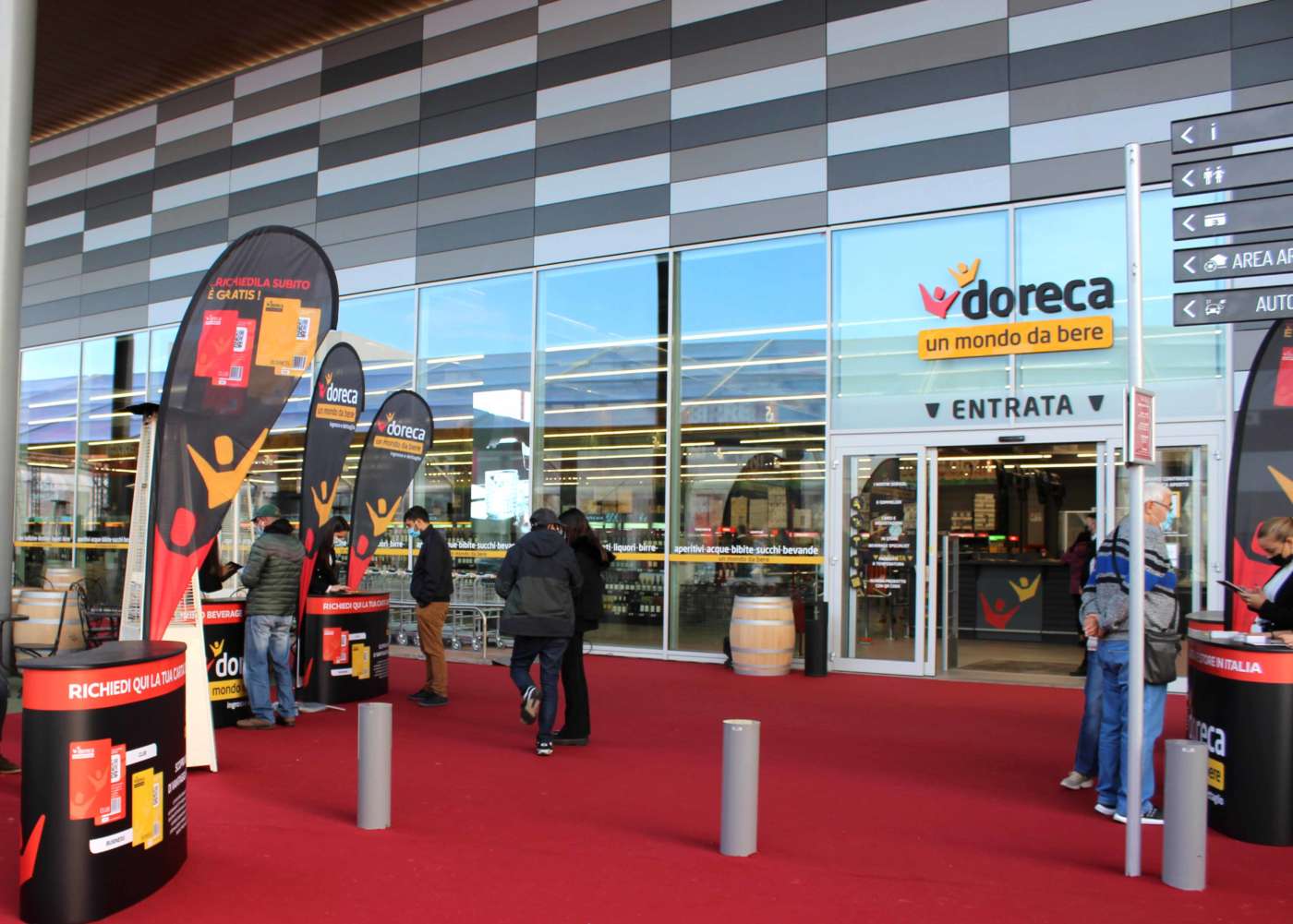
Doreca: managing two audiences without dividing the identity
The Doreca case shows how management and governance work together. The company had to speak to Ho.Re.Ca. professionals and to consumers in retail stores: two audiences with different needs and languages. Operational work concerned campaigns, social media, openings, events and content. The Governance challenge was to build a single voice, capable of adapting to contexts without fragmenting the story of a family business. The choice of a more direct and contemporary register also required an alignment process with the board. Data, progressive testing and shared criteria made evolution possible without turning it into a break. Channel growth was the visible result; the system that made it possible to replicate the same direction across different touchpoints is the part that remains.Aostae 2025: a direction for institutions, events and channels
In Aostae 2025, complexity came from the presence of the Municipality, the Region, the Superintendency, local partners and numerous events distributed throughout the year. Brand Management coordinated the calendar, content, website, social media and campaigns. Governance aligned the institutions, organized approval flows and created a visual system capable of hosting autonomous identities for individual events without losing the link with the parent project. The difference between a campaign and a system becomes very concrete here. A campaign could have produced visibility for a few months. The direction built rules, assets and a community usable beyond the single anniversary. Value does not coincide only with the results recorded during the mandate; it includes the organization’s ability to continue communicating more coherently after the project ends.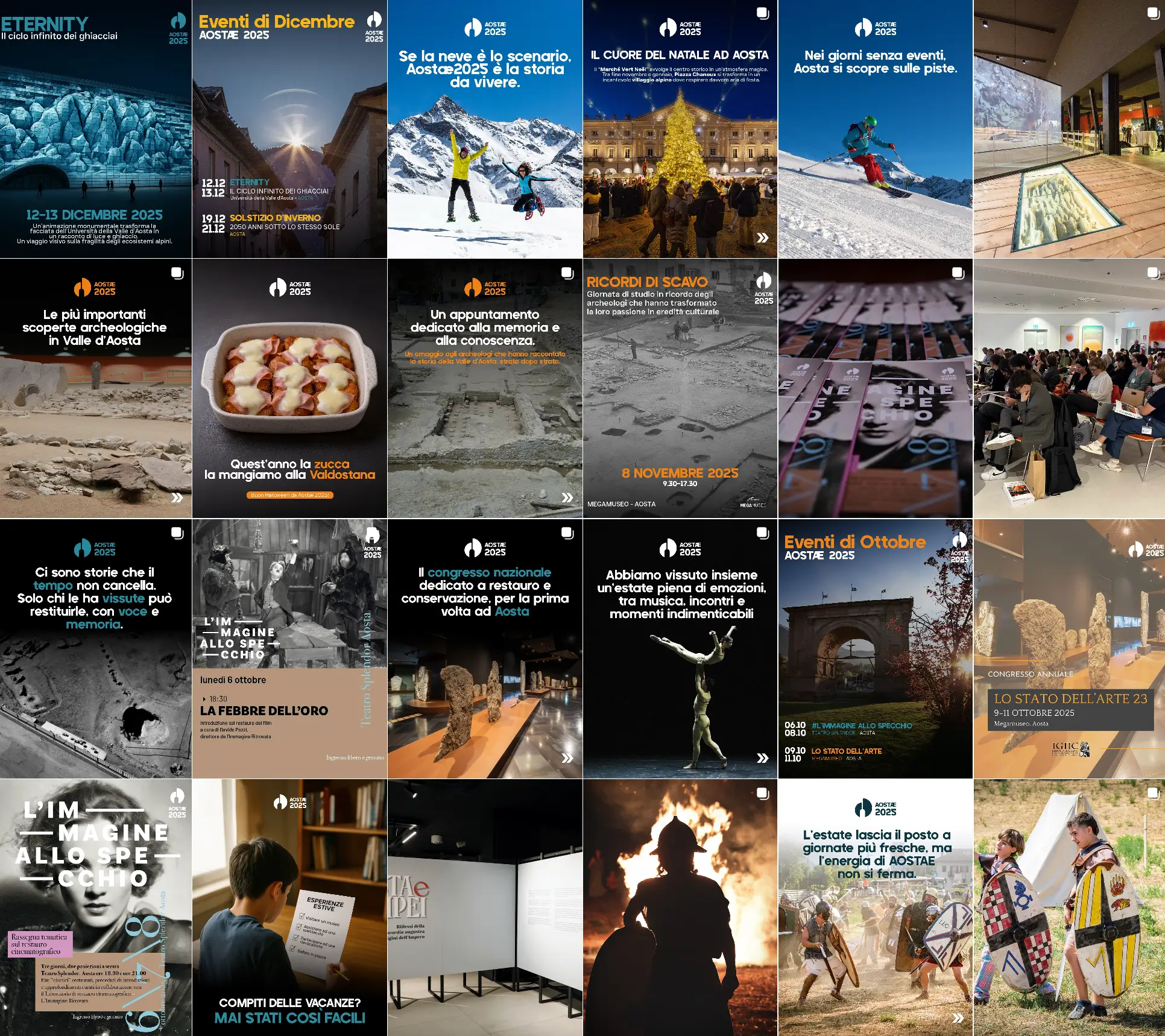
How to integrate Brand Management and Brand Governance
Integration starts with a strategy that can be consulted and is precise enough to guide choices. Immediately afterwards, it is necessary to map the decisions that affect the brand: campaigns, products, pricing, partnerships, language, markets, assets and crises. For each decision, the owner, approver, people to consult, criteria, timing and escalation threshold must be clarified. Brand Management uses this system to work faster. Governance observes deviations, updates tools and intervenes at the points where growth changes the context. In this way, control does not become a sequence of permissions and operational freedom maintains a recognizable boundary. A brand truly grows when people can act without having to reinvent it every time. Management gives it movement. Governance allows that movement to maintain a direction.Domande frequenti
What is Brand Management?
Brand Management is the continuous management of the brand. It coordinates positioning, products, communication, customer experience, reputation and measurement of brand equity, turning strategy into plans, activities and verifiable results.
What is the difference between Brand Management and Brand Governance?
Brand Management manages and coordinates the initiatives that develop the brand in the market. Brand Governance defines the decision-making system that makes them coherent: roles, responsibilities, criteria, approvals, standards and controls. The former oversees day-to-day work; the latter protects continuity as complexity and the number of actors involved increase.
Who should be responsible for Brand Governance in a company?
Responsibility must remain close to top management and involve those who hold authority over brand decisions. Depending on the structure, it may be assigned to the CMO, Head of Brand, ownership, a Brand Council or an external advisor. The Brand Manager participates in the system and ensures its day-to-day application.
Fonti e riferimenti
- Procter & Gamble, Brand Management: cos’è e perché è importante
- Procter & Gamble, L’innovazione di azienda secondo P&G
- Bliss Agency, Brand Governance
- Bliss Agency, Brand Manager: cosa fa e competenze
- Bliss Agency, Brand Architecture
- Bliss Agency, Brand Audit
- Bliss Agency, Doreca: allineare la percezione digitale alla potenza operativa
- Bliss Agency, Aostae 2025