



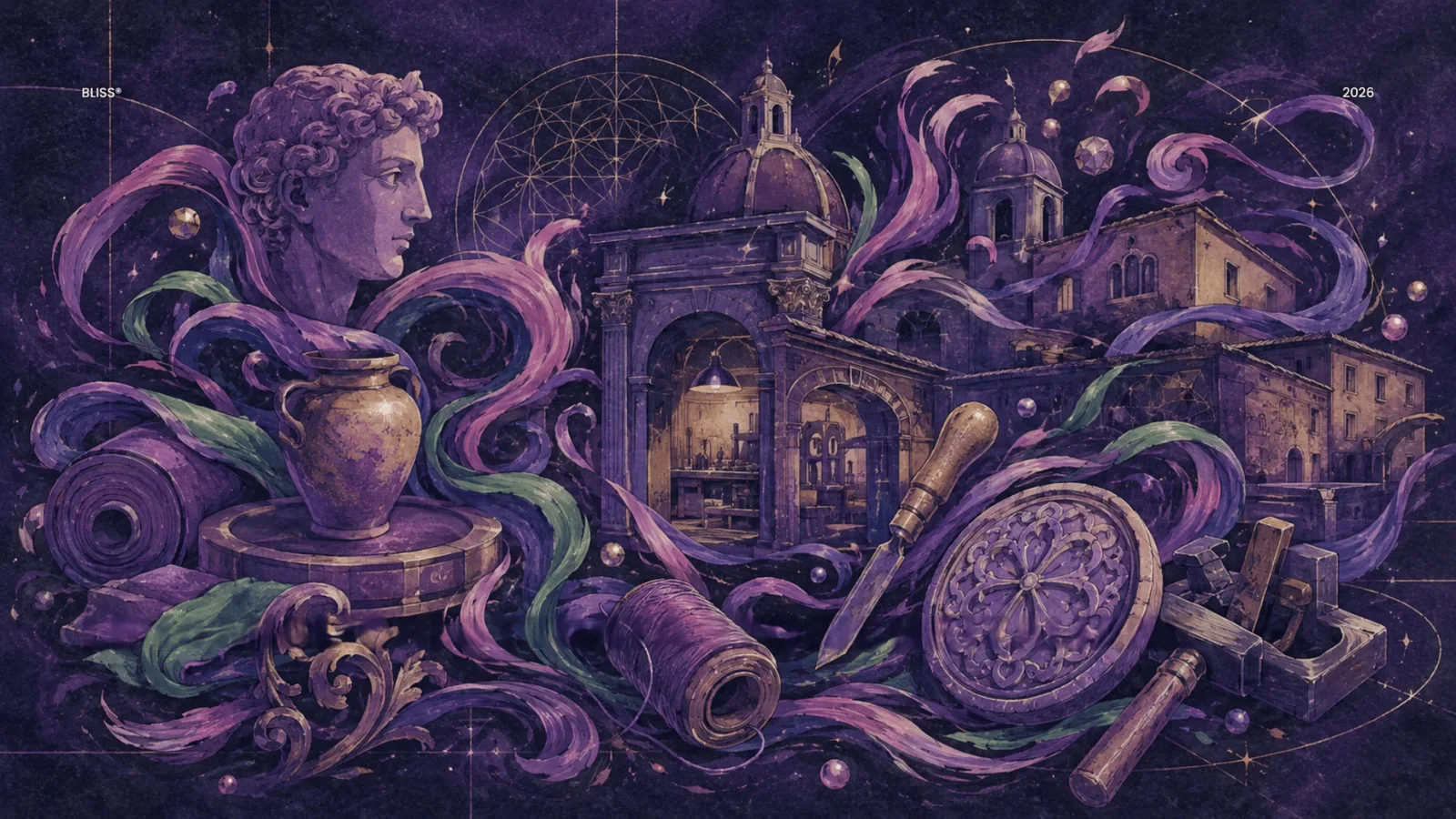
In Italy almost every city preserves a sign that begins with a date. “Since 1720”, “since 1857”, “since 1914”. That number promises experience, solidity and memory. A date alone, however, tells little. Some businesses cross generations while remaining faithful to a formula that has become immobile; others manage to use their past as material for continuing to change.
As a communications agency, we selected ten Italian organizations from different sectors, ordered by year of foundation. The selection looks at how a workshop, an artisanal know-how, a place or an industrial vision can become intangible assets. Capital that lives in people, gestures, products, archives and the reputation accumulated over time.
1. Officina Profumo-Farmaceutica di Santa Maria Novella, Florence, 1221
The history of this almost thousand-year-old organization begins with the arrival of the Dominican friars in Florence in 1221. Over the centuries, the medicinal preparations born in the convent transformed into a universe of products, rituals and places recognizable throughout the world: so much so that today the organization still exists, strengthened by its eight centuries of history.
The headquarters in Via della Scala continues to function as a temporal threshold: people enter to buy, but the experience is built around the feeling of accessing a story larger than the individual object. Here heritage lives in the architecture, names, formulas and theatricality of the space.
2. Barovier & Toso, Murano, 1295
Barovier & Toso traces its origins back to 1295 and continues to produce artistic lighting in the island’s furnace. Seven centuries later, the brand preserves a creative function alongside the safeguarding of technique. Venetian crystal is used in contemporary collections, bespoke projects and collaborations with international designers.
In this way, while taking on new forms, the tradition remains recognizable and continues to live.
3. Caffè Florian, Venice, 1720
On 29 December 1720 Floriano Francesconi opened a shop in Piazza San Marco called Alla Venezia Trionfante. The name soon changed, becoming associated with that of its founder.
And so, over the years, its rooms became a meeting point for writers, artists, travelers and figures in political life. Today the Florian is still there, deserving credit for having transformed the place itself into a product. Furnishings, music, service and location take part in the same experience. Its strength lies in the continuity of a ritual of hospitality that Venice has made impossible to replicate elsewhere.
4. Amarelli, Rossano, 1731
In 1731 the Amarelli family opened a processing plant to extract juice from the licorice roots that grew along the Calabrian Ionian coast. Since then the product has remained at the center, while formats, markets and storytelling tools have changed.
The Licorice Museum, housed in the historic headquarters, makes visible what normally remains closed inside company archives. Amarelli shows how territory, family and specialization can support one another, provided that history is organized and made accessible.
5. Ginori 1735, Doccia, 1735
Carlo Andrea Ginori started the Manifattura di Doccia in 1735, when porcelain was still a rare and experimental material in Europe. Over the following centuries, the manufactory went through corporate changes, crises and relaunches, preserving a grammar made of forms, decorations and expertise.
Today the archive dialogues with contemporary artists and designers, feeding new collections. The past works as a creative reserve: it offers codes to recognize, combine and bring into different contexts.
6. Pineider, Florence, 1774
Francesco Pineider opened his shop in Florence in 1774.
Paper, notebooks and correspondence tools met a clientele of travelers, diplomats, writers and institutions.
Over time the brand expanded its field toward pens and leather goods, keeping writing as its symbolic center. It is an example of coherent extension: the categories change, while the cultural world in which the brand wants to be recognized remains stable.

7. Borsalino, Alessandria, 1857
In 1857 Giuseppe Borsalino opened in Alessandria the workshop from which one of the most famous names in hatmaking would be born. The founder’s surname ended up indicating, in common language, an entire type of hat. It is one of the rarest results for a brand: entering the collective imagination to the point of going beyond the boundaries of the company. Behind that notoriety remains a long and complex process, safeguarded by artisans and made visible through the product.
8. Olivetti, Ivrea, 1908
Camillo Olivetti founded his company in Ivrea in 1908.
Typewriters, calculators and the first computers were only one part of a broader project, in which industry, design, architecture and social responsibility shared the same vision. Today Olivetti operates in digital and the Internet of Things.
The sector has changed several times, while the brand continues to be associated with a precise idea of innovation. Its legacy demonstrates that even a corporate culture can become a recognizable asset.
9. E. Marinella, Naples, 1914
In 1914 Eugenio Marinella opened a shop of just twenty square meters on the Riviera di Chiaia. He wanted to create a small corner of England in Naples, choosing fabrics and objects capable of meeting the taste of high society. That intimate scale has remained part of the myth: even today the customer enters a place where service, personal relationship and product carry the same weight.
Four generations have taken the name beyond Naples, keeping the original shop as the narrative and emotional center of the brand.
10. Ducati, Bologna, 1926
Ducati was founded in 1926 as a company specializing in radio technologies and components. The move into motorcycles came after the war and completely changed the company’s sector, without dispersing its drive toward research, precision and performance.
In 2026 the brand celebrated one hundred years by transforming its archive into events, collections, images and new experiences. Its history closes this selection with an important idea: continuity can survive even a radical transformation, when identity is able to guide it.

History Becomes Value When It Continues to Guide Choices
These ten businesses have ages, sizes and sectors that are worlds apart. What they share is the ability to recognize which elements of their identity deserve to be preserved and which can evolve.
An archive without interpretation remains a repository. Longevity instead requires a precise work of brand governance, capable of codifying its own heritage; to transfer it, protect it and make it usable by those who will lead the organization tomorrow. This step becomes even more delicate in family businesses, where generational continuity involves roles, relationships, culture and public perception together.
In an Italian market where only a very low percentage of companies manages to get beyond the second generation, the existence of organizations capable of enduring for centuries is an incredible indication of value.
Historic businesses that continue to speak to the present have learned to govern time. They preserve enough to be recognizable and change enough to remain desirable.
Domande frequenti
What Really Makes a Business Historic?
Duration is the first requirement, but it acquires value when there is recognizable continuity between origins and the present. Products, places, expertise, archives and reputation must form a readable system, even after changes of ownership or generation.
How Do You Keep a Historic Heritage Contemporary?
History can become material for new products, content, spaces and experiences. The starting point is to identify the brand’s strongest codes and reinterpret them consistently with the audience and the contemporary market.
What Role Does Governance Play in Generational Transitions?
Governance transfers identity from people’s implicit experience to shared tools. Positioning, language, symbols, rituals and decision-making criteria thus become a heritage the new generation can use without interrupting the trust built over time.
Fonti e riferimenti
- Officina Profumo-Farmaceutica di Santa Maria Novella, Otto Secoli di Storia
- Barovier & Toso, About
- Caffè Florian, La Storia del Caffè Florian Venezia
- Amarelli, La Storia
- Ginori 1735, Manifattura Ginori: La Nostra Storia
- Pineider, Storia
- Borsalino, The History
- Olivetti, Olivetti Design Talks
- E. Marinella, La nostra storia: oltre un secolo di stile
- Ducati, Ducati100: il centenario di Ducati 1926-2026