


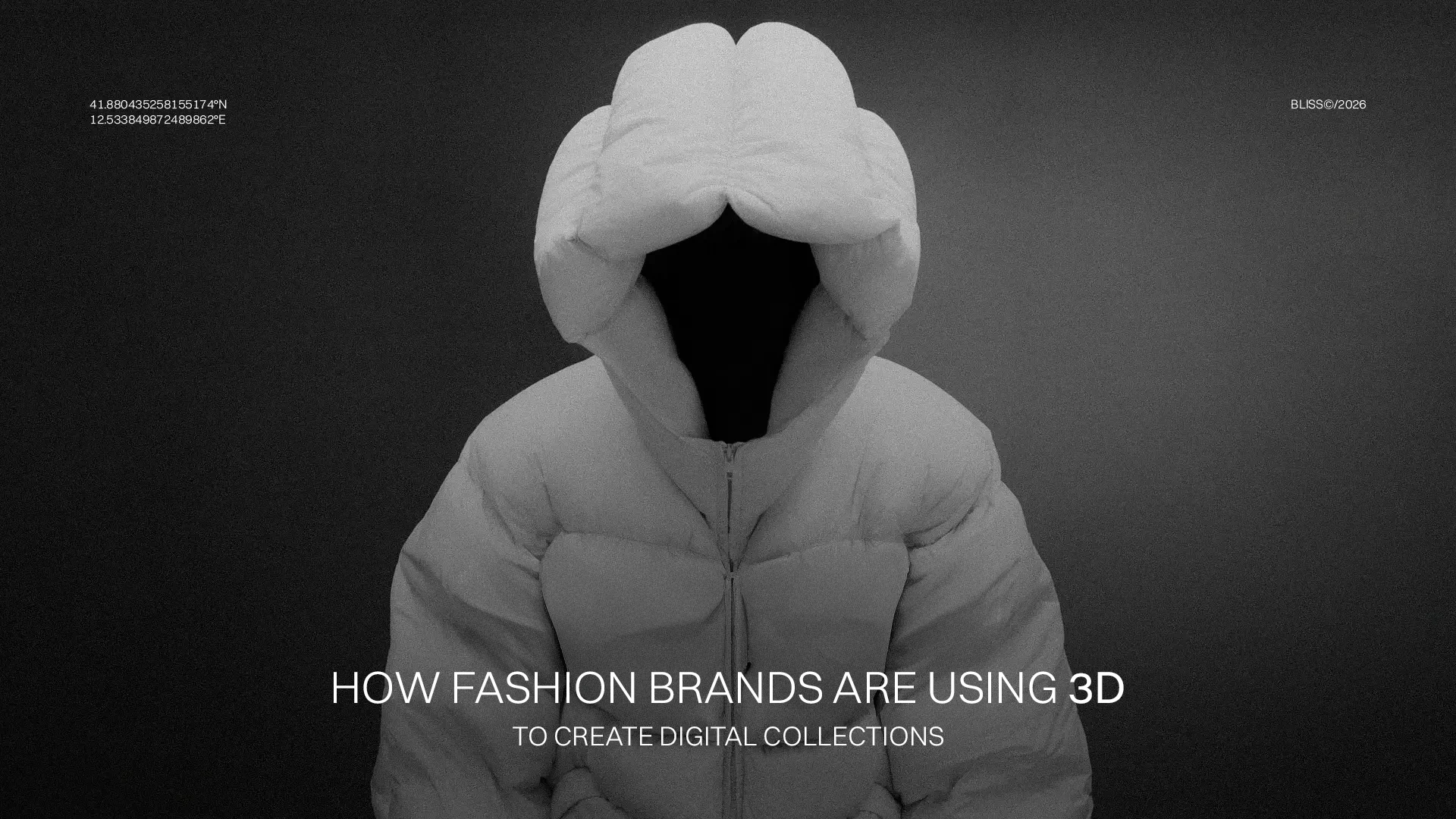
3D design applied to fashion and luxury e-commerce is the set of digital techniques and processes that allow clothing, accessories, and luxury products to be created, visualized, and presented in virtual three-dimensional environments, without relying on physical prototypes or traditional photoshoots. Through advanced simulation software like CLO3D, Marvelous Designer, and Adobe Substance 3D, brands can generate photorealistic renderings, interactive configurators, virtual try-on experiences, and digital showrooms, integrating them directly into online sales platforms. This paradigm has radically redesigned the product lifecycle in fashion, compressing development times, cutting sampling costs, and opening new frontiers in the customer experience. Brands like Louis Vuitton, Zegna, Valentino, and Diane von Furstenberg are already concrete and measurable examples of this.
Bliss
Talk to a
consultant
Tell us about your project. We will find the right path together.
contact usWhat is 3D Design in Fashion and Luxury
3D design in fashion is the process by which designers digitally construct a garment model, complete with materials, simulated fabrics, colors, and construction details, evaluating its fit, drape, and visual impact even before producing a single physical sample. The term covers a broad spectrum of applications: from modeling clothes and accessories for internal presentation to creative teams, to producing digital assets for e-commerce, advertising campaigns, and augmented reality (AR) experiences for the end user.
This technology stands in stark contrast to 360-degree photography or photogrammetry: while the latter starts from existing physical objects to build digital models, 3D design creates the product entirely in a virtual environment, even before it exists in reality. The result is reusable digital files across any channel: e-commerce site, social media, digital catalog, online configurator, virtual try-on app, or virtual reality showroom.
The protagonists of this transformation are the brands themselves, their design and product development teams, specialized creative agencies, and technology providers. But the ripple effects impact the entire supply chain: from production to distribution, from marketing to the customer experience. It is a technology that directly answers the strategic questions that entrepreneurs and marketing managers in the fashion sector are asking today: how to reduce the production costs of visual assets, how to increase the e-commerce conversion rate, how to differentiate the user experience in an increasingly competitive market.
Why Luxury Brands Invest in 3D
Strategic Advantages
The motivation driving a fashion or luxury brand to adopt 3D design is not purely technological: it is strategic. 3D impacts three fundamental levers for competitiveness in today’s market.
The first is the reduction of development costs and times. A traditional photoshoot for a collection can cost tens of thousands of euros, factoring in the photographer, studio, models, post-production, and sample logistics. With 3D, those same visual assets are produced digitally, and they are reusable and modifiable at no additional cost. According to data collected by Prisma Tech, the Italian distributor of CLO3D, companies adopting this technology reduce time-to-market by 35% and halve the production of physical prototypes, directly impacting collection margins.
The second lever is commercial performance. According to Shopify data, products that integrate 3D or AR content into their e-commerce experience register an average conversion rate 94% higher than those with static images alone. Concurrently, brands adopting AR experiences for product visualization report up to a 40% reduction in returns (BrandXR, 2025): a tremendously significant figure for the fashion segment, where returns represent a major operational and environmental cost.
The third lever is sustainability. Fewer physical samples mean fewer materials consumed, fewer international shipments for showrooms and purchasing offices, and less production waste. For luxury brands, increasingly evaluated on their ESG agenda, this is a highly valuable component.
Data Confirming the ROI
Industry numbers confirm structural, not episodic, growth. According to Market Report Analytics projections, the global 3D visualization market for e-commerce is worth approximately $5 billion in 2025 and will grow at a compound annual growth rate (CAGR) of 25%, reaching around $25 billion by 2033. The fashion and luxury segment is among the primary drivers of this expansion.
The virtual try-on market, which relies on 3D assets integrated into AR applications, was valued at $11.38 billion in 2024 and is expected to reach $46.42 billion by 2030, with a CAGR of 26.4% (Grand View Research, 2024). According to Threekit (2024), 71% of consumers say they would shop online more often if AR were available as a product exploration tool. These are data points that describe not a passing fad, but a structural shift in digital consumer expectations.
| Indicator | Data | Source |
| Increase in conversions with 3D/AR | +94% | Shopify |
| Reduction in returns with AR | up to -40% | BrandXR, 2025 |
| 3D e-commerce market growth (CAGR 2025-2033) | 25% | Market Report Analytics |
| Virtual try-on market growth (CAGR 2024-2030) | 26.4% | Grand View Research |
| Consumers who would buy more with AR available | 71% | Threekit, 2024 |
How 3D Design is Applied in Fashion E-commerce
Main Software and Technologies
The starting point for any 3D project in fashion is choosing the right software based on the brand’s objectives. CLO3D and Marvelous Designer are the established benchmarks for fabric simulation and the creation of photorealistic virtual garments, featuring physics engines capable of accurately reproducing the behavior of silk, wool, denim, and even technical materials. Adobe Substance 3D allows for the accurate digitization of real materials and textures, integrating directly into major modeling and rendering environments. For brands working on accessories with structured surfaces like bags, jewelry, and footwear, software such as Rhino 3D, Blender, or ZBrush—designed for rigid and complex geometries—is used instead.
The phase following modeling is rendering: the transformation of the 3D model into photorealistic images or animations ready for use on e-commerce platforms, advertising campaigns, or editorial materials. At this stage, interactive visualization technologies come into play: 3D viewers that can be integrated into the site (compatible with Shopify, WooCommerce, Magento) and AR applications for mobile devices, allowing end users to “try on” or place the product in their real environment directly from their smartphone.
From Digital Prototype to Online Configurator
The typical workflow starts from a creative sketch and, through 3D modeling, arrives at a complete digital asset that can be adapted into multiple formats: a static image for the catalog, a 360-degree rendering for the product page, an interactive model for the online configurator, or an optimized AR file. The online configurator represents the most advanced frontier for luxury e-commerce: it allows customers to customize a product in real-time—choosing colors, materials, and variants—and instantly see the result before completing the purchase.
This is not just an advantage for the consumer: it is an incredibly powerful up-sell and cross-sell lever, as the customization experience increases emotional engagement with the product and reduces the decision-making uncertainty that serves as the main barrier to conversion in the fashion industry.
When to Adopt 3D: Implementation Phases and Brand Maturity
3D design is not an investment reserved exclusively for large luxury conglomerates. The accessibility of these tools has grown significantly, and today there is an adoption scale that allows even medium-sized brands to launch pilot projects with moderate investments.
A first phase might involve the production of 3D assets for the e-commerce product page, partially replacing traditional photography. This is the stage with the most immediate and measurable ROI. A second phase introduces virtual try-on or an interactive viewer, technically integrated into the site. The third, more advanced phase involves building a virtual showroom or product configurator, often combined with augmented reality strategies or, for the most ambitious brands, metaverse experiences.
The ideal timing for adoption coincides with the launch of a new collection or an e-commerce replatforming: moments when the brand is already overhauling its digital assets and can integrate 3D production into the existing workflow with the least possible friction.
Real Examples: Brands That Have Already Chosen 3D
Louis Vuitton and the Digital Show
Louis Vuitton was among the first luxury brands to experiment with a digital 3D runway show, focusing on a format that blended a fashion show with an interactive art installation. Nil Bouaouni, 3D Lead at the Maison, guided a project that redefined the very concept of a collection presentation, leveraging real-time renders and virtual environments to offer a level of engagement simultaneously accessible to a global audience. The initiative generated not only a direct impact on sales but also media and social coverage that amplified the brand’s perception as a pioneer of the future of fashion: an invaluable asset in luxury positioning.
Zegna and Personalization at Scale
The Zegna group integrated the SHOWin3D platform into its e-commerce experience to answer a specific challenge in sartorial luxury: offering total product personalization across hundreds of fabric, color, and tailoring variants without having to produce a physical sample for every possible combination. As Edoardo Zegna, Chief Marketing, Digital and Sustainability Officer of the group, stated, technology becomes a luxury when it simplifies the customer’s life. The solution bridged the gap between the boutique experience, where a consultant assists the customer, and the digital experience, which is often impersonal and limited.
Valentino and SAP Integration
Valentino adopted a 3D configurator developed by SmartPixels (LS GROUP) and integrated it with its SAP system, allowing users to interactively and immediately customize products online. Integration with the ERP system ensured that every visual modification was aligned in real-time with warehouse availability and technical production specifications: a concrete example of how 3D is not just a marketing tool, but an operational asset that impacts the entire supply chain.
Diane von Furstenberg and CLO3D
DVF is adopting CLO3D to transform 2D sketches of its wrap dresses into interactive 3D renderings, aiming to build an online configurator that allows customers to customize the famous wrap dress in real-time, choosing from dozens of print and length variants. An emblematic case of how even a heritage brand can reinvent its relationship with the digital customer without sacrificing product identity.
The Contribution of Bliss: Luxury Still Life and Visual Brand Equity
Bliss actively operates in this space, partnering with fashion and luxury brands in the production of high-end 3D visual assets, from conception to digital distribution. The Luxury Still Life service developed by the Bliss team is a direct example of how CGI rendering can replace or supplement traditional product photography, reducing production costs and times without compromising perceived quality. A photorealistic 3D still life image for a luxury accessory, with advanced management of lighting, materials, and environments, is often indistinguishable from an analog shot: but it can be produced and modified in a few days, without requiring the physical product to be shipped, a studio to be rented, or a creative team to be on-site.
Strategically, the guide “How to Elevate a Brand” published by Bliss delves into the role of high-quality visual assets in the brand equity building process, emphasizing how perceptual consistency across product images, tone of communication, and user experience is one of the most critical factors for positioning in the premium and luxury segment. 3D, in this context, is not just a production tool: it is a direct vector of brand identity.
Bliss
Talk to a
consultant
Tell us about your project. We will find the right path together.
contact us2026 Trends: Towards Phygital and Generative AI
In 2026, 3D design in fashion is increasingly intertwined with generative artificial intelligence and phygital platforms. Today, AI tools automatically generate design variants starting from a base 3D model, further reducing development times and enabling levels of mass customization that were previously unthinkable. According to Grand View Research, the AR market in e-commerce will reach $38.5 billion by 2030, with an annual growth rate exceeding 35%.
Virtual runway shows are no longer isolated experiments, but established formats on major brands’ calendars. Product digital twins—digital replicas that mirror every physical detail in a virtual environment—are becoming strategic assets not only for marketing but for design, quality control, and internal training. Brands that invest in these tools today will hold a structural competitive advantage in digital catalog management, offering internationalization, and the ability to respond rapidly to market shifts.
Another major trend is the integration of 3D with social platforms and social commerce. 3D and AR content are already native to Instagram, Snapchat, and TikTok, where 60% of Gen Z users perceive them as more relevant and personalized compared to static formats (Threekit, 2024). For luxury brands, this signifies a new frontier in digital storytelling capable of reaching younger generations on the channels where they already spend their time.
The Digital Ecosystem Around 3D Design
Web Agency: Finding the Right Partner to Integrate 3D
Integrating 3D design into a fashion e-commerce site requires not only creative skills but solid technical web development capabilities. Choosing the right web agency means relying on a partner capable of managing the integration of 3D viewers, APIs for virtual try-on, and the performance optimizations necessary so as not to penalize site speed. Discover how to choose the right web agency for your brand.
Professional Website Development: The Technical Foundation for 3D
An e-commerce site capable of hosting 3D assets and AR features needs a robust technical foundation. The professional website development for the fashion and luxury sector requires close attention to performance, information architecture, mobile compatibility, and infrastructural scalability. Dive into the complete guide to professional website development for companies and organizations.
WooCommerce vs Shopify: Which Platform Best Supports 3D
The choice of e-commerce platform directly impacts the ability to integrate 3D assets and interactive configurators. Shopify offers a native app ecosystem for 3D and AR visualization, with direct support for the .glb format on the product page; WooCommerce, thanks to WordPress’s flexibility, allows for more advanced customizations and custom integrations. The choice depends on the brand’s size, budget, and specific goals. Read the full comparison on WooCommerce vs Shopify to understand which platform is right for you.
Website Development in Rome: 3D for Made in Italy Luxury Brands
Fashion and luxury brands based in or targeting the Italian market find an indispensable strategic starting point in a meticulously crafted digital presence. Website development in Rome oriented towards luxury requires specific expertise in branding, UX, and SEO positioning in the Italian market. Discover the marketing, positioning, and branding advantages for your brand.
Web Marketing Consulting: Translating 3D into Business Results
Producing 3D assets is only the first step. Turning them into a growth lever requires an integrated web marketing strategy, from SEO to paid media, from email marketing to social management. Specialized web marketing consulting in the fashion and luxury sector allows you to maximize the ROI of technological investments and build a digital presence consistent with your brand values. Discover what it is, when it’s needed, and how to choose the right one.
Frequently Asked Questions About 3D Design in Fashion and Luxury E-commerce
What is 3D design in fashion and what is its practical use?
3D design in fashion is the digital creation process of garments, accessories, and luxury products in a virtual three-dimensional environment, using software like CLO3D or Adobe Substance 3D. It is used to develop products without relying on physical prototypes, produce high-quality visual assets for e-commerce and marketing campaigns, and offer virtual try-on experiences and interactive configurators to online customers.
How much does it cost to integrate 3D into a fashion e-commerce site?
Costs vary depending on the complexity of the project. Producing individual photorealistic 3D assets for a product page can start from a few hundred euros per item, while creating an interactive configurator or virtual showroom requires more structured investments. The correct benchmark is a comparison with traditional photoshoot costs: compared to the latter, 3D often offers a superior price-to-quality ratio as early as the second or third campaign, thanks to the reusability of the generated assets.
Can 3D reduce returns in fashion e-commerce?
Yes, and it is one of the most well-documented benefits of the technology. Brands that integrate 3D and AR visualizations into their e-commerce report up to a 40% reduction in returns (BrandXR, 2025), due to greater accuracy in product representation and the ability for the customer to evaluate size, materials, and fit before purchasing. This translates to a direct improvement in margins and a reduction in logistical and environmental costs.
What software is used for 3D design in fashion?
The industry’s leading software includes CLO3D and Marvelous Designer for fabric and clothing simulation, Adobe Substance 3D for material and texture management, Rhino 3D and Blender for rigid-surface accessories, and Unreal Engine for real-time rendering and immersive environments. The choice depends on the brand’s specific needs, the type of product, and the desired level of integration with digital distribution channels.
How do you integrate 3D into a Shopify or WooCommerce site?
Shopify has native support for 3D files in .glb/.gltf formats on the product page, featuring automatic AR visualization on iOS and Android devices. WooCommerce allows integrations through dedicated plugins or custom-built solutions. In both cases, optimizing 3D files in terms of file size and quality is crucial to guarantee fast loading times, which remains one of the critical conversion factors in mobile e-commerce.
Is 3D also suitable for medium-sized fashion brands?
Absolutely yes. The accessibility of this technology has grown significantly in recent years, and today there are scalable solutions designed even for small and medium-sized brands, with low entry costs and simplified workflows. The most accessible starting point is producing 3D renderings for the e-commerce product page, which offers measurable ROI from the very first tests and can be progressively scaled to more advanced functionalities.
Build the Future of Your Digital Brand with Bliss
3D design in fashion and luxury e-commerce is not a passing trend: it is a structural change in the way brands design, communicate, and sell their products online. Those who enter this transition today with a clear strategy will gain a competitive advantage that will be hard to bridge in the coming years.
Bliss partners with fashion, luxury, and lifestyle brands to build high-end 3D visual assets—from concept to digital distribution—integrating creative, technological, and strategic expertise into a single, cohesive vision. If you want to understand how to practically apply 3D design to your brand, or how to relaunch your digital presence with immersive content that converts, the Bliss team is at your disposal for dedicated consulting.
Contact us to discover how we can transform your products into memorable digital experiences.