


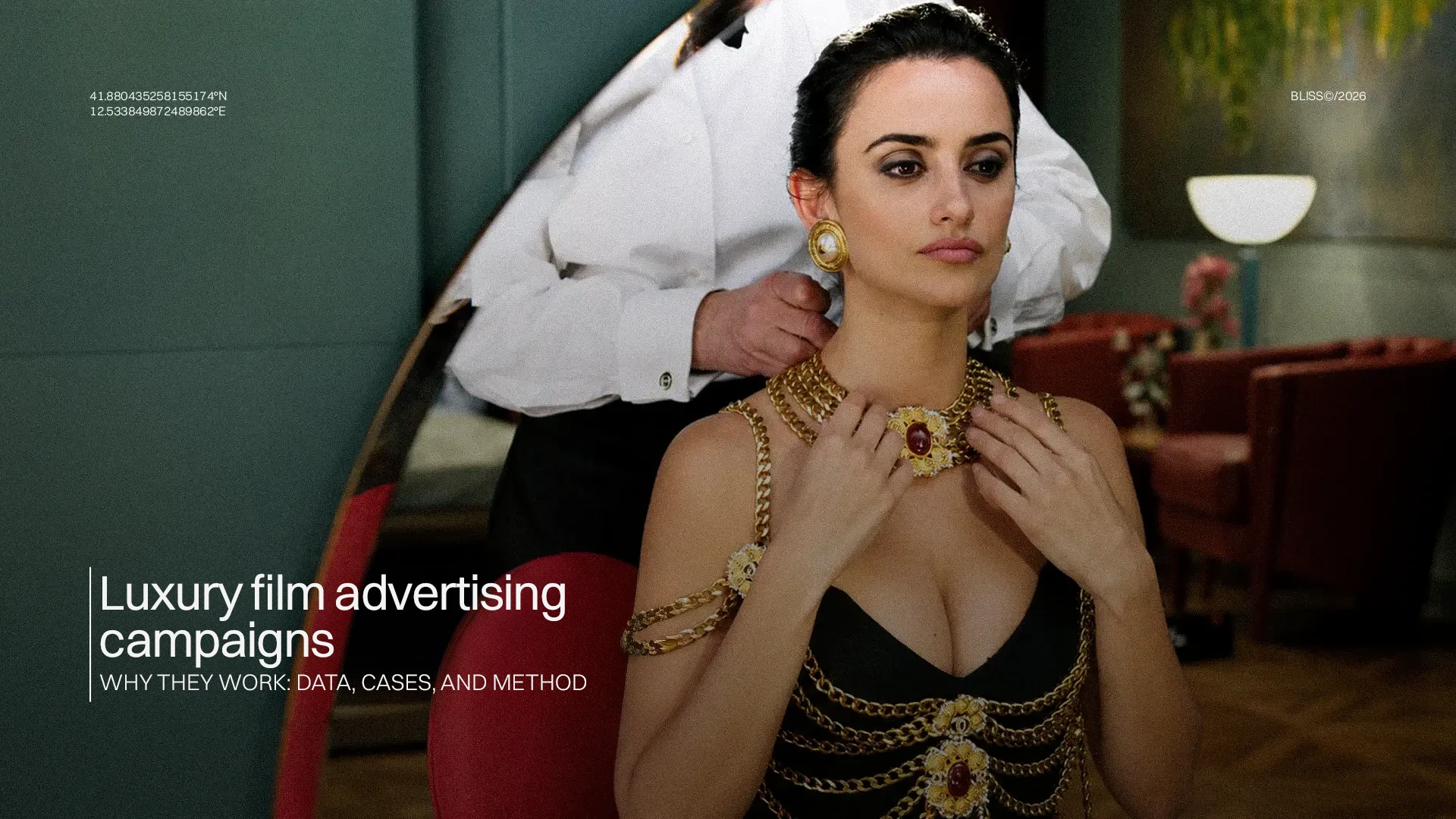
Introduction: When the Maison Meets Hollywood
In recent years, one of the most significant—and least discussed—transformations in the global luxury marketing landscape has taken place: high-end brands no longer limit themselves to commissioning commercials or financing product placement. They are becoming, to all intents and purposes, film and television production companies.
The phenomenon has precise roots and a compelling strategic logic. A luxury brand does not sell a product: it sells a system of meanings, heritage, exclusivity, desirability, and identity. For centuries, these meanings were transmitted through selective distribution, boutique architecture, and craftsmanship highlighted in print campaigns. The problem is that the world has changed: high-end consumers spend hours on streaming platforms, consume TV series, podcasts, documentaries, and perceive traditional advertising—even the most refined—as an interruption. In this scenario, controlling the narrative no longer means buying advertising space. It means producing culture.
The “luxury production house” is the structural evolution of this imperative. It is not a marketing initiative, but an architectural choice in the way a brand decides to exist over time.
Bliss
Talk to a
consultant
Tell us about your project. We will find the right path together.
contact usThe Phenomenon: Who is Doing it and Why Now
Saint Laurent Productions: The First Act
In 2023, the Kering group, through Saint Laurent, created the first true film production company owned by a luxury fashion brand. Saint Laurent Productions did not debut with a commercial disguised as a short film: it debuted at the Cannes Film Festival with two highly prestigious auteur films: Strange Way of Life by Pedro Almodóvar and a posthumous work by Jean-Luc Godard. In the 2024 edition, three Saint Laurent Productions films were competing in Cannes simultaneously, including the multi-award-winning Emilia Pérez by Jacques Audiard, The Shrouds by David Cronenberg, and Parthenope by Paolo Sorrentino.
Creative Director Anthony Vaccarello also heads the film division, overseeing its costumes and aesthetic consistency with the brand’s DNA. This is not product placement: it is an integrated artistic vision, where the brand is both patron and author. As Vaccarello stated, the goal is to work with the great cinematic talents who inspired him and offer them an authentic creative space.
LVMH and 22 Montaigne Entertainment: The System Strategy
In February 2024, LVMH, the world’s largest luxury group with over 75 maisons—including Louis Vuitton, Dior, Tiffany & Co., Bulgari, Moët & Chandon—announced the creation of 22 Montaigne Entertainment, a division dedicated to the development, co-production, and co-financing of films, TV series, and audio content inspired by the stories of its maisons. The name is the Parisian address of the group’s headquarters. The division operates in partnership with Superconnector Studios and reports directly to Antoine Arnault, the eldest son of Bernard Arnault.
The model is explicitly inspired by Nike’s Waffle Iron Entertainment, the division that produced globally successful sports documentaries. The philosophy declared by Anish Melwani, CEO of LVMH North America, is to facilitate the meeting between great cinematic storytellers and the extraordinary stories held within the maisons, stories that in some cases date back to the 14th century.
Films like House of Gucci, Ferrari, and Air have proven that there is a vast and passionate audience for narratives centered around high-end brands. And according to data cited by PYMNTS, the movie House of Gucci generated a 257% increase in demand for Gucci bags in the period following its theatrical release.
Prada and the Foundation as a Cultural Laboratory
A different, but equally significant approach is that of the Fondazione Prada in Milan. Since 2015, the Milanese headquarters has hosted the Cinema Godard, a screening space named after the French-Swiss director who created his only permanent public installations here. The Foundation collaborates with directors like Wes Anderson, who shot the short film Castello Cavalcanti for Prada in 2013 and designed the Bar Luce in the Milanese space, building a cultural ecosystem where the brand becomes a place, not a message.
Why Now: The Five Forces Driving the Transition
Answering the question “why now?” requires reading structural convergences that have overlapped over the last five years.
- Who is making this choice: The top international luxury maisons: LVMH, Kering, Prada Group, and, in different ways, brands like Bulgari, Chanel, Burberry, Ralph Lauren.
- What they are building: Not branded content campaigns, but structured editorial divisions capable of developing proprietary IP (intellectual property) over multi-year horizons.
- Where it happens: Primarily in auteur film circuits (Cannes, Venice, Berlin) and on global streaming platforms (Netflix, Apple TV+, Amazon Prime Video).
- When it started: The strategic shift accelerated between 2022 and 2024, although its roots go back to the previous decade.
Why this urgency: Five fundamental reasons:
- The first is the crisis of traditional advertising. High-end consumers increasingly prefer to consume entertainment via streaming and are willing to pay a premium to avoid ads. In this scenario, brands must become entertainment themselves to remain relevant.
- The second is the battle for the attention of Gen Z and Millennials. 80% of luxury sales are influenced by what customers see online, and new generations of affluent consumers build their relationship with brands through long-form content, documentaries, and fiction, not through banners or display ads.
- The third concerns the protection and enhancement of heritage. Century-old maisons guard historical archives, founders’ stories, and family narratives that have immense, largely unexplored cultural value. Cinema is the most powerful format to convey this depth to a global audience.
- The fourth is the construction of proprietary IP in an era when streaming platforms are hungry for premium and authentic content. A deal with Netflix or Apple TV+ has direct economic value, but above all, it generates a qualified global audience.
- The fifth, perhaps the most subtle, is competitive positioning among the groups themselves. When Kering launched Saint Laurent Productions, LVMH responded with 22 Montaigne. Film production has become a new competitive arena among luxury conglomerates.
Bliss
Talk to a
consultant
Tell us about your project. We will find the right path together.
contact usHow it Works in Practice: Operating Models Compared
There is no single model for a luxury production house. Analysis of the main cases reveals at least three distinct approaches that industry managers would do well to clearly distinguish.
The Maison-Director Model
This is the approach of Saint Laurent Productions: the brand assumes an active role in project selection and creative supervision but leaves total autonomy to the directors. There is no product placement, no explicit commercial narrative. The brand is the “enlightened patron,” and artistic credibility is the main asset derived from it. The positioning achieved is that of a culture-brand, capable of attracting not only consumers but global creative talents.
The IP Factory Model
This is the approach of 22 Montaigne Entertainment. The goal is not artistic recognition but the systematic monetization of an immense narrative heritage. The stories of Tiffany & Co., Dom Pérignon, Veuve Clicquot, or Berluti are extraordinary tales of entrepreneurs, artisans, and visionaries. In an era where Netflix and Apple TV+ seek premium and authentic content, these archives are a goldmine. The model involves co-development, co-production, and co-financing, with the maisons as guardians of authenticity and Hollywood partners as the narrative executors.
The Cultural Ecosystem Model
This is the approach of Prada Fondazione. It is not about production companies in the strict sense, but physical spaces and cultural programs that make the brand a place of cultural production. The Cinema Godard in Milan, the collaboration with Wes Anderson, exhibitions linked to films (like Asteroid City): everything contributes to building a brand identity that goes beyond the product and sits at the heart of contemporary culture.
| Feature | Patron Model (Saint Laurent) | IP System Model (LVMH) | Foundation Model (Prada) |
| Creative Control | Low (autonomy to directors) | Medium (co-development) | Low-None |
| Product Placement | Absent | Potential | Absent |
| Primary Goal | Cultural positioning | IP valuation + reach | Cultural heritage |
| Main Output | Auteur films | TV series, documentaries, films | Exhibitions, screenings, archives |
| Main Circuit | Film festivals | Streaming platforms | Cultural institutions |
The ROI of Culture: Data and Metrics That Matter
The question every marketing manager or entrepreneur asks is legitimate: what is the return on investment of such an ambitious strategy?
The available data suggests that the impact is real and measurable across multiple dimensions.
- According to data from Launchmetrics, luxury brands investing in high-quality video storytelling record significantly higher performance in terms of brand equity and influence on purchasing decisions, since 80% of premium sales are influenced by what customers see online.
- On the macro scenario front, global cinema revenues are projected to reach $52.7 billion by 2026, with an estimated 7.7 billion admissions, confirming the existence of a massive and growing global audience for premium cinematic content.
- According to the PwC Global Entertainment & Media Outlook, the global entertainment market will reach $3.5 trillion by 2029, driven by the growth of streaming services and the demand for premium content.
- Perhaps the most telling figure, however, is consumer behavior post-exposure: the 257% increase in searches for Gucci products after House of Gucci is not an isolated case but the confirmation of a precise psychological mechanism—narrative creates desire, and desire precedes purchase.
What Medium-Sized Italian Brands Can Learn
The model of the grand maisons is obviously distant from medium-sized Italian realities, yet the underlying principles are scalable. You don’t need to produce a film with Pedro Almodóvar to apply the logic of the luxury production house to your communication. You do, however, need to make a precise conceptual leap: stop thinking of video production as an accessory service and start treating it as a strategic branding asset.
This means investing in cinematic-quality video content, even in short formats, with consistent art direction, an authentic narrative, and distribution designed to build an audience over time, not just to generate immediate impressions.
The Contribution of Bliss: From Strategy to Production
In this context, Bliss works daily with Italian and international brands to translate this logic into concrete and measurable visual communication systems. The project for Risivi & Co., an Italian artisanal jewelry brand, is an emblematic example: Bliss developed a complete ecosystem of photographic content, cinematic-aesthetic videos, and advertising campaigns, achieving tangible results such as 6.4 million total views, a 172% fan base growth, and a 380% increase in organic reach. All starting from a profound redefinition of the brand’s aesthetic and narrative codes.
For Profumum Roma, Bliss built a branding strategy that transformed the luxury perfumery brand’s communication through high-impact immersive content, with “ThruPlay” views (users watching over 10-15 seconds) demonstrating deep engagement from the target audience.
For Doreca Spa, a premium distributor in the beverage sector, Bliss produced emotional video content and corporate campaigns in exclusive environments, including productions aboard an MSC cruise ship, confirming the effectiveness of an omnichannel approach where video is a positioning lever, not just for visibility.
Technical Insights: Cluster Pages to Help Build Your Video Strategy
The transition to a cinematic brand logic does not happen by decree: it requires precise operational choices, from the type of content to duration, from format to budget. Bliss has developed a series of practical guides that precisely answer these questions.
- How much does a promotional video cost? If you are evaluating an investment in quality video, our complete guide on promotional video costs provides a clear overview of types, budget variables, and criteria for comparing quotes—indispensable before any creative briefing.
- How long does it take to produce a corporate video? Production times are often underestimated in marketing planning. Our guide on the timelines, phases, and variables of video production helps you plan correctly, avoiding delays and bottlenecks in pre- and post-production phases.
- Vertical or horizontal video? The choice of format is not aesthetic: it is strategic. For brands operating across different channels, from Instagram to YouTube, from TikTok to corporate presentations, our guide on how to choose the right video format offers a clear decision-making framework based on communication goals rather than aesthetic preferences.
- What is the ideal duration of a corporate video? One of the most debated and intuitively managed parameters. Our analysis of the ideal duration of a corporate video debunks common myths and provides indications based on real engagement data, differentiated by content type and distribution platform.
- Luxury Still Life: How to elevate a brand through product photography. For premium and luxury brands, still life photography is never just product documentation: it is the construction of desire. Our guide to luxury still life explores how light, composition, and art direction transform a product shot into a brand statement—the starting point for any high-level visual content strategy.
Bliss
Talk to a
consultant
Tell us about your project. We will find the right path together.
contact usEmerging Trends in 2026: Where the Frontier is Moving
The luxury production landscape is evolving rapidly in three directions that must be monitored.
- The convergence of art, fashion, and digital platforms. The success of Emilia Pérez on Netflix, produced with the support of Saint Laurent Productions and multi-award-winning, proved that an auteur film backed by a luxury maison can achieve global distribution and generate massive cultural impact. Streaming platforms are actively seeking partnerships with luxury brands that bring authenticity and heritage into narratives.
- AI as a production tool, not a replacement. According to EY, in 2026 the brands that make a difference will be those capable of combining AI and authentic human storytelling. Luxury brands are using artificial intelligence to accelerate pre-production, script development, and post-production phases, freeing up human resources for creative direction.
- The luxury experience as content. More and more maisons are turning their events, fashion shows, flagship store openings, and artistic collaborations into video content distributed as mini-documentaries or editorial series. The launch of a collection is no longer an ephemeral event: it becomes IP.
FAQ: Frequently Asked Questions on the Topic
Why are luxury brands investing in film production?
Because traditional advertising is increasingly less effective on an audience that has the power and habit of blocking it. Cinema and TV series allow brands to build deep narratives around their heritage, reach global audiences on premium platforms, and transform the brand itself into a cultural object, with measurable impacts on desirability and sales.
What is the difference between branded content and a luxury production house?
Branded content is content that explicitly promotes a brand, often with advertising logic. A luxury production house produces artistic or narrative content where the brand is the patron or the cultural context, not the message. The distinction is fundamental: artistic credibility and authenticity are not built through blatant communication but through genuine participation in culture.
Can medium-sized Italian brands also apply this approach?
Yes, but with a proportionate scaling. You don’t need to produce feature films to apply cinematic logic to your communication. Investing in high-quality videos with an authentic narrative, choosing formats and durations consistent with your goals, and building a recognizable art direction: these are concrete steps a premium Italian brand can take today, with an investment proportional to its positioning.
Is the ROI of film production measurable?
Yes, but it requires different metrics than direct response marketing. Relevant KPIs include: growth in brand awareness and brand equity, increase in direct site traffic (a signal of spontaneous brand search), rise in positive sentiment, growth in perceived value, and deep engagement metrics (completion rates, viewing time). Data from cases like House of Gucci, with a +257% demand for products after the movie’s release, show that the impact on sales is real, even if indirect.
What is the role of film festivals for luxury brands?
Festivals like Cannes, Venice, and Berlin are for luxury brands what runway shows are for fashion: global cultural positioning stages with unrepeatable media coverage. Presenting a film at Cannes bearing your signature means reaching editors, critics, cultural influencers, and media around the world with a message of excellence that no advertising campaign could replicate.
How do you build a consistent art direction for a luxury brand’s video content?
Consistent art direction stems from a system of visual and narrative codes defined upfront—color palettes, editing rhythm, location choices, linguistic register, music—applied with discipline across all formats and channels. It is not about uniformity: it is about recognizability. A luxury brand should be identifiable even without a logo, simply through the visual language of its content.
Conclusion and Call to Action
The transformation of luxury brands into film production studios is not a marginal trend or a creative experiment: it is the industry’s structural response to an epochal shift in consumer behavior and the attention economy. Those who understand this logic today, and apply it with strategic consistency, will build a competitive advantage that will be hard to erode in the coming years.
Whether you lead an established luxury brand, an emerging premium brand, or are rethinking the communication of a company with a strong heritage, the question is not whether to invest in cinematic-quality video content. It is how to do it in a way that aligns with your positioning, scales with your growth, and is measurable in its results.
Bliss works exactly on this: from brand strategy to visual production, from luxury still life to high-impact narrative videos, with an integrated approach that connects creative direction, technical execution, and performance marketing.
Contact us for an initial consultation and discover how to build—or relaunch—your brand’s visual story with the quality, consistency, and vision it deserves.
→ Contact Bliss | Offices in Rome and Milan | International Operations