


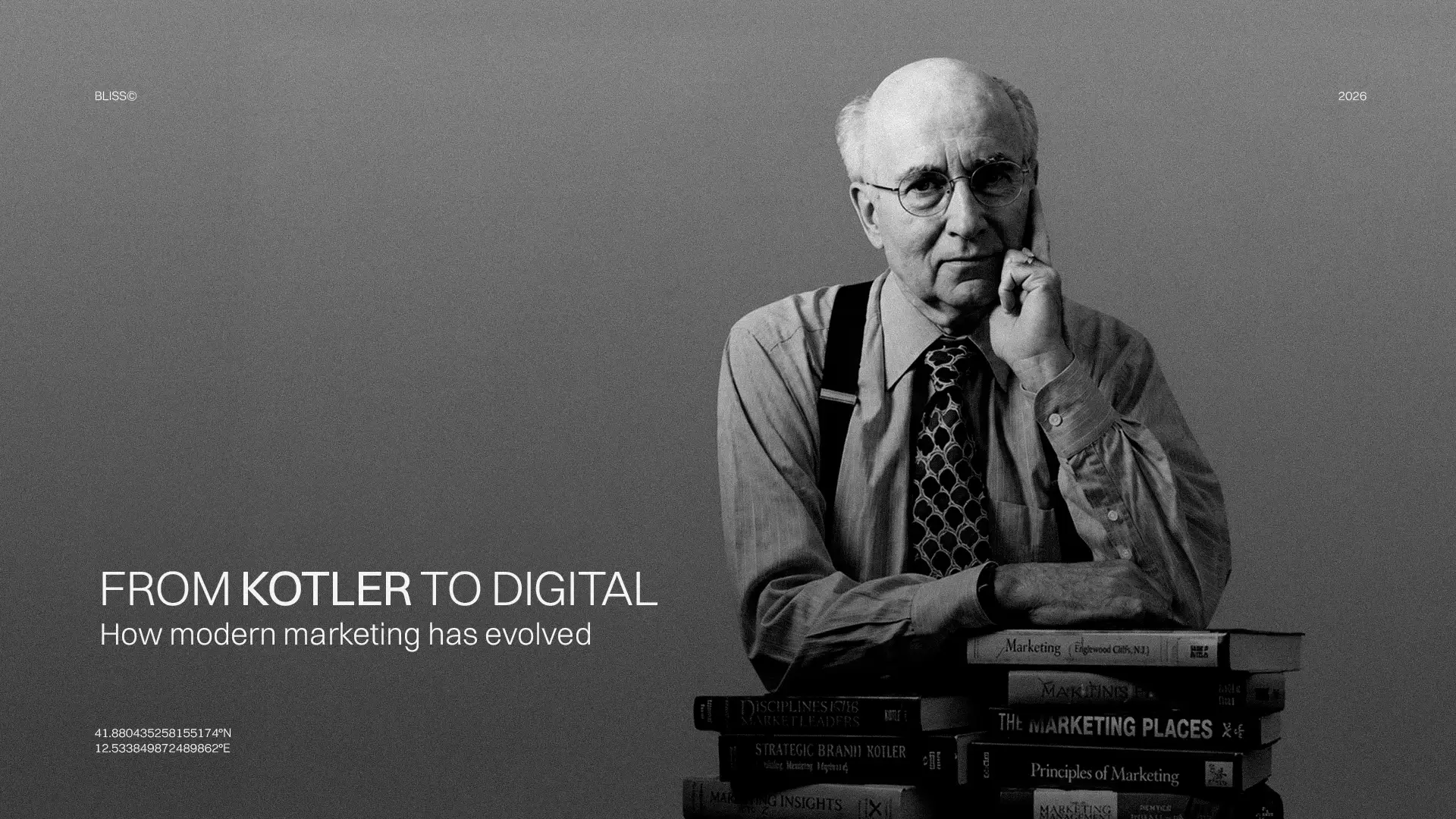
Modern marketing was born twice. The first time, in the academic laboratories of the 1960s, when Philip Kotler transformed an empirical practice into a scientific discipline by providing it with analytical frameworks, a shared vocabulary, and applicable models. The second time, in the early 2000s, when the Internet rewrote the rules of the relationship between brand and consumer, making assumptions that had held for decades obsolete in just a few years.
Understanding this double birth is not an academic exercise. It is the basis for building more conscious strategies: those who know the evolution of marketing know how to distinguish passing fads from structural changes, know when a classic model still works and when it needs to be updated, know how to read the trends of 2026 as stages of a logical path rather than unpredictable discontinuities. This article retraces the stages of that trajectory — from Kotler to digital — with a constant focus on the operational implications for those who manage brands, campaigns, and budgets today.
For the complete definition of marketing, its meaning, the history of its origins, and the framework of the three dimensions (analytical, strategic, operational), read: Definition of marketing: what it is, history and evolution of the discipline.
Bliss
Talk to a
consultant
Tell us about your project. We will find the right path together.
contact usWhy Studying the Evolution of Marketing Is a Strategic Choice
Who is Philip Kotler and why is his contribution still relevant today? When was modern marketing born as a structured discipline? Where did the real fracture between traditional and digital marketing take place? What drives brands to continuously evolve their strategies? Why do companies that ignore this history risk replicating errors already overcome by theory?
These are the five fundamental questions (the 5Ws of marketing) that this article answers. Because understanding the evolution of the discipline is not an academic exercise: it is the basis for building more conscious, effective, and lasting strategies.
Marketing as an organized discipline was born between the late nineteenth century and the early decades of the twentieth century, parallel to the Second Industrial Revolution. But it was in the 1960s that it took the shape we recognize today as “modern.” The catalyst was the work of Philip Kotler, a professor at the Kellogg School of Management at Northwestern University, author of over 80 books, and consultant to companies like IBM, General Electric, Ford, and AT&T. Kotler transformed marketing from an empirical practice to a scientific discipline, equipping it with a rigorous analytical framework, a shared vocabulary, and applicable models.
The Stages of Evolution: From Kotler to Marketing 6.0
To understand where we have arrived, we need to know where we started. Kotler himself systematized the evolution of marketing into progressive phases, each reflecting a social, technological, and economic transformation.
Marketing 1.0: Product-Centric (1960s–90s)
Marketing 1.0 is the marketing of the industrial era. Companies produce standardized goods for mass markets, and communication goes in only one direction: from the company to the consumer, through mass media like television, radio, and print. The reference operational model is the 4P marketing mix, theorized by E. Jerome McCarthy in 1960 and made famous by Kotler: Product, Price, Place, and Promotion. In this phase, demand exceeds supply, and the corporate imperative is to produce more at lower costs.
Marketing 2.0: The Customer as Protagonist (1990s–2000s)
With globalization and market saturation, a simple product is no longer enough. Marketing 2.0 is born, customer-oriented: companies begin to segment markets, develop targeting and positioning strategies (Kotler’s STP model), and build brand equity. The consumer no longer buys just a product, but an experience and an identity. It is in this phase that some of the most iconic brands in history are born, from Nike to Apple, and the concept of brand loyalty becomes a measurable strategic variable.
Marketing 3.0: Values as a Competitive Lever (2000s–2010s)
With the advent of the Internet and social media, the consumer transforms into an active player. In his book “Marketing 3.0” (2010), Kotler introduces the concept of humanistic marketing: companies must no longer limit themselves to satisfying functional and emotional needs, but also spiritual aspirations and ethical values. It is the era of corporate social responsibility, sustainability as an argument for brand positioning, and purpose-driven marketing. Brands like Patagonia, TOMS Shoes, and later Unilever’s Dove become global case studies of this philosophy.
Marketing 4.0: The Integration of Digital (2010s–2020s)
With the book “Marketing 4.0” (2017), Kotler formalizes what many professionals were already experiencing in the field: the need to integrate offline and online channels into a coherent, omnichannel strategy. The customer journey is no longer linear; the consumer constantly moves from one screen to another, from a physical environment to a digital one. The AIDA model (Awareness, Interest, Desire, Action) evolves into Kotler’s 5A framework: Aware, Appeal, Ask, Act, Advocate. The fifth component, advocacy, recognizes the role of consumers as amplifiers of the brand message. This phase sees the explosion of content marketing, SEO, social media as customer acquisition channels, and marketing automation.
Marketing 5.0 and 6.0: Technology for Humanity (2021 to present)
With “Marketing 5.0: Technology for Humanity” (2021), Kotler introduces the systematic application of technologies that imitate human capabilities, such as artificial intelligence, machine learning, and the Internet of Things, to create, communicate, and deliver value along the entire customer journey. Marketing becomes data-driven in a profound sense: Big Data fuels predictive decisions, chatbots manage personalized relationships, and agile marketing allows for real-time testing and optimization.
The latest chapter in this evolution is “Marketing 6.0: The Future Is Immersive” (2023), where Kotler and his co-authors place generative AI at the center of experience design. In this paradigm, the distinction between physical and digital progressively dissolves, giving rise to hybrid, immersive, and multisensory experiences. The brand evolves into an experiential ecosystem driven by AI, where value is co-created with the customer through intelligent systems.
The following table summarizes the entire progression:
| Phase | Period | Focus | Key Tool |
| Marketing 1.0 | 1960s–90s | Product | Marketing Mix (4Ps) |
| Marketing 2.0 | 1990s–2000s | Customer | STP, Brand Equity |
| Marketing 3.0 | 2000s–2010s | Values | Purpose Marketing |
| Marketing 4.0 | 2010s–2020s | Omnichannel | Content, SEO, Social |
| Marketing 5.0 | 2021–present | Technology | AI, Big Data, Automation |
| Marketing 6.0 | 2023–present | Immersiveness | Generative AI, Metaverse |
The Economic Weight of Digital Marketing in 2026
The numbers confirm the centrality of digital in contemporary marketing strategies. According to Dentsu, in 2026 global advertising spending will cross the $1 trillion threshold for the first time, with a 5.1% growth compared to the previous year. Digital will account for 68.7% of total global advertising investments, with a 6.7% year-over-year growth. The fastest-growing channels are retail media (+14.1%), online video (+11.5%), and social (+11.4%).
According to Statista, in 2026 global digital display advertising spending will reach $266.6 billion, up from $207.4 billion in 2023. Programmatic advertising will represent over 80% of total digital investment. These data are not just industry statistics: they are the signal that digital marketing is no longer an accessory component of corporate strategy, but its backbone.
From the Marketing Mix to the 4Cs: The Shift in Perspective
One of the most significant moments in the evolution of marketing thought is the shift from the 4Ps to the 4Cs, proposed by Robert Lauterborn in 1990 and subsequently elaborated by Kotler. The 4Ps describe marketing from the company’s perspective (Product, Price, Place, Promotion), while the 4Cs describe it from the customer’s perspective: Customer Value, Cost, Convenience, and Communication.
This shift in perspective is not cosmetic: it reflects a profound transformation in the balance of power between companies and consumers. In the digital world, where the customer can compare prices in seconds, read hundreds of reviews, and share their experience with millions of people, companies that still think only in terms of 4Ps are structurally disadvantaged compared to those that have internalized the logic of the 4Cs.
Want to delve deeper into the differences between the 4Ps and 5Ps of marketing and understand which model best suits your industry? Read Bliss’s complete guide on the 4Ps and 5Ps of the Marketing Mix.
The Marketing Mix in 2026: Concrete Examples from Big Brands
The marketing mix is not a museum concept: it is still the most used analytical tool in strategic planning processes today. The difference compared to the 1960s is that the variables to manage have multiplied and the levers have become interdependent like never before.
Apple is the most cited example of masterful contemporary marketing mix management. The Product is designed with an obsessive focus on design and user experience. The Price is intentionally premium, reinforcing the status positioning. Place, from Apple Stores to the digital channel, is a consistent and memorable experience. Promotion does not sell technical features, but aspirations and belonging. To these four levers is added the People dimension (the 7Ps of services marketing), with store staff trained as brand ambassadors.
An Italian example of excellence in managing the marketing mix in the luxury sector is the work Bliss carried out for Profumum Roma, an Italian artistic perfumery brand. The challenge was seemingly contradictory: selling a sensory product, perfume, through digital channels where the sense of smell is by definition absent. The solution was a radical reinterpretation of the “Promotion” variable: abandoning classic photography in favor of CGI and 3D modeling, creating dreamlike and hyper-realistic contexts that allow the user’s brain to simulate the missing sensory experience. The result was a +107% in organic social traffic, 2.9 million video views on TikTok, and +61.2% in direct website traffic, a sign that users were no longer encountering the brand by chance, but actively seeking it out.
Want to see how big brands manage the marketing mix in practice? Explore the section dedicated to concrete examples of successful marketing mixes on the Bliss website.
Content Marketing, SEO, and Data-Driven: The Three Pillars of Digital Marketing
In the era of Marketing 4.0 and 5.0, three operational paradigms have emerged as fundamental for any serious digital marketing strategy.
Content Marketing as a Strategic Asset
Content marketing is not about producing content for the sake of publishing. It is the systematic construction of a wealth of knowledge that attracts, educates, and converts the target audience. According to HubSpot, companies that publish at least 16 articles a month on their blog generate 3.5 times more traffic than those that publish fewer than four. The key is not quantity, but relevance: content that answers real user questions, built around coherent thematic clusters, and optimized for search engines.
Search Engine Optimization (SEO)
SEO has become a strategic function of primary importance, not a secondary technical skill. In an ecosystem where 68% of online experiences begin with a Google search, organic ranking has become one of the most valuable assets a company can build over time. Modern SEO is not just about keywords: it’s about understanding search intent, topical authority, user experience, and the technical structure of the site.
Data-Driven Marketing
With the advent of marketing automation systems, advanced CRMs, and artificial intelligence, marketing has fundamentally become data-driven. Decisions are no longer made based on intuition or accumulated experience, but on quantitative evidence extracted in real-time. Generative AI, in particular, is transforming the way content is created, campaigns are planned, and communications are personalized: an area where, according to Dentsu, technology (+10.3%) is expected to be the fastest-growing advertising investment sector in 2026.
Thematic Clusters: Explore Marketing from Every Angle
Marketing is a vast discipline. To truly master it, it is necessary to explore its various dimensions with the right depth. Here are the fundamental themes every professional should know:
- Definition, history, and evolution of marketing. Before applying any strategy, you must understand what marketing really is, how it was born, and how it has transformed over time. Knowing this history allows you to distinguish passing fads from structural changes. Discover the definition of marketing, its history, and its evolution on the Bliss website.
- Schools of thought in marketing. Marketing is not monolithic: there are different approaches, from the functionalist school to the behavioral one, from strategic orientation to relational orientation. Understanding these differences helps choose the most suitable framework for your competitive context. Delve into the main schools of thought in marketing with Bliss.
- Successful marketing mix: examples from big brands. Theory only becomes useful when translated into practice. Analyzing how leading brands manage their marketing mix is one of the most effective training tools for any professional. Explore the successful marketing mix cases of big brands analyzed by Bliss.
- The 4Ps of marketing: differences with the 5Ps. The classic marketing mix has evolved over time with the addition of new variables. Understanding the differences between the models allows you to choose the one best suited to your offering and market. Read Bliss’s guide on the 4Ps, 5Ps, and the differences between marketing mix models.
- The complete marketing mix: 4Ps, 7Ps, and 5Ps explained with examples. For those managing service brands, physical products, or hybrid realities, understanding how the different variables of the marketing mix are articulated is essential to build a coherent and effective strategy. Discover the marketing mix with the 4Ps, 7Ps, and 5Ps explained with practical examples on the Bliss blog.
The Bliss Case: Where Theory Meets Practice
The journey from Kotler to digital is not just a theoretical matter. For a brand, it translates into daily operational choices: which channel to cover, with what message, at what frequency, and with what measurable goal. Bliss is an emblematic example of how this evolutionary path is concretely applied in the Italian luxury and premium market.
The Bliss method is built on the synergy between brand strategy, art direction, visual production (photography, video, CGI, and 3D), digital development, and performance marketing. It is not an agency that simply executes campaigns: it is a strategic partner that designs coherent brand ecosystems, where every physical and digital touchpoint tells the same story with the same voice.
The Profumum Roma case is the most concrete demonstration of this. Starting from an analysis of the behavioral dynamics of the luxury consumer in the digital environment, Bliss built a 3D luxury still life strategy capable of transforming the brand’s visual feed into an aesthetic experience of the highest level, generating over 4 million video views on TikTok and a 172.3% community growth on Meta.
Similarly, in its guide to elevating a brand, Bliss applies the fundamental principles of Kotlerian marketing, particularly the centrality of positioning and perceived value, translated into the tools of contemporary digital marketing: from brand identity to SEO optimization, from omnichannel storytelling to performance measurement.
Bliss
Talk to a
consultant
Tell us about your project. We will find the right path together.
contact usMarketing Trends in 2026: What Managers Need to Know
2026 is marked by structural trends that every marketing manager or entrepreneur should include on their strategic radar.
The first is the rise of generative AI as an operational, not experimental, tool. According to Dentsu, the technology sector has the highest advertising investment growth rate in 2026 (+10.3%), driven precisely by AI product launches and innovation in connected ecosystems. AI does not replace marketers but amplifies their ability to produce personalized content, analyze data, and optimize campaigns in real-time.
The second trend is retail media as a primary advertising channel. With an expected growth of 14.1% in 2026, retail media (i.e., advertising within e-commerce platforms like Amazon, Walmart, or similar) is becoming the fastest-growing channel in the digital landscape, outpacing even social media in expansion speed.
The third trend is the evolution of online video as the dominant format. With an 11.5% growth in 2026 and video already capturing 35% of all digital advertising budgets today, the ability to produce high-quality video content consistent with brand positioning has become a core competency for any marketing team.
Finally, extreme data-driven personalization: according to established industry research, personalized ads generate an engagement rate up to 80% higher than generic ones. In a context where the consumer is exposed to thousands of messages a day, relevance is the fundamental discriminator between being noticed and being ignored.
FAQ: The Most Common Questions About the Evolution of Marketing
Who is Philip Kotler and why is he considered the father of modern marketing?
Philip Kotler is an international marketing professor at the Kellogg School of Management at Northwestern University and author of over 80 books, including the manual “Marketing Management,” now in its fifteenth edition. He is considered the father of modern marketing because he systematized the discipline, transforming it from an empirical practice into a managerial science, providing it with applicable analytical models such as the 4Ps, the STP framework (Segmentation, Targeting, Positioning), and the progression from Marketing 1.0 to 6.0. The Financial Times included him in the list of the top 10 business thinkers in the world.
What is the difference between Marketing 4.0 and Marketing 5.0?
Marketing 4.0 (2017) focuses on integrating online and offline channels into a coherent omnichannel strategy, centering on the customer journey and the role of advocacy. Marketing 5.0 (2021) takes it a step further, systematically applying technologies that imitate human capabilities (artificial intelligence, machine learning, IoT) to personalize the customer experience at every stage of their journey. If 4.0 answers the question “how is digital integrated into the strategy?”, 5.0 answers “how are intelligent technologies used to create value?”
What is meant by data-driven marketing?
Data-driven marketing is an approach to planning and executing marketing strategies based on the analysis of quantitative data rather than intuition or anecdotal experiences. It includes the use of tools like CRMs, marketing automation, site and social analytics, conversion tracking systems, and AI-based predictive models. In practice, it means making decisions on budget, channels, messaging, and campaign timing based on measurable evidence updated in real-time.
How has the role of the consumer changed in the evolution of marketing?
In Marketing 1.0, the consumer was a passive recipient of messages produced by companies. In 2.0, they became a subject whose needs and requirements must be understood. In 3.0, they became the bearer of values that the brand must reflect. In 4.0, they became a co-creator of brand value through their digital interactions and reviews. In 5.0 and 6.0, thanks to AI and immersive experiences, the consumer is at the center of an ecosystem that adapts in real-time to their preferences, behaviors, and usage contexts.
What is the difference between the 4Ps and the 7Ps of marketing?
The 4Ps of the marketing mix (Product, Price, Place, and Promotion) were theorized by E. Jerome McCarthy in 1960 and adapted by Kotler for the marketing of physical goods. The 7Ps extend this model to services marketing, adding three variables: People (the staff who deliver the service), Process (the processes that determine the quality of delivery), and Physical Evidence (the physical proofs that make an intangible offering tangible, like space design or packaging). The 7Ps are particularly relevant for sectors such as tourism, catering, financial services, and consulting.
Is traditional marketing still relevant in 2026?
Yes, but in a logic of integration rather than as an alternative to digital. According to Dentsu, in 2026 even traditional channels like television (+2.4%) and outdoor (+4.1%) will see moderate growth. The real evolution is not the disappearance of traditional channels, but their integration into coherent omnichannel strategies, where every touchpoint, physical or digital, contributes to building a unified and recognizable brand experience. The companies that perform best in 2026 are those that have overcome the distinction between “traditional marketing” and “digital marketing” to adopt an integrated vision of the customer journey.
What skills must a marketing manager have in 2026?
An effective marketing manager in 2026 must master both the theoretical foundations of strategic marketing (market analysis, segmentation, positioning, brand equity) and the operational tools of digital marketing (SEO, content marketing, paid advertising, marketing automation, analytics). To these are added emerging skills such as understanding generative AI and its applications in marketing, the ability to read and critically interpret performance data, and sensitivity to sustainability and communication ethics as positioning variables.
Build or Relaunch Your Brand with Bliss
The evolution of marketing from Kotler to digital is not a story with an ending: it is a continuous process of adaptation that requires strategic vision, updated skills, and reliable partners. Whether you are building a brand from scratch, repositioning an existing one, or looking to maximize the return on your digital marketing investments, the complexity of 2026 requires an integrated and methodical approach.
Bliss is the strategic partner for brands that want to take this path with method, consistency, and creative excellence. From brand strategy to visual production, from SEO to performance campaigns, from luxury still life to institutional communication, Bliss accompanies every project with the same philosophy: uniting art, technology, and strategy to build iconic and recognizable brands.
Contact Bliss today for a strategic consultation and discover how to transform your brand into a lasting competitive asset.