


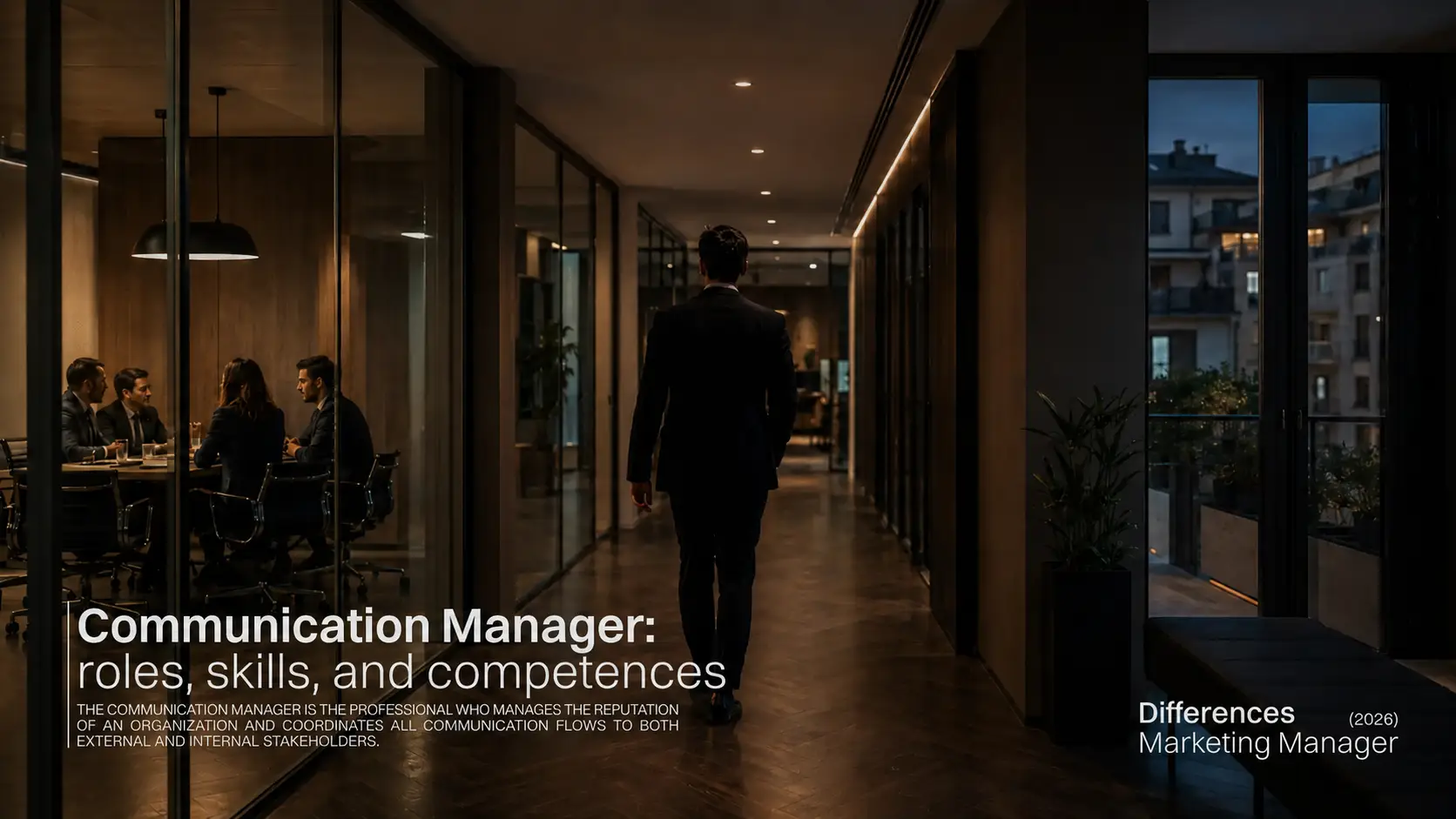
The Communication Manager is the professional who governs an organization’s reputation and coordinates all communication flows, both external and internal. They are the ones who decide what a company says, how it says it, to whom, and at what time: from press releases to crisis management, from institutional communication to stakeholders, up to the tone the brand uses to address its employees.
In structured organizations, this role is distinct from that of the Marketing Manager: where marketing generates demand and measures revenue, communication builds reputation and measures perception. Confusion between the two profiles is frequent in SMEs, where the same person often covers both, but understanding the differences is essential for anyone who wants to structure a communication department or evaluate a career in this field.
This guide analyzes in detail what a Communication Manager does, what skills the market requires in 2026, how much they earn, and how they differ in their main specializations (corporate, web, marketing communication manager).
Bliss
Talk to a
consultant
Tell us about your project. We will find the right path together.
contact usCommunication Manager: definition and corporate placement
The Communication Manager is the professional responsible for an organization’s integrated communication strategy. Their mandate is twofold: to govern external communication toward media, institutions, partners, and the general public, and to coordinate internal communication, meaning how the company speaks to its employees and collaborators.
Unlike many other managerial roles, the Communication Manager almost always reports directly to the General Management or the CEO, not to the commercial department. This placement is no coincidence: an organization’s long-term reputation requires independence from short-term sales logic. A company handling a media crisis cannot afford messages dictated by commercial urgency; it needs a coherent, calibrated, and strategic voice.
The role exists autonomously in medium and large organizations. In SMEs, the same responsibilities are often absorbed by the owner, a marketing manager, or an external agency. In multinational corporations, the Communication Manager coordinates a structured team that includes specialized figures in PR, media relations, internal communication, and crisis management.
What a Communication Manager does: responsibilities and areas of intervention
The Communication Manager is the professional who governs how the outside world perceives the organization. Their scope is broader than that of the Marketing Manager because their audiences include not only customers and prospects but all the organization’s stakeholders: employees, investors, media, institutions, local communities, and partners.
The Communication Manager defines and oversees the institutional communication strategy, manages relationships with media and press offices, coordinates PR and public relations activities, supervises corporate storytelling and the brand’s tone of voice across all channels, manages internal communication toward employees, and oversees the management of reputational crises. In a context like Microsoft, the Communication Manager operates across the board: managing relations with global media, defining institutional messages, handling reputational crises, and coordinating corporate events. In this type of structure, the communication team reports to general management or the Corporate Affairs department, not the commercial division.
The organizational distinction is not accidental: the Communication Manager needs a position of independence from short-term commercial logic to effectively protect the organization’s long-term reputation. A company facing an environmental crisis, an accusation of misconduct, or a controversy on social media needs someone to handle the response with a reputational logic, not a sales logic.
Skills and tools of the Communication Manager in 2026
The Communication Manager in 2026 must master relations with traditional and digital media, communication crisis management, corporate storytelling, multichannel communication, and social platforms from an institutional perspective. They must have excellent writing skills, structured narrative thinking, and the ability to adapt complex messages to different audiences with varying communication styles. They must also have a sufficient understanding of digital tools and data to evaluate the impact of their activities, even though their priority remains the quality of the message rather than the performance of the campaign.
According to Glassdoor data updated to November 2025, the average salary for a Communications Manager in Italy is around 47,000 euros per year, with the typical salary range between 41,455 and 64,000 euros, and more senior profiles reaching 85,800 euros. Professionals with over 20 years of experience can exceed 114,000 euros, according to Jobbydoo data.
The specializations of the Communication Manager
The title ‘Communication Manager’ actually encompasses profiles with very different scopes, which vary based on company size, sector, and organizational structure. The four most common specializations in the Italian market are:
Corporate Communication Manager
Operates in large companies and multinational corporations with the primary responsibility of managing the organization’s institutional reputation. They deal with investor relations, communication with institutions, reputational crisis management, and corporate storytelling. It is the figure closest to the board and general management and requires a strong ability to work under pressure and in contexts with high media visibility.
Marketing Communication Manager
This is the most common hybrid profile in medium-sized companies: it combines brand communication management with support for marketing activities. They coordinate integrated campaigns, ensure message consistency across all channels, and act as a bridge between the marketing team and institutional communication functions. Often referred to in English as MarCom Manager, it is among the most sought-after profiles in the consumer goods, fashion, and food sectors.
Web Communication Manager
Handles the organization’s digital communication: manages the corporate website, supervises social media presence from a reputational (not just performance) perspective, coordinates the production of editorial content, and oversees the brand’s online tone of voice. Requires transversal skills between traditional communication and digital marketing, with a particular focus on consistency between online and offline channels.
Communications Manager (international)
In English-speaking multinational structures, the title Communications Manager (plural) often indicates a senior profile with responsibilities across multiple markets or multiple communication functions in parallel. In Italy, this typically corresponds to the figure of the Head of Communication (Responsabile della Comunicazione), with structured teams and significant budgets to manage autonomously.
Salary of a Communication Manager in Italy in 2026
The salary of a Communication Manager in Italy varies significantly based on experience, company size, and geographical location. According to Jobbydoo data updated to 2026, the average compensation is €69,500 gross per year, equal to about €3,200 net per month, which is 106% higher than the national average salary.
| Seniority | Years of experience | Average annual salary (gross) |
| Junior | 0–3 years | ~€49,800 |
| Mid career | 4–9 years | ~€73,400 |
| Senior | 10–20 years | ~€98,000 |
| Top management | Over 20 years | Over €128,000 |
The geographical differential is relevant: in Milan and large cities, remuneration packages are on average 15-20% higher than the national average. In the luxury, finance, and multinational sectors, senior profiles with over 15 years of experience can exceed €100,000 gross per year, often with variable components linked to reputation management goals.
Source: Jobbydoo (2026), 24ORE Business School, TechCompenso.
How to become a Communication Manager: educational path and career
There is no single path to access the role of Communication Manager, but some educational trajectories are distinctly more frequent in the Italian market.
On the academic front, the most common entry degrees are Communication Sciences, Humanities and Philosophy with a communication focus, Economics with a specialization in marketing, and Political Science with a focus on international relations or journalism. Increasingly, Communication Managers are found with backgrounds in Law, particularly for roles in corporate affairs and crisis management.
After a bachelor’s or master’s degree, the typical path involves a specialized master’s in corporate communication, public relations, or communication marketing. The most recognized schools in Italy for this type of training include IED, IULM, 24ORE Business School, and Sole 24 Ore School of Management.
In terms of career, one typically starts from junior roles such as PR specialist, press officer, or content editor (3-5 years), advances to Communication Specialist or Coordinator positions, and reaches the managerial role with 8-12 years of overall experience. In multinational corporations, the path can be faster thanks to dedicated internal development programs.
Communication Manager vs Marketing Manager: the main differences
Observing the differences through the most relevant operational variables allows us to understand where the two roles diverge and where they overlap.
| Dimension | Communication Manager | Marketing Manager |
| Primary goal | Reputation and perception | Generating demand and revenue |
| Target audiences | All stakeholders | Customers and prospects |
| Time horizon | Long term | Short and long term |
| Key metrics | Brand awareness, sentiment, media coverage | ROI, CAC, conversion rate |
| Typical reporting | CEO / General Management | CMO / Commercial Management |
The differences between the two roles are clear in terms of goals and metrics, but in daily practice, they often overlap: both work on brand perception, both manage external agencies and content production. The distinction that truly matters is the organizational one: who they report to, what KPIs they are evaluated with, and what decisions they can make autonomously.
Where the two roles overlap
The areas of overlap between the two roles are real and often a source of organizational friction. Content marketing, brand storytelling, social media management from an institutional perspective, and brand awareness campaigns are areas where both roles have a say and shared responsibilities. In these areas, collaboration is indispensable: the Marketing Manager brings data, audience segmentation, and performance logic; the Communication Manager brings narrative consistency, tone, and long-term vision.
Even in digital campaigns, the two roles are interconnected: the Marketing Manager plans the strategy, content, and platforms, while the Communication Manager shapes the message based on the tone of voice and corporate context, integrating public relations and digital events. Working in synergy means sharing briefs, insights, goals, and resources, avoiding the misalignments that generate inconsistent campaigns and contradictory messages.
Marketing Manager and Communication Manager in luxury: the Bliss cases
Bliss, specialized in brand advisory and integrated marketing for the premium and luxury segment, has built an operational model in which the two functions operate in a coordinated manner, with clear roles and shared goals, avoiding the risks of unmanaged overlap.
In the project for Profumum Roma, an Italian niche perfumery maison, the marketing function governed the acquisition strategy on Meta and TikTok, audience segmentation, paid campaign management, and performance measurement. The communication function built the digital luxury still life visual system based on 3D bottle modeling, defined the brand’s tone of voice, coordinated the launch of the TikTok channel as a narrative extension of the niche positioning, and oversaw the consistency of the visual identity across all touchpoints. The two levels always spoke the same language: every marketing campaign was rooted in a communication system consistent with the maison’s positioning.
In the project for Risivi & Co., a Roman luxury jewelry store, Bliss demonstrated how the two functions can generate multiplied value in synergy: collaborations with personalities like Marcell Jacobs presented at the 2025 Sanremo Festival were handled simultaneously as a communication lever, managing media relations and coordinating corporate storytelling, and as a marketing lever, amplifying paid campaigns, attracting new target segments, and increasing qualified traffic to the site.
The editorial cluster: delve into every dimension
The roles of Marketing Manager and Communication Manager are part of a broader ecosystem of skills and tools. Bliss’s editorial cluster offers resources to delve into each dimension.
- Marketing Management provides the strategic and operational framework within which the Marketing Manager works: from planning objectives to budget management, from market analysis to ROI measurement. Understanding how the marketing function is governed at a managerial level is the prerequisite for building an effective and measurable team. Discover definitions, functions, and key skills.
- Services Marketing illustrates how, in sectors where the offering is intangible, the Communication Manager’s skills become even more critical: in the absence of a physical product to show, the communication system is the main proof of value perceived by the customer. A territory where the two functions merge inseparably. Discover how to apply the 7Ps to services marketing.
- Database Marketing is the lever with which the Marketing Manager transforms customer data into personalized and relevant campaigns: an informational asset that, if shared with the Communication Manager, allows for building communication that is not only consistent but also relevant to each audience segment. Learn why it is crucial in contemporary digital marketing.
- To understand the theoretical foundations that explain why these two roles exist and how they relate, the article on Marketing and Communication: differences, roles, and synergies offers a complete guide to the distinction between the two disciplines and the conditions under which they generate multiplied value. A fundamental read before any organizational decision.
All this translates operationally into the ability to build an effective communication strategy in 2026: a structured path that integrates the work of the Marketing Manager and the Communication Manager into a coherent plan, with shared goals and aligned metrics. The reference operational guide for those who want to move from theory to execution.
Bliss
Talk to a
consultant
Tell us about your project. We will find the right path together.
contact us2026 trends: how the two roles are evolving
The Marketing Manager increasingly becomes a data scientist
In 2026, the demand for marketing managers with advanced analytical skills has grown significantly. According to the Serviceplan Group’s CMO Barometer 2026, 86% of CMOs state that the responsibilities of their role are expanding to include analytics, data strategy, and AI governance. The Marketing Manager of 2026 cannot limit themselves to interpreting reports: they must know how to build the measurement logic, select the right metrics, critically evaluate the forecasts of predictive models, and translate data into defensible business decisions in front of the CFO.
The Communication Manager becomes the guardian of authenticity in an era of AI content
With the proliferation of content generated by artificial intelligence, the Communication Manager’s function has acquired a new centrality: protecting authenticity, narrative consistency, and the human voice of the brand in an increasingly automated communication ecosystem. According to Kantar’s Marketing Trends 2026, authenticity will emerge as the primary performance driver in an AI content-saturated landscape: brands that can maintain a genuine and consistent narrative will have a structural competitive advantage. This is the Communication Manager’s territory: not replacing AI, but governing it so that every piece of content produced is consistent with the brand’s identity and values.
The convergence towards the hybrid role of Marketing and Communication Manager
In SMEs and startups, the two roles increasingly tend to converge into a hybrid profile, the Marketing and Communication Manager, who oversees both functions with an integrated approach. This profile requires more transversal training and an ability to move fluidly between the performance logic (typical of marketing) and the reputation logic (typical of communication). According to data from Partitaiva.it, hybrid roles between creativity, data, and AI are the ones with the highest salary growth in 2026, with remunerations that can reach 80,000 euros per year for the most senior and complete profiles.
Frequently Asked Questions
What does a Communication Manager do?
The Communication Manager governs an organization’s integrated communication strategy: manages media relations, coordinates institutional communication, supervises the brand’s tone of voice, manages reputational crises, and oversees internal communication toward employees. They typically report to the CEO or General Management.
What is the difference between a Communication Manager and a Marketing Manager?
The Communication Manager’s primary goal is the organization’s reputation toward all stakeholders; the Marketing Manager focuses on demand generation and commercial performance toward customers and prospects. The former reports to General Management, the latter to the CMO or Commercial Management.
How much does a Communication Manager earn in Italy in 2026?
The average salary is €69,500 gross per year (about €3,200 net per month). The junior bracket (0–3 years) sits around €49,800, the mid-career profile (4–9 years) around €73,400, and the senior (10–20 years) around €98,000. Top management profiles can exceed €128,000. Source: Jobbydoo 2026.
What degree do you need to become a Communication Manager?
The most common entry-level degrees are Communication Sciences, Humanities, Economics with a marketing focus, and Political Science. In many cases, it is useful to supplement this with a master’s degree in corporate communication or public relations. The typical path requires 8–12 years of experience before reaching a managerial role.
What does a Corporate Communication Manager do?
Manages institutional reputation in large companies and multinationals: deals with investor relations, communication with institutions, crisis management, and corporate storytelling. It is the most senior variant of the role and reports directly to the board or General Management.
Does the Communication Manager also manage social media?
It depends on the company structure. In smaller organizations, they also supervise social channels. In large structures, social media is handled by a dedicated team that reports to the Communication Manager: in that case, their role is strategic—defining tone, messages, and guidelines—not operational.
Build your team with Bliss
Having clear roles for the Marketing Manager and the Communication Manager is the first step to building an effective organizational structure. The second step is to equip yourself with a strategic partner capable of filling gaps, integrating internal skills, and bringing a systemic vision to both functions. Bliss supports entrepreneurs, marketing managers, and brand managers in building integrated strategies that govern both the commercial performance dimension and the reputation and identity dimension: from brand advisory to premium content production, from digital campaign management to corporate communication. If you want to build or relaunch your marketing and communication system with a structured approach consistent with your brand’s positioning, contact us to discover how we can work together.