


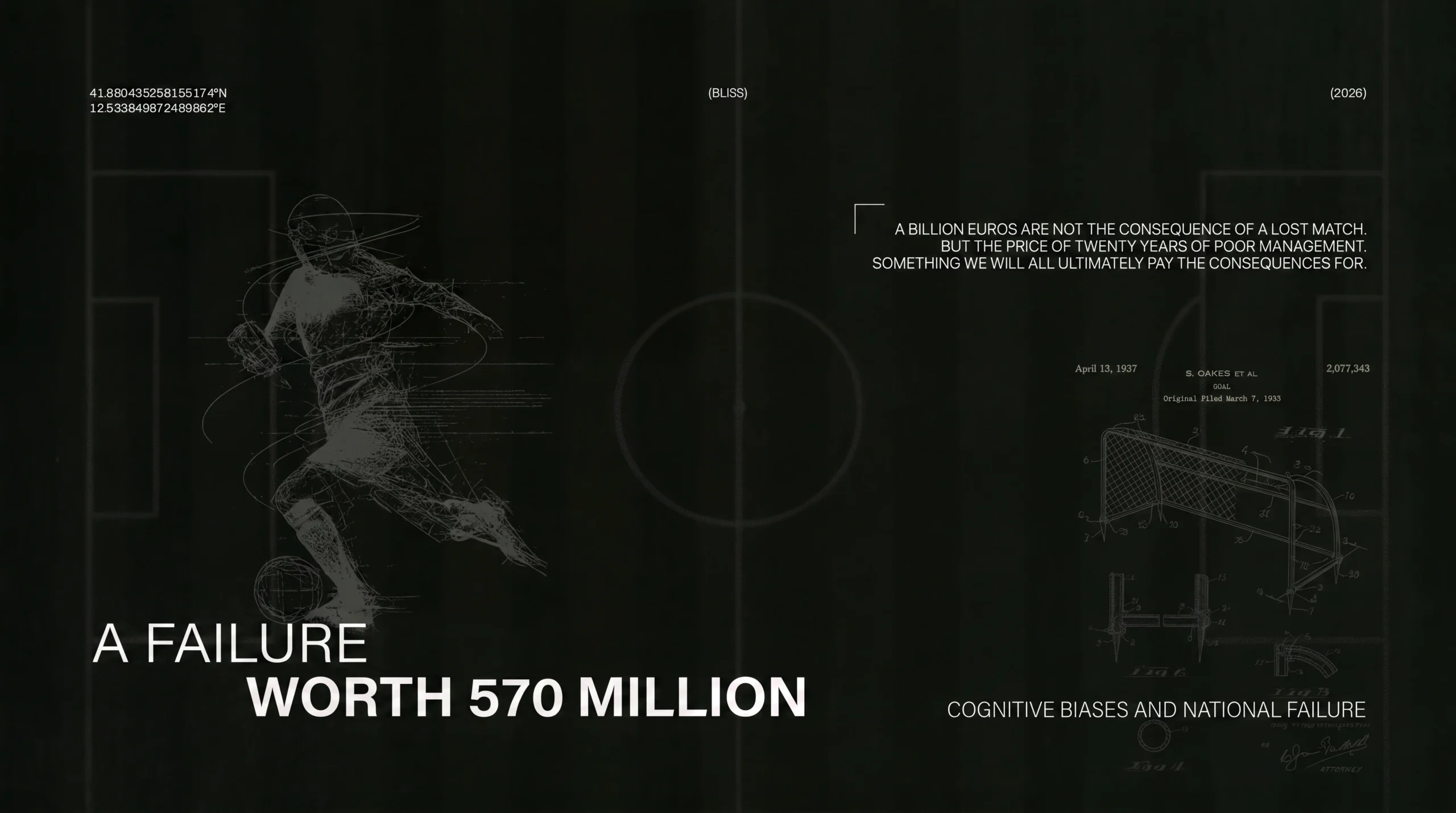
Tuesday night, while Cristante hit the crossbar and Bosnia celebrated, millions of Italians were doing the same thing. They were celebrating because they had found a culprit.
Gravina. Gattuso. The penalty takers. Bastoni’s foul. The federation. The agents. Foreign players in Serie A. The youth who don’t grow. The veterans who won’t step aside.
We are talking about a mechanism as old as humanity and neurologically inevitable. In jargon, it is defined as the fundamental attribution error: the tendency of the human brain to attribute negative events to personal and identifiable causes rather than to complex and invisible systems.
Our minds cannot handle a vacuum. Particularly a causal vacuum. If we don’t know who to blame, we find someone. We need a face. A name. Someone to point the finger at.
And it is exactly this need—understandable, human, and neurologically explainable—that prevents us from seeing what is really happening. Today, I am not talking to you about football, but about the management of uncomfortable information, governance, and error attribution. Because Italy’s failure to qualify for the World Cup tells us much more about ourselves and our psychology than it does about the state of Italian football.
The debt left behind by the national team
Stop for a second and look at the iceberg. Gattuso, the penalties, and the lost match are just the tip.
What is not seen when discussing the national team’s failure is the immense economic deficit that will follow the defeat against Bosnia. According to the Unimpresa Research Center, factoring in all effects, the lost revenue that the “Italy system” will accumulate due to the missed qualification will exceed 570 million euros.
The starting point is the FIGC, with direct losses exceeding 50 million euros, including a 9.5 million FIFA prize, 9.5 million in sponsor penalties, uncollected sporting bonuses, and failed merchandising and commercial agreements.
570 million. And this is only the beginning.
The most expensive bet
Even before Bosnia and Italy took the pitch, someone had already decided who would win.
The Italian television system is perhaps the most affected entity, and its situation is partly paradoxical: the rights had already been purchased before the playoffs, betting on the Azzurri’s qualification.
RAI had secured the free-to-air broadcast of 35 matches for over 100 million euros but included a clause allowing it to reduce the outlay to about 70 million in case of Italy’s absence. DAZN, on the other hand, invested between 35 and 50 million for all matches, banking on the event to drive subscriptions and summer growth.
RAI and DAZN had already opened their wallets before the match began. They had already built the schedules. Already sold the advertising space. Already made the subscription projections. Because for everyone—broadcasters, sponsors, bookmakers—Italy at the World Cup was a certainty.
Look at the odds that night: Bosnia was listed as a massive underdog. The market had already priced in Italy’s qualification. TV rights had been negotiated with that implicit premise. This was a grave cognitive and collective error on an industrial scale. Perceived certainty replaced real risk assessment, leading to a debacle.
Why the brain sees certainty where there is habit
This is where neurobiology comes into play. The human brain uses an evaluation system called the availability heuristic. It estimates the probability of an event based on how easily it can imagine or remember it, and acts accordingly.
Italy at the World Cup is a familiar, rooted, and automatic image. Four World Cups, generations of football lived as national identity. Even though our country has not participated in the most important competition for eight years, our minds are more oriented toward seeing it as a leader rather than an outsider.
The result? The brains of fans, TV executives, sponsors, and bookmakers processed the qualification non-objectively, finding probabilities well beyond the data. Habit neutralized the capacity for risk assessment, distorting reality.
This presumption did not just affect people at home, but also management and players. Italy entered this match as the heavy favorite. Players had even been criticized for celebrating the chance to face Bosnia instead of more fearsome teams, behaving with a sense of entitlement. It was a systemic error—a neurological bug shared by an entire country that stopped treating its own failure as useful information.
The damage no one is measuring
As mentioned, according to estimates by the Confcommercio Research Office, the total damage to the Italian productive system exceeds 500 million euros, distributed among lost consumption, postponed technological purchases, and losses for the FIGC.
Assuming an average of 9 million viewers for each of the three group stage matches, about 30 percent (2.7 million people) would have watched the games in bars, restaurants, and pubs. Over five hypothetical matches with an average spend of 25 euros per person, the lost revenue for commercial businesses is approximately 330 million euros.
330 million from bars alone. From those who would have ordered an extra beer, a plate of pasta, or a second round.
The sports betting sector will also suffer a significant backlash. Italy’s matches are where the highest volume of bets is concentrated. Without them, betting turnover drops significantly for the duration of the tournament, with an estimated loss of 15 million euros for platforms and a reduction in tax revenue for the State.
An Italy semifinal or final is worth, in advertising terms, as much as entire weeks of ordinary programming. And something harder to quantify is also lost: the ability to build a coherent schedule around a major event that drives ratings for weeks. We are talking about an economic system that built expectations, contracts, and budgets on a team that hadn’t qualified in twelve years—and yet continued to act as if qualification were a given.
What are we really talking about?
Not football. We are talking about how the human brain handles uncomfortable information. How an entire country ignored the signals that contradicted the expected model and continued to operate as if the world were what we wanted it to be.
We are talking about confirmation bias on a national scale: the tendency to seek confirmation of one’s own vision and downplay contrary evidence. Italy is strong. Italy is prestigious. Bosnia is small. It will be fine.
We are talking about deferred loss aversion: the pain of defeat is so unbearable that the brain processes it as an exceptional event (an accident, a crossbar, a referee) instead of the predictable outcome of a trajectory that has lasted for years.
And finally, we are talking about the most human mechanism of all: the scapegoat. Identifying a simple, visible, nameable cause (be it Gattuso, Bastoni, or Gravina) to avoid facing the complexity of a system that has deteriorated slowly and silently.
The real problem makes no noise
Serie A closed the 2025 financial year with a hole of over half a billion euros—a 531 million net loss. When decision-making processes are focused on short-term logic, every piece of content passes through long approvals that cause delays, making communications obsolete before they are even published.
Italian football did not lose on Tuesday night. It has been losing for the last twelve years: one compromise at a time, one qualifying cycle at a time, always with the consent of those who should have flagged the problem but didn’t.
This is the real iceberg. Not the coach. Not the penalties. It is the mechanism by which a system can produce signals of crisis for years while everyone operates as if those signals were exceptions rather than evidence.
The question this case study leaves us with
The brain is designed to see the superficial because it is visible—the match, the penalties, the manager’s name—immediate and emotionally accessible. It is designed not to see the profound—the trends, the systems, the trajectories—because they are abstract, diffuse, and lack a face to blame.
True competence, in sports as in business, is not the ability to react well when things go wrong, but to read the weak signals before they turn into 570 million euros in damages. That capacity requires the opposite of what the brain does naturally: to stop looking for a culprit and start reading the system.
This article was never really about football. Football was simply the most visible and emotionally accessible case study for a phenomenon that governs every complex organization: the human tendency to process crises by seeking a simple cause instead of reading a deeper dynamic.
Frequently Asked Questions
Do cognitive biases really influence important business decisions?
The more important the decisions, the more biases matter. Anchoring to the past, confirmation bias, and overconfidence act with greater force when the stakes are high. It is simply how the brain functions under pressure.
How can companies make better decisions and reduce bias?
By building processes that make biases visible before they take effect. This includes external advisors, objective data, and “pre-mortems” on decisions. Biases cannot be eliminated; instead, systems must be created to compensate for them. Awareness is not enough; structure is required.
Why are successful companies most at risk of bias?
Because success generates continuous confirmation. Every positive result reinforces the belief that the current method is correct. When the market changes, this mechanism delays the recognition of the problem—precisely when intervention is still possible.