


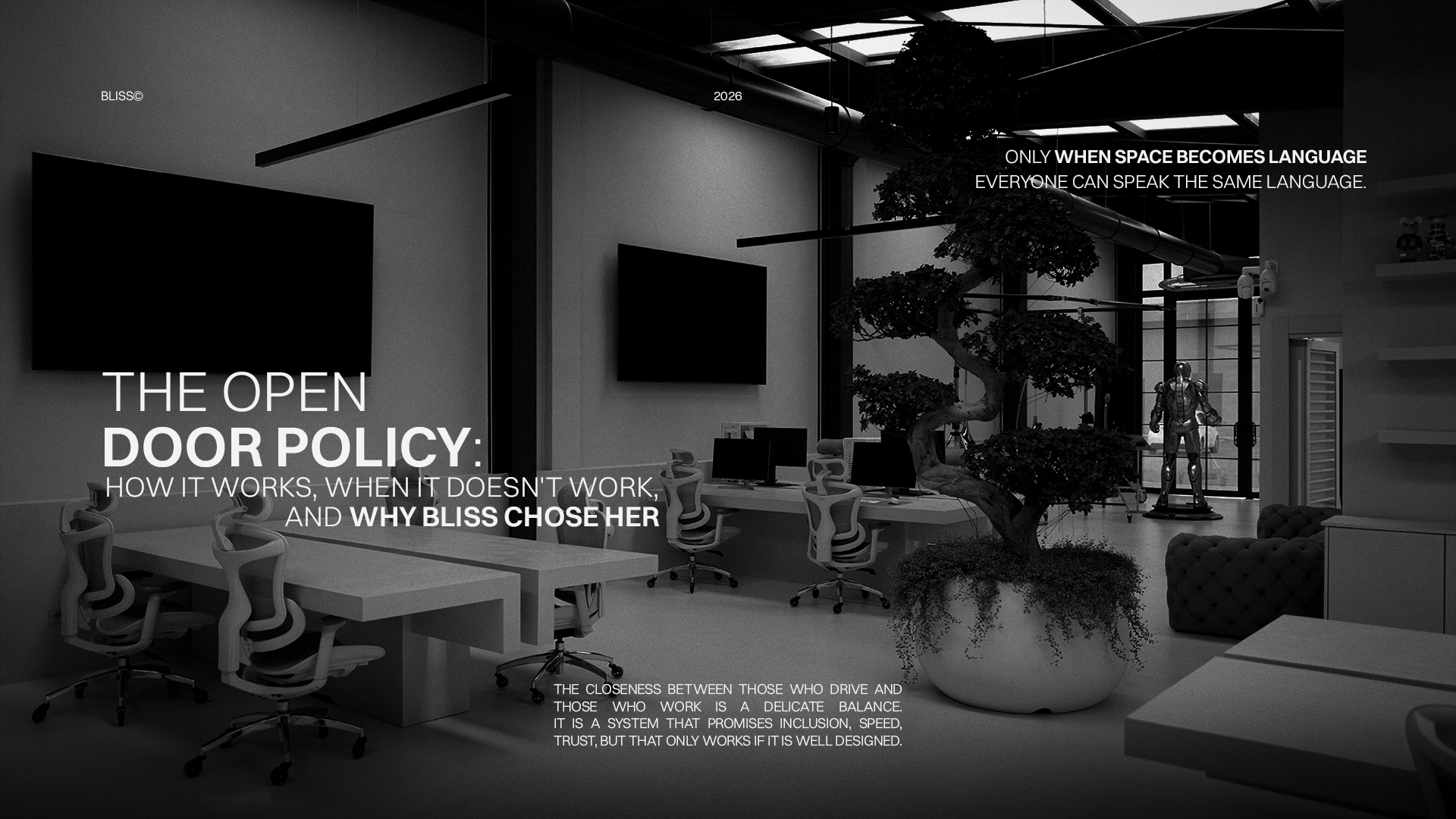
Try leaving the door open at the office. Actually, try knocking them all down. No walls, no barriers. Direct access to discussion, without distances. Now, tell me how it went for you, and if it worked.
The closeness between those who lead and those who work is a delicate balance. It is a system that promises inclusion, speed, and trust, but it only works if it is well designed. At Bliss, we chose the open-door policy, but not all organizations can apply it. Here is how we succeeded, and why intelligence (emotional and relational) is so important to achieve it.
Why I chose to tear down the doors
When a workplace is full of walls and barriers, it looks more like a labyrinth than a creative space.
Over the years, I have experienced firsthand the reality of those organizations where access to the top is mediated by layers of approval, and where talking to the CEO or a manager requires appointments (and months of waiting). Designed to protect decisions, that structure slows down processes. And so, real problems turn into perceived problems, and priorities become distorted. Over time, people stop reporting what isn’t working, and this is because the cost of doing so is too high compared to the benefit.
Organizational distance produces silence. And silence, in companies, is almost always an alarm bell.

Barriers in the brain
Neuropsychology speaks clearly. When people perceive they have direct access to decision-makers, cortisol levels drop. A study by the American Psychological Association found that employees who feel heard by their direct management show engagement levels up to 40% higher than those who perceive distance and inaccessibility.
But there is an even more relevant data point. Research on psychological safety (the concept made famous by Google’s Project Aristotle) has shown that the most predictive variable of a team’s performance is neither individual talent nor clarity of objectives. It is the perception that it is safe to take interpersonal risks: saying the wrong thing, asking questions, reporting a problem without fear of consequences.
The open door is, first and foremost, a signal of psychological safety. And psychological safety is the necessary condition for people to truly work, without limiting themselves to merely executing.
The hidden risk
And so, opening up spaces (both physically by eliminating doors and environments, and psychologically by inviting dialogue and discussion beyond hierarchies) brings great benefits to a corporate reality that makes decision-making its operational base.
Yet, there is one thing that is never said enough about this model. And that is that it works well only if the people who enter it bring two things with them. Emotional intelligence and structural respect.
We are not talking about the formal respect born of fear. The understanding that access is always a privilege and not an unlimited right is a fundamental component of this type of model. A condition that is, unfortunately, increasingly rare among new generations.
Without these two elements, the open door produces degeneration. Given an inch, people take a mile. Boundaries erode. The time of those who lead is taken up by requests that shouldn’t reach that level. And proximity, which was supposed to be a resource, turns into a source of conflict. I have seen it happen often. And the difference was entirely in the people operating within it, and in the clarity with which the model was explained and overseen.

How to tear down every door
The open-door policy is simply a different structure. Not an absence of structures, but a new structure.
Anyone can bring a real problem, a useful observation, or a legitimate question without getting lost in intricate channels. Information can flow freely, and those who work must be able to feel that their contribution has real weight in the system. For this to be possible, maturity is necessary. It requires the ability to distinguish what is worth direct access from what is not: and therefore, the ability to discern how to take up other people’s time.
Contrary to what is now often thought, true inclusion is not the absence of boundaries. If anything, it is having clear boundaries that everyone can understand. And that people respect by recognizing their sense.
What it produces, over time
When this model works, as it does for us at Bliss, it produces something that no traditional hierarchical system can replicate: real growth.
Through unfiltered information, skills hybridize: knowledge is exchanged quickly, efficiently, and productively. Solutions flourish, and from many perspectives, a single solution is reached. A unified vision.
The most effective organizations I know have made their spaces a tool and not just a place. And only when space becomes language can everyone speak the same language.
New Connections (FAQ)
Does the open-door policy really improve productivity or does it just create interruptions?
It depends on how it is built. Amy Edmondson has shown that the perception of access to management increases engagement by up to 40% and reduces turnover. But the same access, without clear operational rules, produces cognitive overload and micro-decisions that erode the strategic time of leaders. The open door works, therefore, when it is a system.
How do you create an inclusive work environment without losing authority as a leader?
By separating accessibility from unlimited availability. An inclusive leader is reachable on matters that count (vision, growth, real problems), while not being reachable for every operational micro-decision.
What to do when the open-door policy is abused by the team?
Reviewing the rules of the system is the only solution. Also because closing the door wouldn’t help. Abuse is almost always a symptom of unclear rules or rules that are not applied consistently. If the team takes a mile, it’s usually because they were never precisely told where the inch ends. The problem is the absence of a framework defining what deserves direct access and what should follow other channels.