


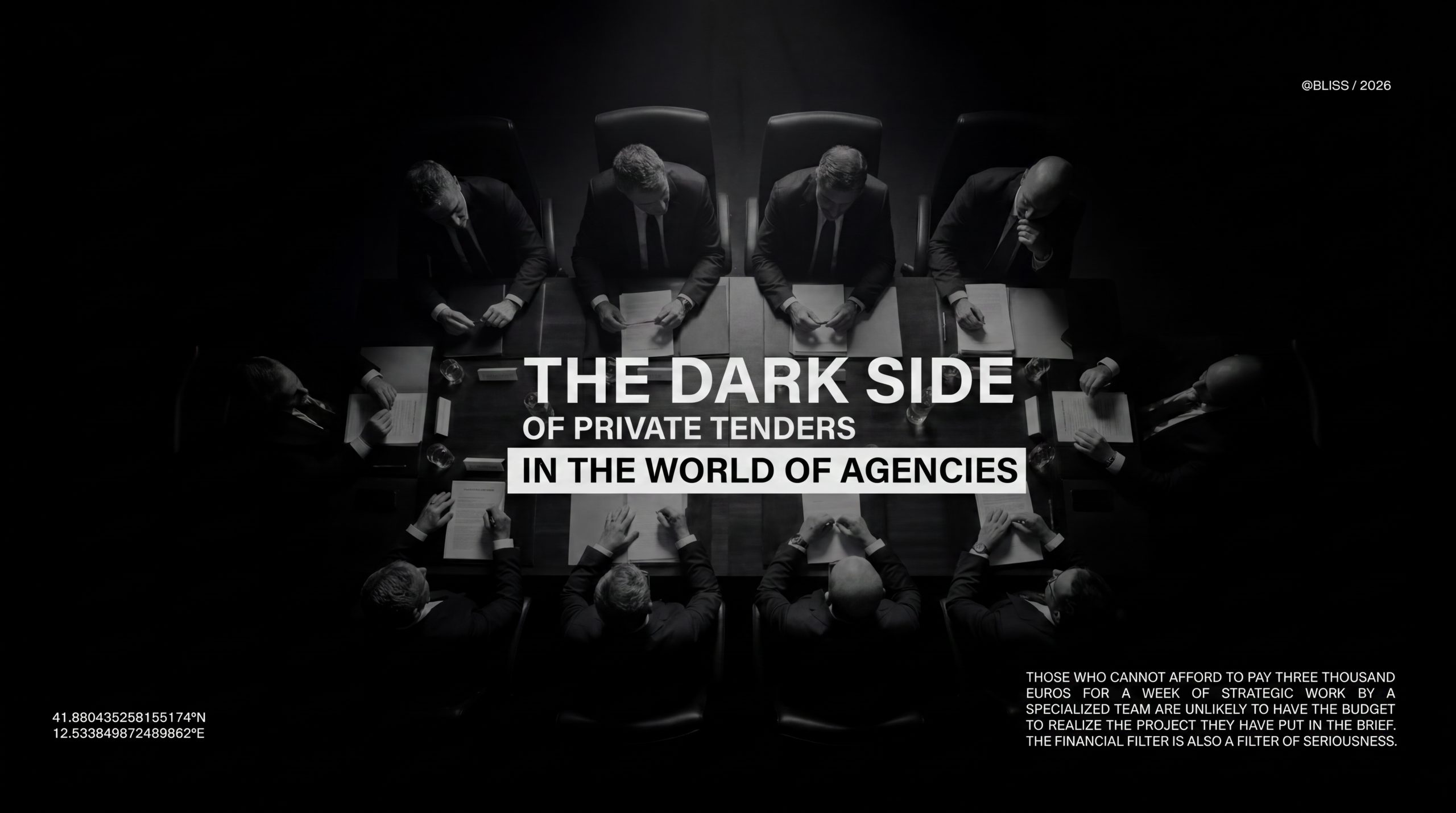
Because asking for work without paying for it doesn’t select the best. And in the end, the brand always pays the bill.
There is a practice that has been normalized in silence. And the silence is the problem.
It works like this: a company decides to look for a partner. It writes to five, six, ten agencies. It puts them in a pitch. It asks for an already built website, an already defined strategy, an already developed brand identity, an already established governance for international markets. Weeks of work, hours of research, brains in motion. And then, at the end of the process, it decides. The winner gets the contract. The loser gets nothing. Not even out-of-pocket expenses covered.
This phenomenon is called an unpaid pitch. And in recent years it has become so common that it seems normal. It is not.
When the brief becomes a lottery
There is a fundamental difference that many companies pretend not to see.
If you want to understand how an agency works, how it thinks, and how it moves, you can do so. You can ask for a meeting, look at past work, talk to clients who have already worked with them. You can ask for an approach, a vision, a direction. This is a legitimate selection process.
It doesn’t require the agency to work for free: it requires them to present themselves.
But if your brief says: I want to see the finished website, the ready strategy, the developed visual identity, then you are asking for work. And work, in every other sector in the world, is paid for.
No entrepreneur asks a lawyer to write the complete defense brief before signing the contract. No one asks an architect to deliver the executive project to evaluate whether to hire them. Yet in marketing, this logic has become an established practice, and those who endure it often accept it, because refusing means giving up the chance to win.
The result is a system that works exactly the opposite of how it should.
Reverse selection: why the free pitch selects the worst
Here lies the paradox that few companies stop to consider.
The company that launches an unpaid pitch is convinced it is making a meritocratic choice. Putting everyone on a level playing field. Selecting the best.
In reality, exactly the opposite happens.
Agencies with solid positioning, acquired clients, and a reputation built over time refuse unpaid pitches. They do it because they can afford to. Because they know their value isn’t proven for free. And because—this is the crucial point—those who work for free unconsciously signal to the client that their work isn’t worth enough to be paid for. The No Free Pitches Manifesto, signed by hundreds of agencies internationally, is the public formalization of this position.
Those who remain in the running are therefore those who lack this solidity. Those who need the contract. Those willing to do anything just to get in. Not out of bad faith, but out of necessity.
Necessity, however, is not an indicator of quality. On the contrary, it is an indicator of fragility.
The neurobiology of perceived value confirms this dynamic unequivocally: research by Stanford University has shown how the human brain assigns value to things in proportion to the effort or price paid to obtain them. The ventral striatum and the dopaminergic system (the brain structures linked to reward) activate with different intensity depending on the investment made. What comes for free is processed, literally, as less valuable.
It is not a moral judgment. It is a neurological mechanism.
Translated: when you choose the agency that accepted your unpaid pitch, your brain has already unconsciously decided that it is worth little. You have just poorly set the starting point of the entire relationship that will follow.
The ideas that disappear without a trace
There is a chapter of this story that is kept even quieter. Many companies use the ideas of the agencies they didn’t select.
Sometimes they do it consciously, commissioning a cheap supplier to execute a concept that came from someone else. Other times, no—maybe simply because an idea presented in a pitch settled in the mind of whoever saw it, and six months later resurfaced as their own.
BrewDog ended up in the spotlight for this. Its former agency publicly stated that the concept for a campaign had been presented in the pitch, rejected, and then executed by others without credit or compensation. It is not an isolated case. It is the tip of an iceberg that the industry knows well but rarely calls by name.
The 4A’s rule is explicit: a client has no ownership rights over ideas developed by an agency during an unpaid pitch. But enforcing this principle has a legal cost that most agencies cannot afford. So intellectual theft goes unpunished, and the system continues.
The company that uses other people’s ideas without paying for them is not saving money. It is building its strategy on orphaned foundations, without context, research, and a deep understanding of what lay beneath them.
And this shows sooner or later. Always.
The table where the decision-maker was absent
There is another element that those who have lived this process know well, and that is rarely put in writing.
The pitch is presented. The agencies work. Evaluation day arrives. And the CEO is not at the table. The CMO is not there. The person with the real weight of the decision is not there. There are middle-management employees, often disinterested, often without a clear mandate, often without the necessary vision to understand the difference between a deep strategy and a pretty presentation.
This is not a people problem. It is an incentive structure problem. Behavioral economics has precisely documented what happens when decision-makers have no skin in the game: without personal risk, the brain does not activate the deepest evaluation circuits and settles for superficial criteria: aesthetics, price, the likability of the presenter.
The result is a double defeat: the best agency loses because it wasn’t evaluated by someone who would have understood its value. The company loses because it chooses based on criteria that have nothing to do with what it really needs.
What public administration has understood, and the private sector ignores
There is a paradox worth naming openly.
Public administration is often described as slow, bureaucratic, and inefficient. Yet, in the way it manages tenders between suppliers, it respects rules that the private sector has never imposed on itself.
The new Italian Procurement Code (D.Lgs. 36/2023) explicitly introduces the principle of good faith, which obliges both parties to behave fairly. It establishes the obligation to communicate who won, how, and why. It guarantees unselected participants the right to appeal and to receive motivated feedback. It provides for independent supervision (ANAC) on the correctness of every procedure.
These are not obligations born by chance. They are the result of decades of abuse, opacity, and conflicts of interest that made formal regulation necessary. Transparency is not institutional courtesy. It is a protection tool for those who participate, for the market, and for those who commission.
The private sector does not have these obligations. It can invite ten agencies, ask for weeks of work, vanish in silence, and not have to answer to anyone. It is not illegal. But it has a cost, which is rarely accounted for. According to industry data, UK agencies lose on average tens of thousands of pounds a year just in unpaid pitches.
The final bill is always paid by the brand
The story always ends the same way.
The company saves on the pitch. It chooses the cheapest agency—or the most available one, which is not the same thing. It gets mediocre work. It replaces the agency after six months. It starts over. And in the meantime, it has burned time, budget, and slowly consumed the consistency of its brand.
The industry knows this well: the PR industry has openly discussed how the systematic free pitch is not just an ethical problem, but a mechanism that degrades the average quality of the market in the long run, discouraging the very best professionals from entering the competition.
The brand is not just the logo. It is every interaction that generates a perception. It is how a company relates to its suppliers, to those working to build it, to those participating in a pitch without being selected.
All of this is already brand. It is already a message. It is already reputation: built or destroyed, one interaction at a time.
And the reputation built within the agency market—the tight-knit one where information travels fast—is the same one that determines which partners will be available next time.
The best agencies don’t show up for pitches from certain clients. Not because they don’t need work. Because they already know how it will end.
The question that changes everything
It is not about choosing between paying or not paying for a pitch.
It is about deciding what kind of relationship you want to build with the people who will work for your brand. And understanding that that relationship begins long before signing the contract: it begins the moment you write the first brief and decide how to treat those who respond.
Those who govern a company’s decisions have the responsibility to bring this awareness to the table. Not as an abstract ethical issue. As a concrete strategic choice: the best market isn’t found by asking everyone to work for free. It is found by creating the conditions for the best to have an interest in showing up.
And these conditions have a price. Like everything that is truly worthwhile.
Frequently Asked Questions
Why does running a pitch to choose a marketing agency often lead to mistakes?
Because it selects those who know how to win pitches, not those who know how to produce results. Pitches optimize for the presentation, not for the real strategy. The brief never captures the complexities of the business, and the relationship established is strictly vendor-based.
How do you choose a brand advisory partner without pitches?
Through real case studies, preliminary strategic conversations, and small pilot projects. This approach reveals how a team thinks, not how it presents itself. The cost is lower, the signal is more reliable, and the risk of incompatibility is discovered before signing.
What is the true cost of a tender process for an agency?
Weeks of sunk-cost work, partially interpreted briefs, and relationships built on competition rather than collaboration. For agencies, participating in a pitch is a high-risk investment. For companies, on the other hand, it is often the slowest way to find the wrong partner.