


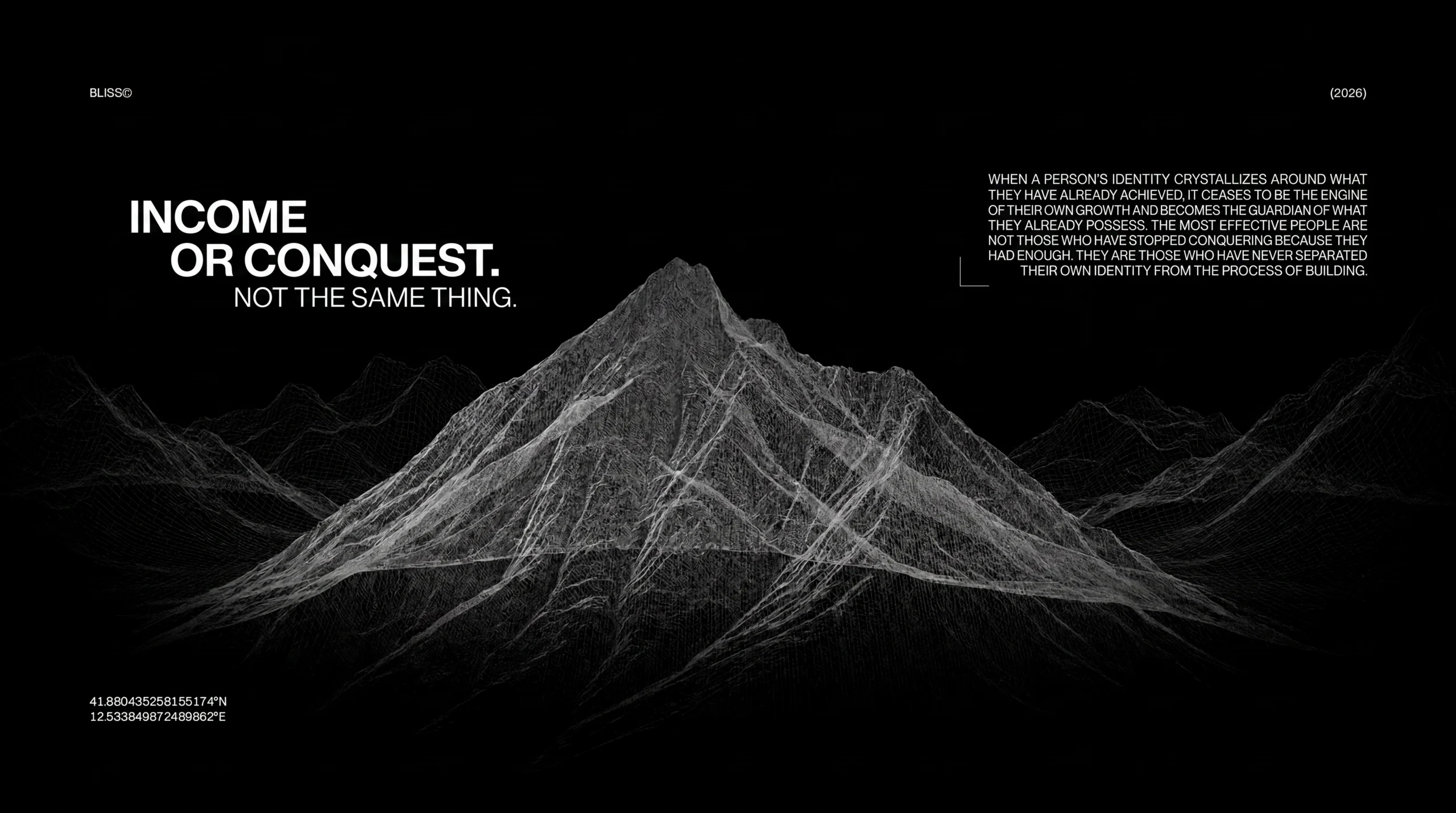
There is a distinction we have stopped making. We talk about passive income as if it were the ultimate finish line. The moment you stop running and let the system work for you. The stated goal of an entire generation. And yes, there is a part of this narrative that is true: building assets that generate value over time is real economic intelligence.
The problem isn’t the income itself, but when the income becomes your identity. When you stop asking yourself what you are building and just start counting what comes in. Right there, in that moment, something breaks.
Where value comes from
Conquest is something that did not exist before and exists afterward because someone decided to make it exist. Rent is the fruit of something that already exists, and which continues to produce because, at a previous moment, someone had conquered something solid enough to withstand time.
The question few people ask is: how long does that solidity last without new conquest?
What the brain registers
The dopaminergic system does not simply respond to reward. It responds to reward in relation to the effort invested to obtain it. NIH research published in Science in 2020 demonstrated that higher levels of dopamine in the caudate nucleus increase the willingness to choose difficult tasks: because the brain calculates that the benefit justifies the cost. When that calculation fails, when the result arrives regardless of the effort, the system becomes dysregulated.
It doesn’t shut down suddenly. It slowly atrophies. Like a muscle that stops being used.
Those who live solely on rent, over time, lose something harder to quantify than money: they lose the ability to tolerate uncertainty, to manage risk, to find motivation where there are no guarantees. The brain adapts to the environment we build around it. An environment without effort produces, over time, a brain less capable of effort.
The paradox no one talks about
The most powerful rents always come from previous conquests. Netflix is not a rent: it is a continuous conquest, year after year, in changing markets and against growing competitors. Rents from real estate seem like passive income, but behind them lay the conquest of capital, market decisions, and the risk at the moment of purchase.
Pure rent (the kind that requires no oversight, attention, or updating) erodes value over time faster than it preserves it. Markets move. Technologies change. Those who stand still, even in a solid position, are already moving backward.
Conquest is not an event. It is a permanent attitude toward reality.
The athlete who has already won
Think of a champion at the moment of victory. They possess something real: a title, a reputation, a level of recognition. They could stop and live off that rent. Some do.
But the body adapts. Conditioning decays. The skills that produced the victory diminish, not because they have disappeared, but because they are no longer exercised. That rent is still valid, but they would no longer be able to win it back if it were taken away.
Those who continue to conquer (even having already won), on the other hand, do not do so out of economic need. They do it because they have understood that conquest is not the means to arrive at rent. It is the method to remain capable of facing whatever comes next.
Who are you when you stop building?
Robert Dilts’ Neurological Levels model describes how identity, the deepest level of who we are, conditions everything else: beliefs, capabilities, behaviors, results. An identity built on “I am someone who has built” is radically different from “I am someone who builds.”
The first is in the past tense. The second is in the present continuous.
When a person’s identity crystallizes around what they have already achieved (wealth, title, position), they stop being the engine of their own growth and become the custodian of what they already possess. It is a subtle difference at first. It becomes enormous over time.
The most effective people are not those who stopped conquering because they had enough. They are those who never separated their identity from the process of building.
The right question
For all these reasons, the right question is not: “How much does what I’ve built yield?” But, on the contrary: “What am I building now, and what will I be able to build in five years?”
Rent is the natural consequence of a well-executed conquest. It cannot be the goal. Because a goal that, once reached, stops requiring effort, also stops producing growth. And a system (personal, corporate, economic) that stops growing does not remain stable.
It begins, silently, to decline.
Frequently Asked Questions (FAQ)
Why does a brand that stops investing in itself lose value even if the numbers hold up?
Brand equity is a perishable asset that deteriorates if it is not nourished. Balance sheet numbers measure the present; the position in the consumer’s mind measures the future. A brand that does not actively guard its positioning cedes mental space to competitors without this appearing on any Excel spreadsheet. When the deterioration becomes visible in sales, it usually has a years-long head start.
What is the difference between managing a company and building an asset?
Managing means optimizing what exists. Building an asset means creating something that produces value independently of the founder’s presence and market contingencies. The difference is measured in valuation multiples: a managed company is worth its cash flows. A brand with precise positioning, recognizability, and structured loyalty is worth much more.
How is the brand used to enter new markets without lowering the price?
By building topical authority before expanding. A brand perceived as a reference in one category is welcomed into adjacent ones with a trust advantage that reduces acquisition costs and protects margins. Entry by authority is different from entry by price: the first scales, the second erodes.
How do you transform a defensive corporate culture into a growth-oriented one?
By changing what is rewarded. A defensive culture rewards those who make no mistakes; a conquest-oriented culture rewards those who generate new value. The shift is structural even before it is motivational: it requires governance systems that make calculated risk possible, goals that include the creation of new value, and leadership that proves with actions that exploration is worth more than preservation.