


There is a phrase that never stops circulating.
Sergio Marchionne said it on July 9, 2013, before the workers of the Sevel plant in Atessa. He repeated it at Bocconi University. He wrote it, he spoke it, he embodied it. And when he died in 2018, that phrase went around the world for a second time—as if the collective mourning had finally made room for an idea that, when he was alive, seemed uncomfortable, and when he was gone, seemed prophetic.
“Let me say that rights are sacrosanct and must be protected. But if we continue to live only of rights, of rights we will die.”
It was not a provocation. It was a diagnosis.
Where the Problem Originates
Marchionne was not contesting rights per se. He was describing a distortion that had consolidated slowly, generation after generation, until it became structural.
The starting point was 1968. A movement—in his words—”fully agreeable, which allowed us to make enormous strides in social and civil achievements.” But which had, paradoxically, “a devastating effect on the attitude towards duty.”
This is not a political judgment. It is a cultural trajectory. Every great achievement carries a risk within it: that of crystallizing into possession, of ceasing to be the result of a process and becoming a precondition. The right to a permanent job, to a guaranteed wage, to work close to home. All legitimate, all protectable. But all of them, the moment they are separated from the duties that make them sustainable, transform an achievement into a rent. And rents, over time, are consumed.
“This evolution of the species,” Marchionne used to say, “creates a generation much weaker than the previous one. Without the courage to fight. With the hope that someone else will do something. A kind of wait-and-see attitude that is perverse and involutive.”
What Neurobiology Has Always Known
The point is that Marchionne was describing, using the language of an entrepreneur, something that neuroscience and evolutionary biology have documented precisely for decades.
The human brain is built on reciprocity. Not as an abstract value—as a concrete neurological architecture. Oxytocin, the neuropeptide often called the “social bonding hormone,” does not simply activate when we receive something. It activates in response to reciprocal exchange. Research published in the Journal of Neuroscience has demonstrated that oxytocin facilitates the propagation of cooperation in social networks precisely through the mechanism of reciprocity: those who receive trust tend to reciprocate trust, triggering a cooperative cascade that expands from the individual to the group.
But this mechanism has a condition: it must be reciprocal. When cooperation becomes unidirectional—when someone systematically receives without giving back—the system jams. Oxytocin levels drop. Trust retreats. Cooperation shrinks. And the social fabric, which seemed solid, begins to silently unravel from the inside.
Neurobiology calls this “free riding”—riding the benefits of the collective system without contributing to it. Studies on fairness in social decisions confirm that the perception of an imbalance in giving and receiving activates neural aversion responses even in those not directly involved. The wait-and-see attitude, in short, does not only damage those on the receiving end. It corrodes the foundations that made possible the rights that seemed acquired forever.
The Right That Eats the Duty, and Then Itself
There is an analogy that clarifies the mechanism better than any theory.
Imagine an ecosystem. Every species has rights—the right to food, space, reproduction. But every species also has implicit duties: to contribute to the equilibrium of the system that feeds it. A species that takes without giving back does not dominate the ecosystem. It exhausts it. And when the ecosystem collapses, the species collapses with it.
Rights without duties work exactly like this. They are not unsustainable because they are inherently wrong—but because they feed on a substrate that does not regenerate automatically. That substrate is the collective contribution: the work, the commitment, the willingness to give before receiving. When that contribution stops flowing, rights do not disappear immediately. They are hollowed out. They become promises that no one can keep anymore.
“To have, you must also give,” Marchionne used to say.
Not as a moral imperative. As a description of a mechanism. As a law of how systems function.
Duty is Not the Opposite of Right. It is Its Condition.
Here lies the point that is often misunderstood—and that turns this conversation into an ideological trap from which it is difficult to escape.
Those who speak of duties are often interpreted as those who want to reduce rights. As if it were a zero-sum game: more duties, fewer rights. But the mechanism is the exact opposite. Duties do not compete with rights. They make them possible. They finance them. They defend them over time. A right that has no duties to support it is like a structure without a foundation: it holds up until the first pressure arrives, and then it collapses on those who had taken refuge inside.
Robert Dilts’ model of neurological levels describes this as a problem of alignment between identity and behavior. A person who defines themselves only through what is owed to them has built their identity on an external element, outside their control.
An identity built on what others must give you is by definition fragile. An identity built instead on contribution—on what you are capable of giving, doing, building—is rooted in something internal, stable, not revocable from the outside. Paradoxically, it is also the one that generates the most rights over time: because those who contribute create value, and the value created justifies and produces recognition.
The Wait-and-See Attitude as an Unconscious Choice, and Its Consequences
But why does the wait-and-see attitude spread? Why does “the hope that someone else will do something” become such a pervasive pattern?
The answer is neurological before it is moral. The human brain is optimized to minimize effort for the same result. This is not a flaw—it is an evolutionary efficiency. The problem arises when the incentive system is distorted: when effort is punished or ignored, while non-effort is rewarded with the same guarantees.
At that moment, the brain—which is not stupid—quickly learns that the cost of commitment is not justified by the differential benefit. And it stops committing.
Not out of laziness. Out of rational adaptation to a poorly designed environment.
This is the mechanism that Marchionne was dismantling when he clashed with systems that protected jobs regardless of performance, with contracts that guaranteed wages regardless of contribution. He was not against the workers. He was against a system that was training workers for helplessness.
“The interests of the workers are not served,” he said in 2013, “by defending an industrial relations system that is incapable of guaranteeing that the agreements stipulated are actually applied.”
The Equilibrium That Keeps Everything Alive
Rights and duties are not two opposing forces. They are two sides of the same coin that keep each other alive. A right without a duty is a promise that no one can keep. A duty without a right is exploitation.
Communities that have prospered over time—civilizations, organizations, families—are not those that have maximized rights or those that have maximized duties. They are the ones that have found and maintained a dynamic equilibrium between the two.
“We must rediscover the meaning and dignity of commitment.”
Not sacrifice. Not renunciation. Commitment. That thing you do not because you are forced to, but because you understand that your contribution is the condition for your right to the future.
The Question That Matters
The question Marchionne left us is not, “How many rights do I have?” It is: “What am I doing so that those rights will still exist tomorrow?”
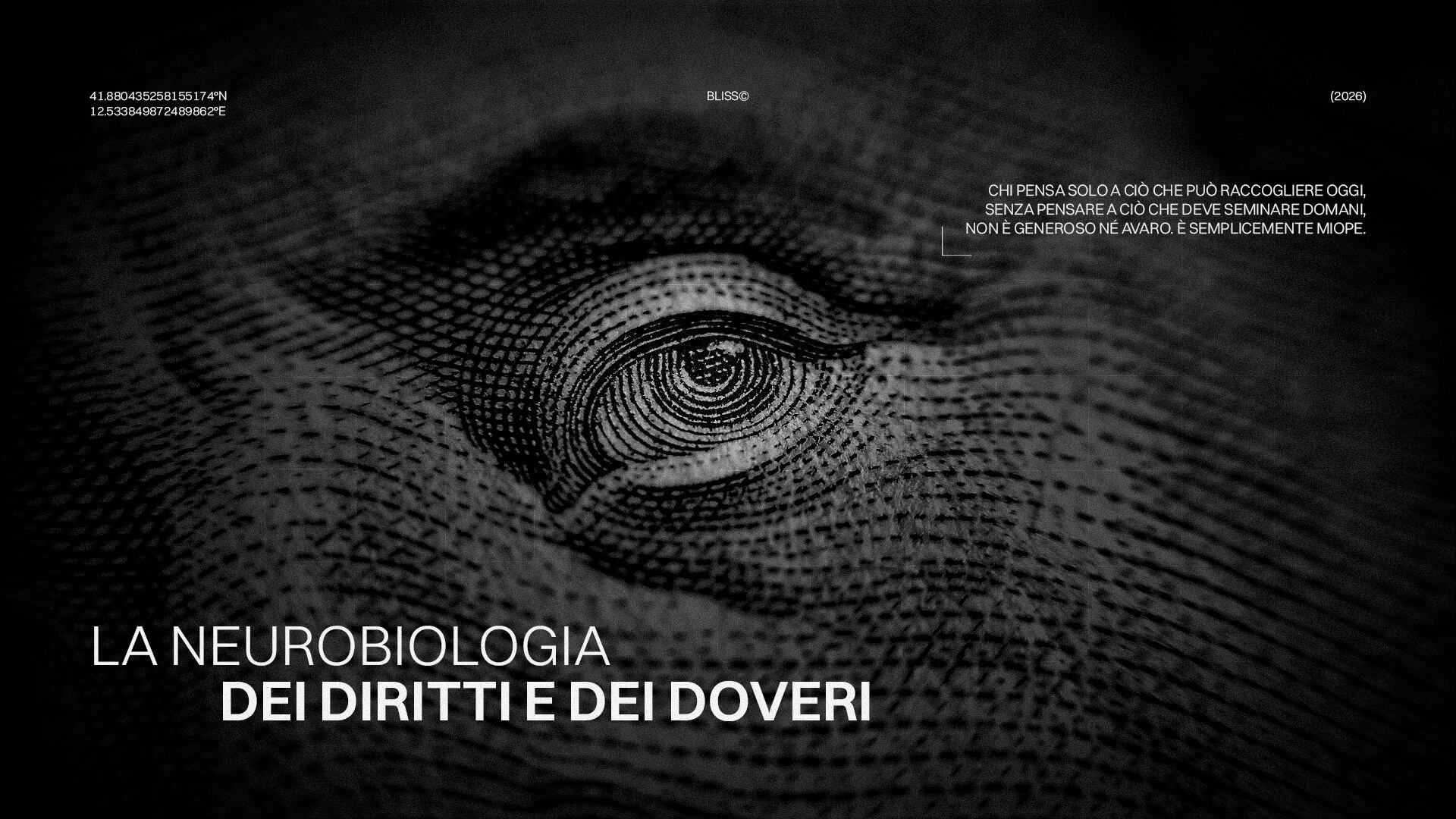
Not out of guilt. Not out of moralism. For the exact same reason a farmer does not harvest the entire crop and leaves a part for the next year. Not out of generosity—for survival. Because those who think only of what they can harvest today, without thinking of what they must sow tomorrow, are neither generous nor greedy. They are simply short-sighted.
And short-sightedness, in societies as in organizations, is always paid for. Usually much later than when it would have been possible to correct it. And usually by those who had not chosen that short-sightedness.