


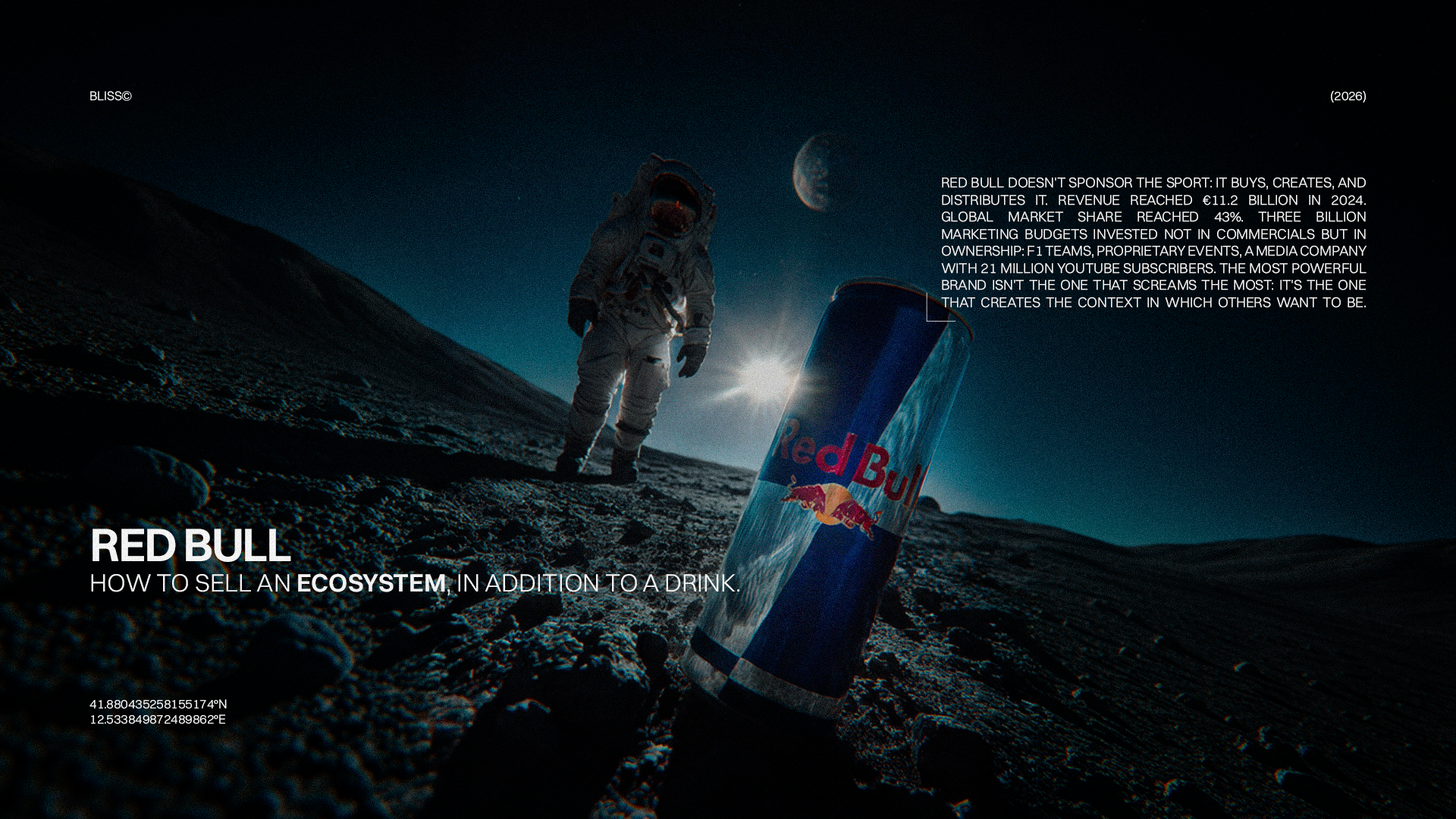
The question might seem obvious, yet the answer is not. In fact, it might be that it is no longer entirely one or the other. Red Bull is now an ecosystem. At its core, it includes soccer teams, racing cars, global events, a media house, and ventures. And beverages, of course. Beverages too…
Understanding how this system works, why it was built, and how it can help brands and consumers better understand the market and its strategies is one of the most useful exercises one can undertake. For this reason, we at Bliss have analyzed its entire ecosystem: the numbers, the neuroscience, and the logic behind this massive world that is Red Bull.
The Numbers That Tell the Structure
In 2024, Red Bull recorded revenues of €11.2 billion, selling 12.7 billion cans across 178 countries. Its global market share in the energy drink segment stands at 43%. The brand’s value exceeds $20 billion. The marketing budget hovers around €3 billion annually, equal to 25-30% of its revenue. This is a percentage unmatched by any other major consumer brand in the world.
But the figure alone tells us nothing, because what truly matters is how it is distributed. Not in television commercials. Not in traditional digital campaigns.
In ownership.
The Logic of Acquisition: Buying the Sport
In 2004, Red Bull bought the Jaguar Formula 1 team for one dollar, plus approximately $400 million in operating costs assumed over the following three years. It was a move that many in the industry judged as sheer madness at the time. A beverage manufacturer buying a loss-making Formula 1 team, in a championship where operating budgets were (and are) among the highest in global sports, sounded almost suicidal. Yet Red Bull’s logic was simple, and at that moment, no one had understood it.
Until then, sponsorship was the only way to enter a sports sector. However, sponsoring a team meant buying space on someone else’s engine cover; depending on the results of an external driver. It meant having no control over the narrative.
Owning a team is the exact opposite. Every race, every technical update, every victory or defeat is about Red Bull. The brand doesn’t profit indirectly: it doesn’t benefit from someone else’s success. It directly receives all the credit. And merit after merit, its credibility grows. Formula 1 broadcasts in 180 countries, reaching over 445 million viewers. Every race weekend, for 24 weekends a year, the Red Bull brand is at the center of that audience’s attention. As a protagonist.
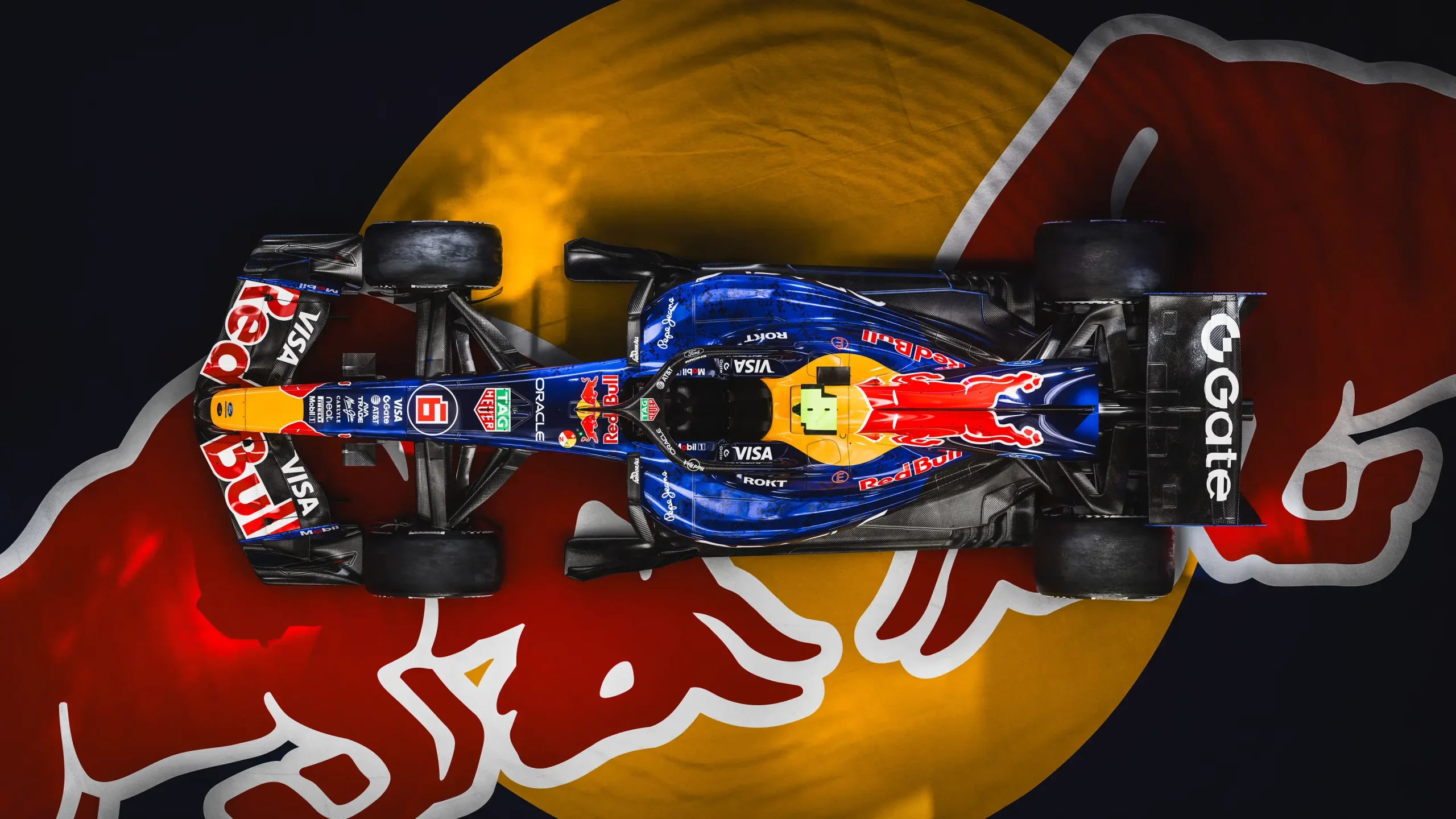
Today, Red Bull manages two Formula 1 teams: Red Bull Racing and Racing Bulls. The former has won six Constructors’ titles and multiple drivers’ championships with Sebastian Vettel and Max Verstappen. From failure to success, validating the narrative of that famous promise: “Gives You Wings.”
And so, the message that comes across is: if our energy can help a disastrous team win the F1 world championship, what can it give you every day? Not a direct claim, but a subtle, almost subliminal one. And certainly, a successful one.
The Red Bull Ecosystem: Sports, Media, Athletes, Events
From that moment on, Red Bull never stopped. Its sports ecosystem today includes over 750 athletes in 73 countries, soccer clubs on four continents (RB Leipzig, FC Red Bull Salzburg, New York Red Bulls, Red Bull Bragantino), a racing circuit, and proprietary extreme sports events that the brand creates, such as Red Bull Cliff Diving, Red Bull Rampage, Red Bull Air Race, Red Bull Flugtag, and many others.
Once again, the principle remains the same: when a brand sponsors an event, it is a guest. But if a brand creates an event, it is the host. It decides the rules, the narrative, and the values to transmit. It is the brand that owns the content.
In 2007, Red Bull formalized this logic by founding the Red Bull Media House: a content production division that makes films, documentaries, live coverage, and programs. Red Bull’s YouTube channel has surpassed 21 million subscribers. The Red Bulletin magazine reaches 7 million readers. The content licensing system generates approximately $2.5 billion in revenue. Red Bull Media House is a media company that generates independent profit, going well beyond the role of a PR office. The content it produces is the purest experience the audience has with the brand. And the can benefits from it.

The Stratos Case: The Content is the Product
On October 14, 2012, Felix Baumgartner jumped from a capsule at an altitude of 128,000 feet (almost 39 kilometers above the Earth’s surface) in a free fall until he landed in the New Mexico desert. The event, called Red Bull Stratos, reached approximately one billion views.
No $100 million commercial has ever generated that kind of coverage. No traditional campaign has ever produced such a volume of earned media. Despite this, the most interesting aspect of the campaign is the association. Baumgartner jumping from the stratosphere says nothing about the can: Red Bull doesn’t even try to advertise itself. If anything, it communicates only one thing: that this brand is associated with the human ability to push past limits. Physically, without metaphors. An association that is worth billions. And that no traditional advertising could ever bring.

The Psychology of the System: Why Red Bull Leverages Our Brains
The Red Bull model triggers a psychological mechanism that classic advertising cannot replicate. While traditional advertising is recognizable as such and activates automatic cognitive defenses in the consumer’s brain, Red Bull content is often not even recognized as advertising. On the contrary, it is sought out, shared, and watched by choice.
A Red Bull Rampage video is an extreme mountain biking video that just happens to have been produced by Red Bull. How could cognitive defenses activate if there is nothing to defend against?
The result is an association between the brand and adrenaline, between excellence and extreme performance, between courage and the logo.
And this process embeds itself in the consumer’s emotional system without encountering resistance. So that every time they encounter a red and blue can, the association is reactivated in a visceral way.

What the Red Bull Ecosystem Teaches Us
Red Bull proves that the most powerful brands are often those that know how to create a context. Many entities sponsor events created by others. Red Bull doesn’t: it has built its own spaces. Accepting, at most, to rent them out to others.
Even if the can that “gives you wings” remains the product, the brand’s intention is to go beyond a simple commodity. By creating an ecosystem, Red Bull made the ecosystem itself its competitive barrier. After all, an ingredient can be copied, as can a claim or a format. But decades of authentic content, Formula 1 victories, athletes who built their careers inside the Red Bull system, and adrenaline… That cannot be copied.
This is why, after almost forty years, the red and blue can continues to be worth more than the others. Because in the collective imagination, it will always be worth something different.