


Moving always brings many emotions with it. Some of these are positive, sweet, exciting. Others are more melancholic or fearful.
Yet, whatever the reason for changing homes, or moving from one office to another, there is something that remains. And what remains is the feeling you get after spending hours looking at instructions, tightening screws, taking apart and putting together the same panel six times—the emotion you feel standing there, hands on your hips, looking at the piece of furniture you just assembled. Precise, perfect. Assembled.
Nothing can match that feeling. And the reason is that that piece of furniture is now yours. Maybe you didn’t create it, or design it: but you assembled it, you put it on its feet. Now it is your furniture. And this makes it special. And it is a feeling that no other product, outside of IKEA, will ever be able to create.
Not out of sentimentality. It is neurobiology. And someone gave a specific name to this mechanism. We are talking about the IKEA Effect.
The study that changed marketing
In 2012, three behavioral researchers (Michael Norton of Harvard Business School, Daniel Mochon of Tulane, and Dan Ariely of Duke) published a study destined to become a benchmark in marketing and consumer psychology. The title was direct: “The IKEA Effect: When Labor Leads to Love”.

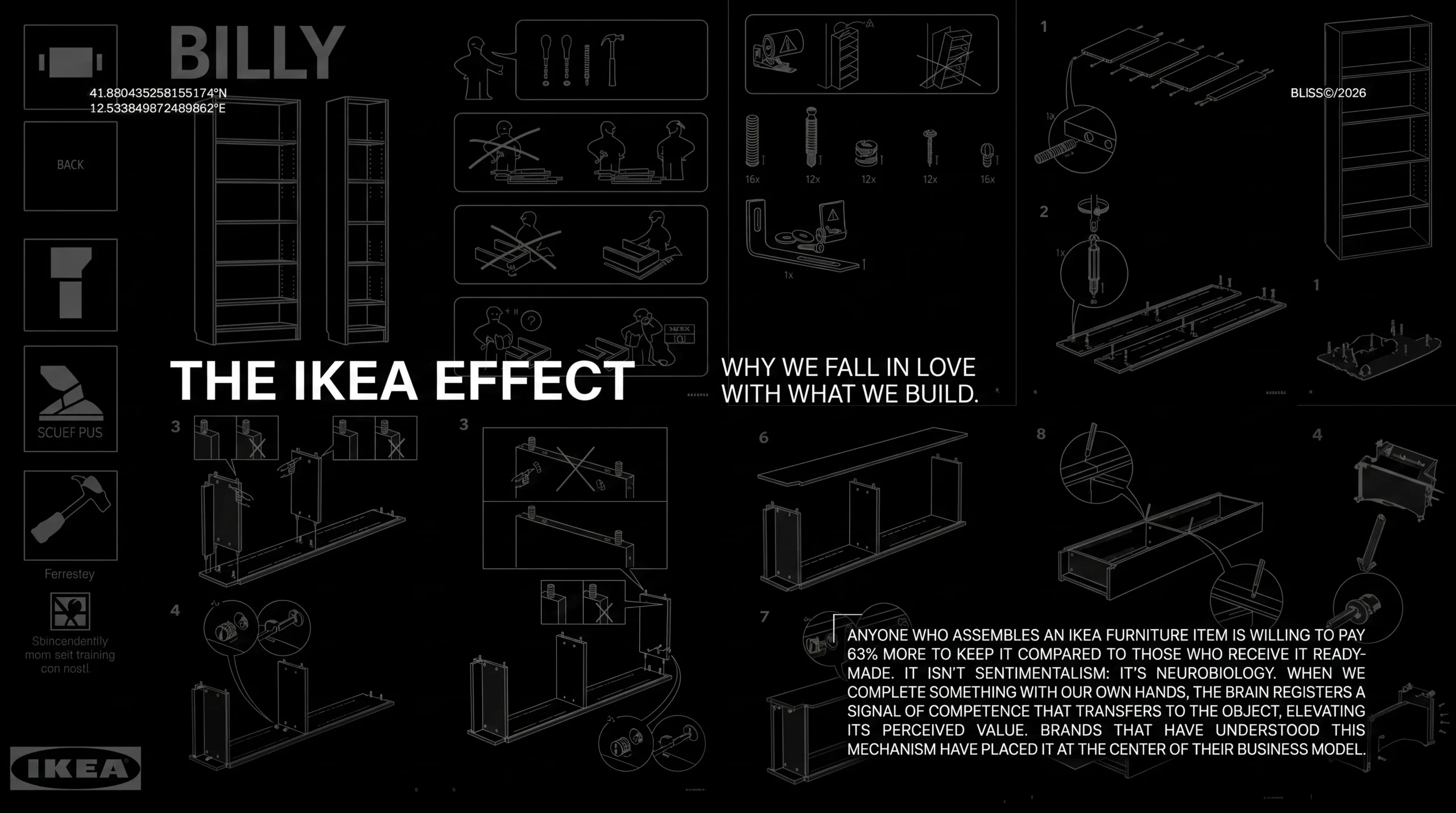
The experiment was simple. One group of participants was asked to assemble a standard IKEA piece of furniture. Another was given the exact same piece of furniture already assembled. Then, both were asked how much they would be willing to pay to keep it. The result? Those who had assembled the furniture offered 63% more than those who had received it ready-made. The object, however, was the same: identical in every way.
The experiment was replicated with origami and Lego sets. The result was always the same: people valued their creations (both the imperfect ones and those made by following the instructions to the letter) as if they were works by experts. Obviously, they expected others to see them the same way.
Norton and his colleagues identified the underlying mechanism of this process in effectance: the fundamental human need to produce tangible results in one’s environment. When we successfully complete a task, the brain registers a signal of competence. And that competence transfers to the created object, elevating its perceived value. However, this effect only applies when the task is completed. As soon as participants disassembled their creations, the perceived value plummeted.
The three psychological mechanisms working together
The IKEA Effect is not, however, the product of a single cognitive process. InsideBE summarized the research, identifying three mechanisms working in parallel:
- Effort justification. The brain needs to believe that the effort was worth it. When we invest time and energy into something, we automatically increase the value we attribute to that object to retroactively justify the investment. It is a form of cognitive consistency: we cannot believe we wasted an hour on something of little value.
- Endowment effect. Once an object is “ours” (even if only because we touched and worked on it), the brain values it more. Ownership generates attachment. And attachment distorts evaluation.
- Need for competence. Successfully completing a task activates the brain’s reward system. That feeling of having “figured out how to do it” binds to the produced object, which becomes the tangible symbol of one’s ability.
Three distinct mechanisms. One single result.

Betty Crocker’s flour: the case that anticipated it all
Before Norton, Mochon, and Ariely gave the phenomenon a name, the market had already learned how it worked.
In the 1950s, General Mills launched a line of completely instant Betty Crocker cake mixes: just add water. The product was technically flawless, but sales were a disaster. According to researchers, American housewives felt guilty baking that way. The cake was simply too easy to make. It required nothing. And an object that requires nothing gives no satisfaction.
The solution was counterintuitive: remove the powdered egg from the mix and ask consumers to add a fresh egg. A minimal change, no practical difference in the result. But just the small action of cracking an egg and mixing it in was enough to make the cake feel like something that had been achieved. Sales recovered.
The brands that applied the effect most intelligently
Obviously, IKEA didn’t invent this principle: it simply put it at the center of its business model. And so, in large IKEA stores, you don’t just receive the product to assemble: you have to search for it yourself in the massive facility, navigating the shelves to find a door here, a hinge there, and so on. Many small actions that any other business would have automated to make the job easier for the customer, but which IKEA instead chose to complicate, to arouse effectance.
Today, other brands also apply similar principles. Nike By You, for example, is Nike’s online customization program, allowing customers to choose colors, materials, and details of their shoes. It generates margins 30% higher than standard shoes, despite the customer’s physical contribution being minimal. In that case, it is not the effort that activates the effect, but the participation in the creation.
Build-A-Bear is another perfect example, applied to the toy market. Customers choose the bear’s casing, insert the heart, choose the clothes. By doing so, a standard plush toy is transformed into something that was, literally, assembled with their own hands. The price goes up, but the perceived value goes up even more. With attachment following closely behind…
HelloFresh and meal kits are a rapidly growing industry. True, you could buy the same ingredients separately, and it would cost less. But receiving the box, following the recipe, and assembling the dish produce a feeling that a ready-made meal would never give. Researchers confirm this: even a modest effort in preparation significantly increases food appreciation.
And then we have Minecraft, perhaps the most radical example. A game built entirely on the IKEA Effect, with no story, no predefined goals, no levels to climb. Only, and solely, construction. But those constructions (often modest when compared to those of professional designers) are viscerally defended by those who made them.

The sectors where the effect applies today
Obviously, this principle is not limited to the physical realm. There are also other sectors or fields where the IKEA Effect arouses appreciation and shapes perception.
The most obvious is the field of software and configurable dashboards. After all, whoever spends time customizing their interface always develops a greater attachment to it.
However, this principle is also true in education and learning. Experiencing theoretical concepts through practice or problem-solving exercises improves memory, cognitive processes, and attachment to concepts. Experts speak of learning by doing: a mechanism more resistant to time compared to traditional theoretical study.
Even in brand advisory and strategic consulting, practice helps. When a client is involved in the building process, the result is not only more adherent to their needs but is also better defended and more valued. Participation generates psychological ownership even before contractual ownership.
Starting, yes, but finishing above all
The effect described by Norton and his colleagues is activated, as seen, only when the task is successfully completed. If the furniture cannot be assembled, if the cake does not rise, if the software is not put online, the result is reversed. The effort not only does not produce attachment. It creates resentment.
Not all businesses can, like IKEA, rely on effectance. There are sectors that can afford it, and sectors where the basic logics are different. When this principle is applied, however, it is important that brands calibrate the process so as to make it challenging enough to generate satisfaction, but guided enough to guarantee its completion.
IKEA invests in the clarity of its instructions precisely for this reason. Not out of politeness: simply to ensure that the effect is activated. The line is thin. But it is the difference between a customer who loves what they have built and one who never buys again.
Frequently Asked Questions (FAQ)
Why does IKEA make its customers assemble its products?
Because the physical or mental contribution to building something activates an affective evaluation higher than the objective value of the product. The brain associates the effort made with the competence demonstrated: and so, the object becomes proof. This mechanism, documented by Norton, Mochon, and Ariely in 2012, increases the willingness to pay and drastically reduces the probability of abandonment.
Does customer involvement also work in digital services?
It works especially there. Every moment the user molds the tool to their own needs creates a sense of digital ownership. The more the system reflects the user’s choices, the less inclined they will be to migrate to a standard alternative.
How is the IKEA Effect used to increase long-term brand loyalty?
By designing co-creation moments distributed over time, not just concentrated on the initial purchase. Every time a customer contributes (perhaps by customizing, configuring, choosing), they reinforce the bond with the brand. The psychological cost of switching to a competitor is therefore not just the alternative price, but the emotional investment already made. A brand that understands this sells a relationship in which the customer has something to lose.