


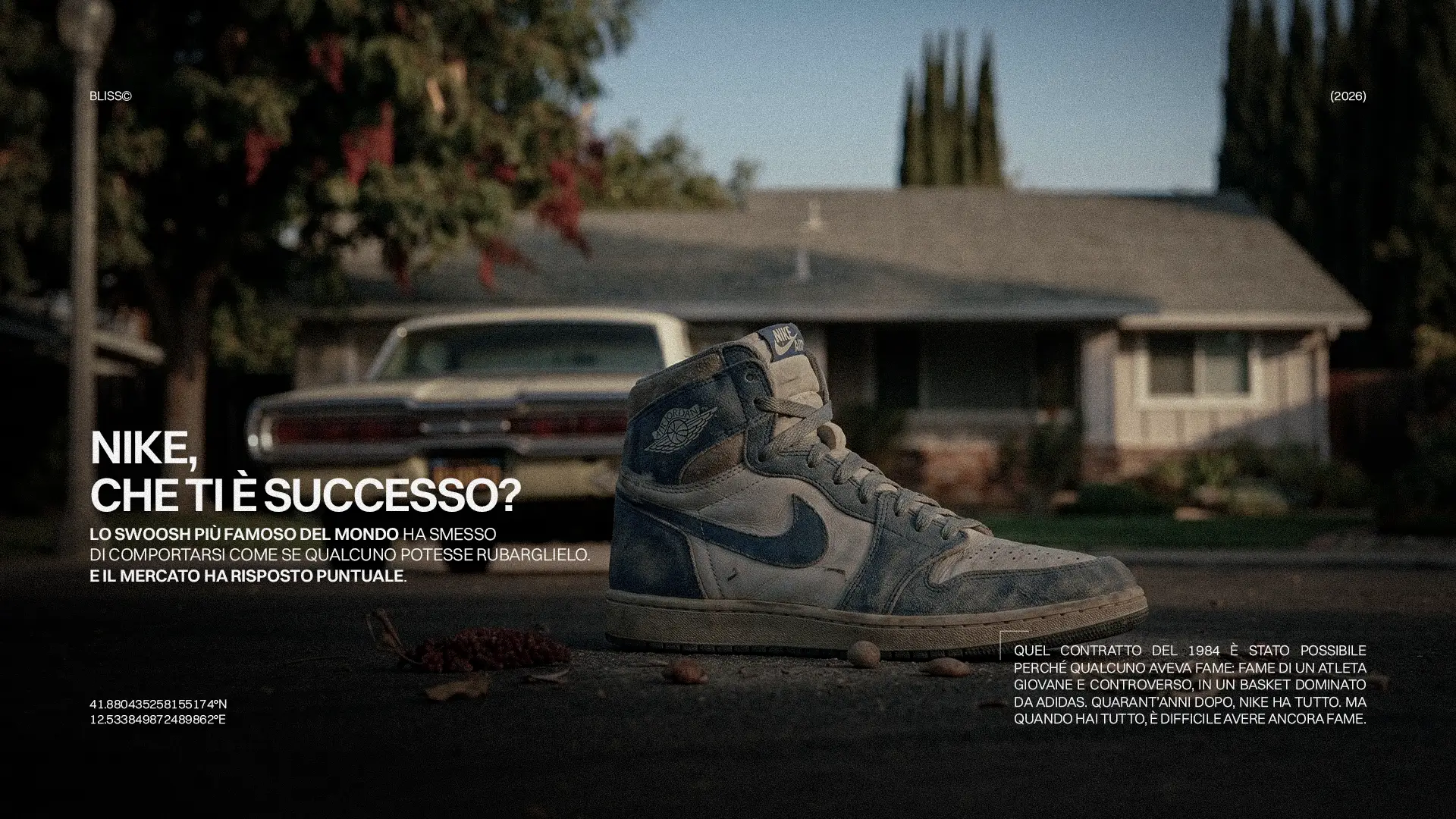
The most famous Swoosh in the world stopped acting like someone could steal its crown. And the market responded right on cue.
This is the company that invented sneaker culture. The company that built the most recognizable sports brand in history. The company that signed the contract that changed sports marketing forever (the $500,000 a year given to Michael Jordan in 1984—a monstrous sum at the time that everyone said was too much).
Forty years later, that same company has seen its stock drop by 27% in a year, its EBIT collapse by 42%, and its Jordan Brand lose 16% in revenue, while a Japanese running brand (Asics) grows by 600% on the same platforms.
This isn’t just a story of a changing market. It is the story of a brand that forgot who it was.
The Golden Era: When Nike was Nike
Between 2000 and 2010, Nike built something few companies in human history have ever achieved: a system where the product, the athlete, and the culture fueled each other automatically.
- LeBron James signed in 2003 at eighteen.
- Kobe Bryant took the Swoosh into every NBA arena.
- Innovation followed suit: The Vaporfly in running, the Mercurial in football, the Kobe System in urban culture.
Nike wasn’t just selling shoes; it was building the visual lexicon of global sport. Then, around 2015, something changed—silently, and dangerously.

The Shift from Athletes to Influencers
Nike’s pivot can be seen in a data point analyzed only in hindsight: the brand progressively shifted its narrative from athletes to macro-influencers. Travis Scott. Virgil Abloh. Collaborations with fashion and music made sense for visibility, but less so for positioning.
The problem wasn’t the partners themselves, but the logic behind them: the idea that a brand’s cultural relevance could be purchased through the right partners rather than built through product and performance.
An athlete brings technical credibility and long-term loyalty. An influencer brings immediate visibility but equally immediate decay. This is campaign logic, not brand logic. And if you run a brand like a campaign, you get results that only last as long as the campaign.
Numbers That Cannot Be Ignored
In fiscal year 2025, Nike recorded revenue of $46.3 billion, down 10%—the worst result in years (excluding COVID).
| Brand / Division | Annual Performance (2024-2025) |
| Jordan Brand | -16% ($7.3 billion) |
| Converse | -19% |
| Overall EBIT | -42% |
| StockX Resale (Nike/Jordan) | -21% |
| Asics (Growth on StockX) | +600% |
These numbers prove the market isn’t in trouble; it has simply moved. And Nike wasn’t where it needed to be.

“Just Leave It”: When the Icons Walked Away
When the very people you helped make famous start leaving, you have a problem.
- Roger Federer left Nike for On Running.
- Tiger Woods left to found his own brand (Sun Day Red).
- Simone Biles moved to Athleta.
- Josh Allen chose New Balance.
Nike had the money to keep them, but they chose to go elsewhere. The reason was consistent: Nike was no longer the place where the best things were being built. It had become a distribution machine with a logo on top, rather than a partner in innovation.

The Strategy of Oversaturation
For years, Nike’s model relied on scarcity. The best shoes were hard to find. Limited releases and exclusive SNKRS drops built desire.
Then, Nike decided to scale. They increased production, opened up the catalog, and flooded direct-to-consumer channels. The result? Only 20% of the new Air Max DN models sold on the official site. The rest sat on shelves.
When everyone can have a Nike easily, having one says nothing. When a brand loses the ability to signal identity through possession, it loses its most valuable asset.
What Competitors Understood
While Nike was optimizing, the market was moving:
- On Running: Founded in a Swiss garage, it grew by double digits in 2024. Federer isn’t just an ambassador; he’s an owner who believes in the product.
- Hoka: Entered the premium running market with polarizing, maximalist designs and built a “tribe” of runners who never look back.
- New Balance: Kept its identity consistent and waited for the right cultural moment.
None of them beat Nike by copying Nike. They beat Nike by being exactly what Nike stopped being: a brand with a point of view.
The Return of the Old Guard
In October 2024, Nike recalled Elliott Hill, a veteran executive from the “old guard,” to lead the restructuring. The signal is clear: the company knows the problem is cultural, not just operational.
Whether it works depends on one variable: Is Nike still capable of acting like a company with something to prove? Or has the organizational weight of 30 years of leadership become too heavy to allow for agility?
FAQ: The Brand Identity Perspective
Why did Nike lose appeal despite being the global leader?
Because they optimized distribution at the expense of desire. When a brand is in every supermarket and outlet, it stops being aspirational. The brain equates rarity with value. Nike chased volume and sacrificed the uniqueness that justified premium pricing.
How do smaller brands like On or Hoka compete?
By owning a specific territory with a precise identity. They speak to someone (not everyone) very clearly. Being essential to a niche is often more valuable than being generic to the masses.
Can a brand that lost exclusivity win it back?
Yes, but it requires painful choices: reducing distribution channels, killing underperforming product lines, and reinvesting in high-identity projects. You cannot simply declare you are premium again; you have to prove it with choices that cost you revenue in the short term.