


There is a story that begins in 1997 with a young boy who cannot swim.
Eiichiro Oda is twenty years old when he publishes the first chapter of One Piece. It is the story of a pirate with none of the obvious qualities one would expect from a pirate. He cannot swim. Nor is he particularly intelligent. He has no plan. He only has one thing: he wants to become the King of the Pirates, and he tells anyone he meets with a disarming, almost childish certainty.
Almost thirty years later, One Piece is the best-selling manga in human history. Over 70 million viewers tuned in for the Netflix live-action adaptation. The trading card game (TCG) resells at art-market prices. A new LEGO set. Viral and impossible-to-find Easter eggs.
The world has surrendered to Luffy. And looking closely at why, one understands something fundamental about leadership: something that all the management courses, podcasts, and books in the world still cannot explain properly.
The problem with the leadership everyone wants
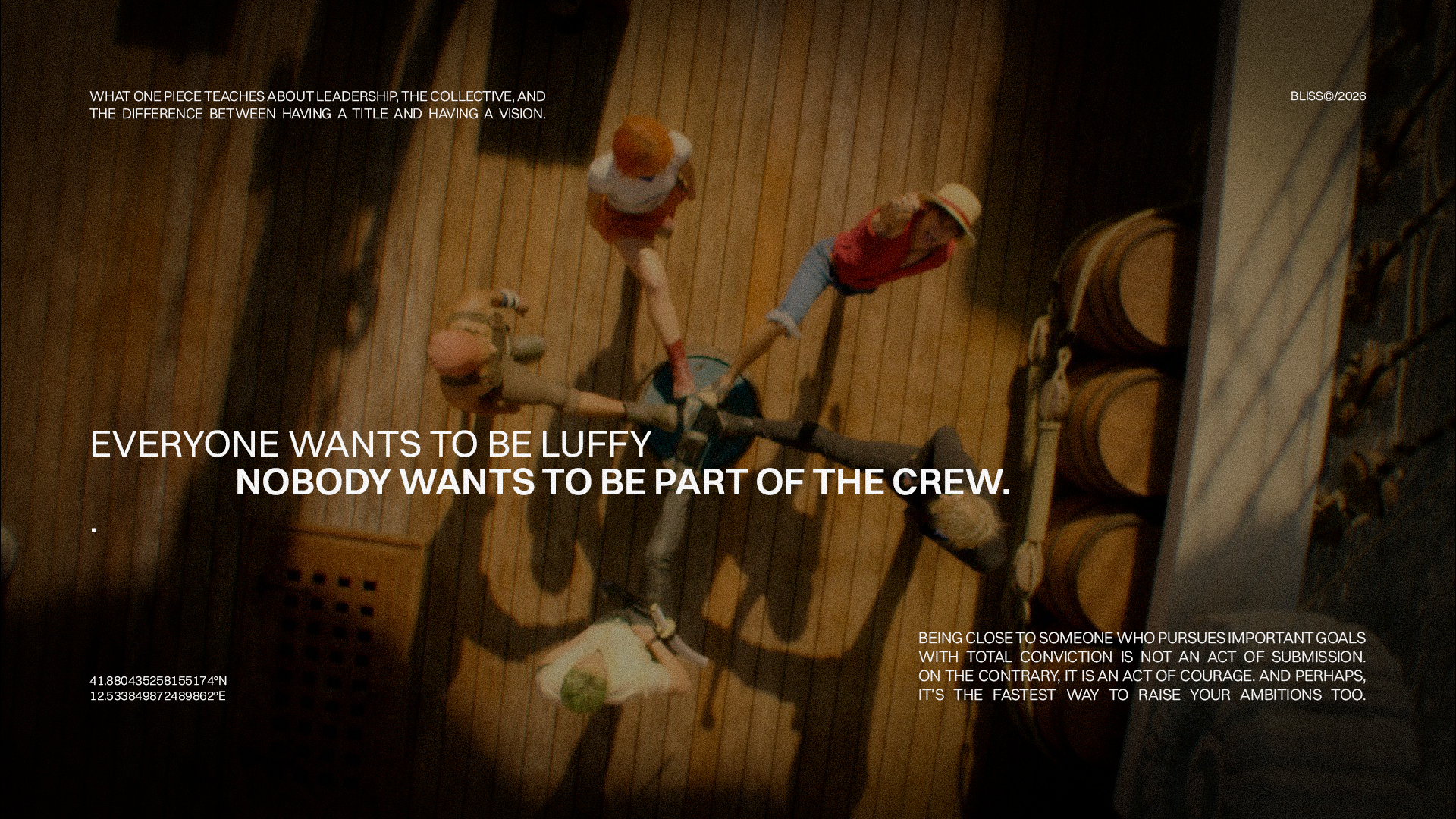
In recent years, a cult of personal leadership has exploded in Italy, producing a curious and paradoxical effect: everyone wants to be the captain, no one wants to be the sailor.
Every LinkedIn profile is a manifesto of vision. Every course promises to bring out the leader inside you. Freelancers and startups launch, shine for six months, and collapse. Entrepreneurs describe themselves as inspiring without having inspired anyone yet. It is a market full of people applying for the role of Luffy, and almost no one willing to be Zoro, Nami, Sanji, or Usopp.
The point is that in One Piece, it is exactly that willingness to be part of a collective—to be extraordinarily good at something specific within a system larger than oneself—that makes every adventure possible. Including the growth of the protagonist.
Leadership is not learned. It is recognized.
Luffy doesn’t want to command. He has no particular interest in being the captain in the conventional sense of the word.
He wants to find the One Piece. Command has become, over time, a side effect of his dream: not his goal.
And this is the distinction that changes everything. Those who seek a title build hierarchy. Those who bring a vision build an ecosystem.
True leadership is not a skill that is acquired. You don’t buy it in a two-day course. It is something closer to a magnetic field: it is felt, it is recognized, it attracts. And Luffy proves this to us with every person who chooses to board the Going Merry first, and the Thousand Sunny later. Not because he convinced them with a pitch, but because each of those people saw something in him that made their own dream more possible.
Zoro, Mihawk, and the pact among equals
The relationship between Luffy and Zoro is the beating heart of the entire series. And it must be explained well, because it is also the thing that management manuals cannot describe.
Roronoa Zoro does not follow Luffy because he is stronger than him. Perhaps he isn’t even stronger—at least not at the beginning. Zoro follows Luffy because he sees something specific in him: if a man with that determination can become the King of the Pirates, then he too can become the greatest swordsman in the world. Luffy’s dream makes his own credible.
It is not servility. It is not subjection. It is a strategic and identity choice all at once: Zoro knows that the path traversing through that crew is clearer than any other. And he proves it in the moment that gives chills to anyone who has loved this story.
Zoro meets Mihawk. Dracule Mihawk, “Hawk Eyes”—the greatest swordsman in the world, one of the Seven Warlords of the Sea, the man who single-handedly destroyed a fleet of fifty ships and five thousand men with a handful of strikes. A human being so far above the rest that he considers almost no one worthy of his true blade. When Zoro faces him, Mihawk doesn’t even use his sword—Yoru, the greatest sword in the world. He uses the tiny knife he wears around his neck as a pendant. A gesture of contempt, in its most elegant form.
But Zoro does not back down. Not even a single step. Even when Mihawk asks him directly—almost with scientific curiosity, almost amazed by what he sees before him. Zoro replies that if he were to take even a single step back, it would be like betraying every promise he has made up to that moment. Mihawk listens to him, and does something he almost never does: he puts the little knife away and unsheathes Yoru. Out of respect.
The defeat comes anyway. It couldn’t have been otherwise. But when Zoro gets back up—with his chest slashed open, blood pouring down—he turns to Luffy and says something that anyone who wants to build something great should tattoo somewhere: “I will never lose again, as long as you’re alive. Because if you can become the King of the Pirates, I can become the greatest swordsman in the world.”
It is not a surrender. It is a pact among equals. Two people who choose to walk together not because one commands the other, but because the direction is the same.
Hernán Cortés burns the ships: and Luffy does too
In 1519, Hernán Cortés landed on the shores of Mexico with eleven ships and just over five hundred men. He faced the Aztec empire.
His soldiers had already positioned the boats with the bow towards the sea—ready to escape in case things went bad. Cortés looks at the ships. Then he gives a simple order: burn them.
The soldiers are left speechless. And they ask: Captain, and now what will we do if we lose? The answer has gone down in history: “There is only one option left. Win and return home with the enemy’s ships.”
Luffy burns his ships every time he makes a decision. Every time he chooses to fight a battle he cannot win—and wins it anyway, or loses it and gets back up with something more. Every time he takes his crew to a place from which there is no easy way back. The absolute certainty that there is no “Plan B” is the most powerful force a leader can transmit to the people who follow them.
It is not recklessness. It is a vision so solid that it makes the alternative superfluous.
The collective multiplies talent
Nami is the best navigator in the world. Sanji is an absolute top-tier chef. Chopper is an extraordinary doctor. Each of them is exceptional in their own specific domain. But none of them would have gotten where they are without the others. Without the crew.
The collective is not the place where individual talent is compressed. It is the multiplier that makes that talent relevant on a larger scale. And it is also the place where you discover who you really are—not alone in front of a mirror, but in contact with someone who challenges you, protects you, asks you to give your best.
The problem is that this requires something difficult to accept: not always being the star of the show. Knowing that your contribution at certain times is invisible—and that it is still essential. Understanding that the glory of the collective is worth more than individual recognition.
This is the part that no leadership course teaches. And it is the most important part.
The question worth asking
The cult of personal leadership has produced an Italy full of captains without a crew. Of visions without an expedition. Of dreams formulated in the first person singular that collapse not because they were wrong, but because they were too solitary to withstand the weight of the open sea.
A leader with a clear vision attracts people with equally big dreams. They do not attract executors. They attract co-protagonists—people who have something to prove, something to build, and who see in the leader’s vision an additional reason to believe in their own.
At Bliss, we have set ourselves this goal: to cultivate individuality, putting ourselves at the service of “the crew.” Aware of the fact that the question worth asking, in any organization, is not “who is the leader?” but: is the vision we have big enough to contain everyone’s dreams?
If the answer is yes, the course is the right one. And maybe, along the way, you will also meet people like Zoro, willing to follow you not because they have to, but because they have understood that your victory and theirs are the exact same thing.
Frequently Asked Questions
Why do a brand’s values matter more than the products it sells?
Products are copied, values are not. In saturated markets where functional differences are zeroed out, identity and value consistency are the only elements that create an irreplaceable emotional bond. The customer, thus, ends up buying what the brand represents.
How do you build a loyal community around a brand?
With consistency and courage. A community is born when people identify with the vision of the leader and feel they are part of something that goes beyond the transaction. It requires taking a stand, accepting that you won’t please everyone, and staying the course even when it’s difficult.
What does One Piece teach about brand strategy?
That a mission greater than profit is the engine of loyalty. Luffy convinces others with the strength of his vision and the consistency between what he says and what he does. Brands that inspire loyalty work the exact same way.