


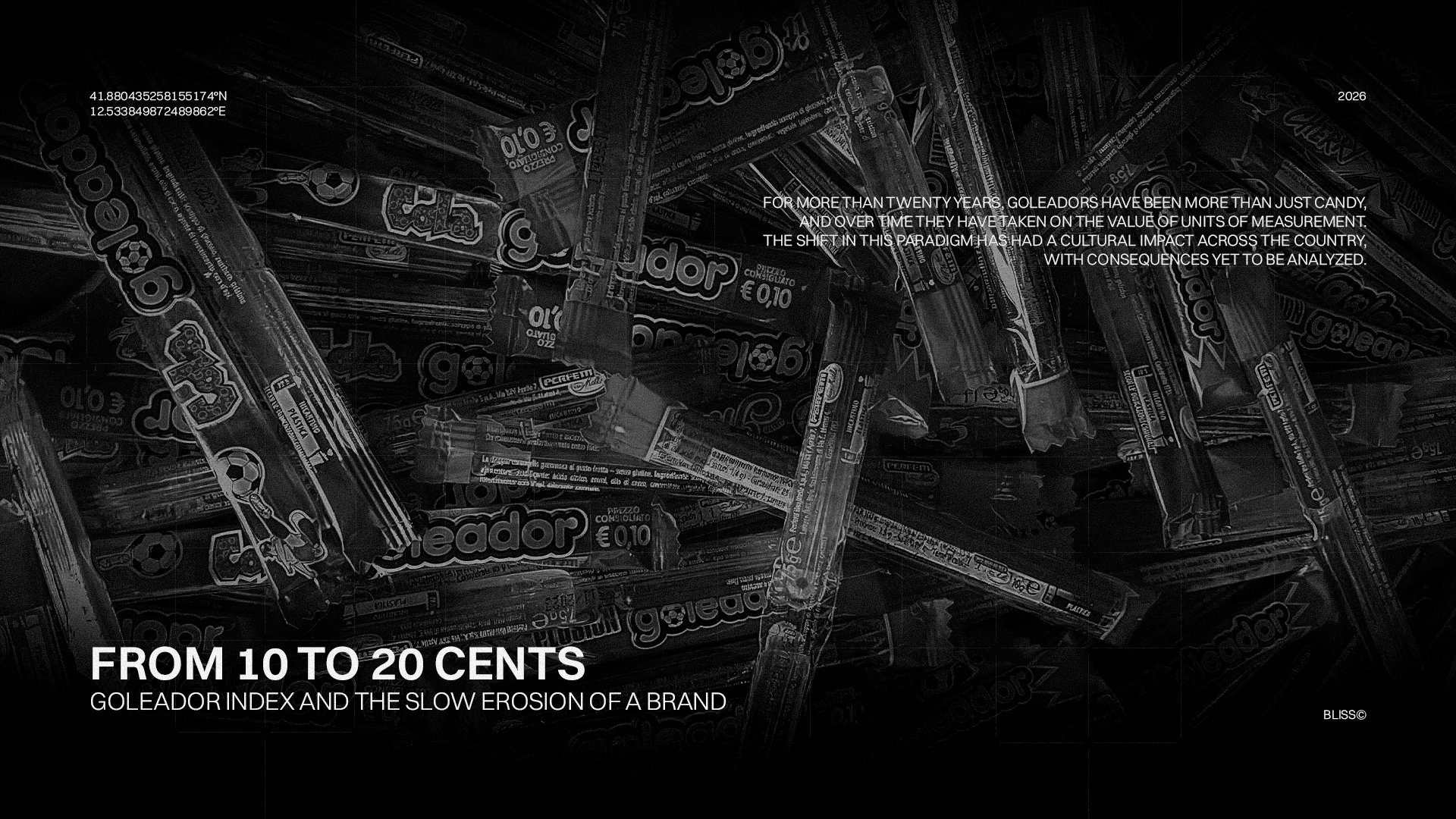
Petitions on Change.org. Viral videos on TikTok. Articles about the end of an economic certainty.
When Goleadors went from 10 to 20 cents (a 100% increase in a single blow, justified by the fact that “they hadn’t increased since 2002”), all of Italy went into an uproar. And rightly so.
For more than twenty years, Goleadors have been more than just a candy; over time, they took on the value of a unit of measurement. The change in this paradigm, therefore, had a cultural impact on the country, but also an effect on the revenue of the Perfetti Van Melle group.
In this case study, we at Bliss will analyze the Goleador case: the Goleador Index, the loss of a precise identity, and what major brands can tell us about the market.
The Goleador Index: When Ten Cents Are Worth More Than Ten Cents
You are in a tobacco shop and you end up spending €4.90. What do you do, take ten cents in change or buy a Goleador?
For over twenty years, ten cents represented the minimum economic exchange value in Italy. That is, the smallest coin that made sense to spend. With 2 cents you can’t buy anything, nor with 5: but with 10, you could get a piece of candy.
The Goleador occupied exactly that blurred line between value and non-value; and it did so for so long that it became a cognitive benchmark even before being a product.
Ideally, we could almost speak of a Goleador Index, referencing the famous Big Mac Index, which for years has served as an informal economic indicator of purchasing power.
If the Big Mac tells us about the differential between markets, the Goleador Index shows us the minimum value that Italians’ pockets can afford to spend. When this value doubled, the purchasing power of Italians consequently halved. The 10-cent threshold no longer exists in the 2026 market. What has always been accessible is no longer accessible in the same way.
The neuroscience of price perception describes this mechanism with precision. The human brain, in fact, does not process prices in an absolute way: it processes them in relation to cognitive anchors established over time. However, when an anchor is removed or abruptly altered, the emotional response is disproportionate to the actual change. We are not processing ten extra cents. We are processing the loss of a reference point.

The Context That Goleador Made Visible
The reaction to the doubling of the Goleador price was so intense also because of the historical period in which it occurred. Between 2021 and 2022, Italian real wages collapsed by almost 6 percentage points (the highest drop in the EU: more than double the European average). According to the International Labour Organization, Italy is among the only three advanced G20 countries where real wages in 2022 were lower than those in 2008.
The purchasing power of Italians, then, didn’t just “halve”: the loss compared to pre-Covid levels exceeds 8% in real terms, with even higher peaks for lower incomes. And in a country where wages were already among the lowest in Europe before inflation, a further 8% loss produced effects that are felt even in small things. Like a 10-cent candy that is now worth 20.
The Perfetti Van Melle group did not cause this hardship: yet, it made it tangible. It gave a concrete shape to something that already existed but was difficult to measure. A function that iconic products perform unintentionally, acting as emotional thermometers of the economic context in which they exist.
The Second Mistake: A Catalog That Lost Its Thread
If doubling the price was an economic positioning problem, Goleador’s strategic response over the years produced an additional positioning problem.
From the original three flavors (fruit, cola, and licorice), the catalog expanded to include Maxi Shock, Fizzy Soft, Xplosion, Dribbling Rainbow, Mystery, Ooolaaa, Gooold, as well as limited editions with heroes to collect, manga, sour variants, fizzy variants, and filled variants.
Seventeen active SKUs, compared to the original three.
On the surface, Perfetti Van Melle’s was a growth strategy. In reality, it produced a dilution of the most precious asset Goleador had: immediate recognizability.
When a consumer thinks of “Goleador,” they imagine the double gummy candy. A precise, shared, instantaneous image. Today, that response has become fragmented. Some think of the Dribbling, some of the Maxi Shock, some no longer know what to expect. The brand gained products but lost sharpness.

The Neurobiology of Iconicity: Why Simplicity is Worth More
There is a precise neurological mechanism behind this phenomenon that is worth exploring.
The human brain does not process brands as lists of products. It processes them as cognitive schemas: simplified structures that allow us to categorize and retrieve information quickly.
The more coherent and predictable a schema is, the easier it is to recall. In doing so, it generates an emotional response associated with recognition.
Coca-Cola maintained an essential catalog for decades not out of a lack of creativity, but because every new variant introduced an uncertainty that eroded the consolidated cognitive schema. Apple built its iconicity by removing products, not adding them. IKEA made its model globally replicable precisely because the experience in every store around the world is predictable.
The fragmentation of the Goleador catalog produced the opposite effect: every new candy requires the consumer to make an additional cognitive effort to understand what they are buying. And when cognitive effort increases, the perceived value of the brand as a whole decreases. Not because the products are worse, but because the brain struggles to build the association automatically.
The Mistake Small Brands Make When Imitating Big Brands
There is a seemingly rational logic behind the choice to expand the catalog. If fruit Goleadors sell, maybe the sour ones will sell more. If kids love the Dribbling, maybe adults will love the Fizzy Soft. If every flavor niche has its dedicated product, you capture more of the market.
The problem is that this logic only works if the brand already has sufficiently solid governance to maintain consistency throughout the expansion. Big brands can afford sub-brands, parallel lines, and seasonal variants: and this is because they have identity management systems that ensure every new product strengthens, rather than dilutes, the main brand.
Goleador did not have that governance. The result is that every new SKU eroded a bit of what made the brand unmistakable. Goleadors didn’t disappear. They just became less iconic.
And a brand that stops being iconic is a brand that can be replaced.
What Goleador Teaches Those Who Build Brands
The Goleador case is not a story of decline. It is a story of silent erosion: the kind of erosion you don’t see until you look back and wonder why something that seemed solid no longer does.
There are three lessons that apply to any brand, big or small:
- Price is not just an economic number, it’s a positioning signal. When you change a price that has become part of the brand’s perceived identity, you are changing the way the brand exists in people’s minds. Doing so without communicating why, without building a narrative that justifies the change, produces a cognitive fracture in the customer.
- Catalog simplicity can be an asset. Adding products can give the illusion of growth. Yet, it is often more of a dilution. Strong brands are not those with the most products, but those with the clearest and hardest-to-displace cognitive schema.
- Iconic brands are economic thermometers. When the price of a Goleador doubles and people react as if a calamity has occurred, they are actually reacting to everything the candy represented. Understanding this function is fundamental to understanding what you are really selling, and what you risk losing when you change something that seemed irrelevant.
Goleador is more than a candy.
It is a reminder for all brands.