


technical SEO
SEO is in the details. The ones you don't see.
Even the best content and the most authoritative backlinks produce partial results on a technically weak site. Authority does not flow where it should, crawl budget is spent on the wrong pages, and slow pages lose rankings regardless of what they contain. Technical problems build up silently and surface when they have already caused damage that is hard to quantify.
Bliss works on the site’s technical infrastructure as the foundation of any organic visibility strategy. Diagnostic audit, prioritised interventions, ongoing oversight. Technical SEO is not a one-off intervention: it is the maintenance of the most important asset a company has online.





Definition
What technical SEO is and why it is the foundation
Technical SEO is the branch of Search Engine Optimisation that deals with a website’s infrastructure: everything that is neither content nor link building, but determines whether Google can correctly crawl, index and understand every page. Without this foundation, the rest of the SEO work delivers less than it deserves.
We might call it the art of the invisible: as long as everything works, nobody notices. When it fails, search positioning collapses silently. Duplicate URLs generated automatically by the CMS consume crawl budget without producing value. Incorrectly configured canonicals disperse authority across different versions of the same page. Unoptimised images drag Largest Contentful Paint below Google’s quality threshold. All problems that build up invisibly, and surface when they have already caused damage that is hard to quantify.
Technical SEO steps in before this happens. And when it has already happened, it diagnoses and resolves the problem with precision, not with generic fixes.
91%
of web pages receive no organic traffic from Google, often because of technical issues
2.5s
Google’s LCP threshold: beyond this time, the page is penalised in rankings
53%
of web pages have not a single backlink and receive close to zero organic traffic
Areas of intervention
Technical SEO: the 6 areas of intervention
Technical SEO covers six distinct but interconnected areas. A problem in one often affects the others: a poorly managed crawl budget prevents optimised pages from being indexed; missing structured data limits rich snippets even on excellent content. Bliss maps all six before deciding where to start.
01.
Crawling and indexing
Google must find the right pages. Crawl budget is optimised by excluding URLs with no organic value.
- robots.txt and crawl directives
- Structured XML sitemap
- Index coverage (GSC)
- 404 error and redirect management
- Googlebot log file analysis
02.
URL structure and canonicals
Every URL has a precise function. Authority is not dispersed across duplicates or non-canonicalised variants.
- Canonical tag configuration
- Parameterised URL management
- Coherent URL architecture
- Redirect chains and loops
- www / non-www / HTTP versions
03.
Core Web Vitals and performance
LCP, INP, CLS: the three metrics Google uses as a direct ranking signal. Optimised page by page.
- Largest Contentful Paint (LCP)
- Interaction to Next Paint (INP)
- Cumulative Layout Shift (CLS)
- Image optimisation and lazy loading
- Removal of render-blocking resources
04.
Structured data (Schema markup)
schema.org JSON-LD for rich snippets, AI visibility and semantic understanding by Google.
- Organization, LocalBusiness
- Product, Offer, AggregateRating
- Article, FAQPage, HowTo
- BreadcrumbList, Event, Person
- llms.txt for AI visibility
05.
Technical on-page optimisation
H1 tags, meta titles, meta descriptions, ALT attributes: the on-page signals Google reads to understand each page.
- H1 tag audit and normalisation
- Meta titles and descriptions by keyword
- Image ALT attributes (SEO + WCAG)
- Internal linking and anchor text
- External link security (noopener)
06.
Backlink profile and link audit
A domain’s external authority depends on the quality of its link profile. Toxic links must be identified and removed.
- Complete backlink mapping
- Per-link toxicity analysis
- Disavow via Google Search Console
- Monitoring of newly acquired links
- Anchor text distribution
the method
Audit, prioritisation, intervention.
Then we start again.
Technical SEO is not tackled with a generic checklist applied to any site. It is tackled with a domain-specific diagnosis, followed by a plan of interventions prioritised by expected impact on ranking. Every site has its own hierarchy of problems. The order of interventions determines how quickly results appear.
Audit of the existing backlink profile
The mandatory starting point is a complete map of the existing backlink profile: active referring domains, anchor text distribution, per-link toxicity and thematic consistency of sources. This audit produces two lists: links to disavow (toxic or artificial links that risk penalties) and links to replicate (sources that pass on real authority and indicate the editorial territory where the brand already has a presence). Disavowing toxic links is often the first intervention — and it takes effect within a few weeks.
Mapping authoritative sources
Every sector has a hierarchy of publications that Google and AI systems regard as authoritative: national titles, sector verticals, thematic portals with genuine organic traffic, blogs with established Domain Authority. Bliss builds a map of the relevant sources for each client, based on the sector, the geographic market and the type of queries on which ranking needs to improve. This map guides all subsequent work.
Editorial strategy for acquisition
The key question is: what can we offer these publications that is genuinely relevant to their readers? Proprietary sector data, original research, expert opinion, verifiable case studies, authoritative commentary on emerging trends. Bliss builds the editorial plan for link acquisition starting from this question — not from a list of sites on which to buy space. The result is content that publications choose to publish because it has standalone value, and that generates natural editorial backlinks.
Editor relations and outreach
Authoritative publications do not publish every press release they receive. Building relationships with editors — understanding what they are looking for, pitching at the right moment, offering angles their peers are not covering — is the part of link building that cannot be automated. Bliss nurtures these relationships over time: not with mass e-mails, but with personalised approaches calibrated to each publication and each journalist.
Profile monitoring and ongoing oversight
A domain's backlink profile evolves continuously: new links acquired, links lost (the linking site changes or closes), new toxic links appearing spontaneously. Bliss monitors the profile monthly: checking new referring domains, analysing anchor text distribution, identifying any new toxic links to disavow, and detecting strategic lost links to recover. The profile is presented in a monthly report showing changes against the previous period and the expected impact on ranking.
Technical SEO and GEO are the same system, optimised on different fronts.
Correct structured data and llms.txt increase citability in generative AI systems as well as ranking on Google.
Case study
PROFVMVM ROMA®
Full technical
realignment in one month
Niche perfumery · WooCommerce · Rome · January 2026
PROFVMVM ROMA® is an Italian artistic perfumery maison with a WooCommerce e-commerce store. In January 2026, Bliss launched a structured technical realignment of the site: infrastructure work not immediately visible to users, but essential to improving semantic consistency, indexing quality, crawl budget management and overall technical solidity.
January was month zero: technical groundwork for the strategic activities that followed. The principle never changes: organic positioning cannot be built on fragile technical foundations. Below is the full technical report of the work carried out.
January was a month of technical consolidation: work not immediately visible to users, but which forms the foundation for any subsequent organic positioning activity. The result in Q1 2026, after the technical phase: 36,811 organic clicks, 4.5% average CTR (almost double the industry benchmark) and €512K in annual revenue from the organic channel.
The causal link is not obvious: technical SEO does not produce immediate rankings. But without it, no content and no backlink could have produced those results in the time it took.
Audit Report · PROFVMVM ROMA · January 2026
7 interventions · all completed
H1 tag optimisation - 130 pages
Full audit of every page on the site. 145 URLs identified with missing or incorrectly configured H1 tags. 130 strategic pages corrected and normalised. Non-indexable areas (Privacy Policy, Terms and Conditions, Account Area) deliberately excluded so as not to spend crawl budget on pages with no organic value.
llms.txt file implementation - GEO ready
Generated and published the llms.txt file, an emerging standard for communicating the nature of the site and its strategic pages to artificial intelligence models in a structured way. Objective: to improve semantic understanding by Gemini, ChatGPT and Perplexity and increase citability in generative answers.
Production of ALT attributes for ~1,500 images
Widespread absence of alt attributes detected across the entire catalogue. Began producing approximately 1,500 alternative texts consistent with each image's content and category. Twofold impact: SEO (Google's understanding of visual content) and accessibility (WCAG 2.1, screen readers).
robots.txt and XML sitemap review
Full analysis of the robots.txt file and the XML sitemap. We verified correct crawl control, consistency between indexable URLs and URLs in the sitemap, and the absence of crawl budget waste. Outcome: no structural issues found; the files were already correctly configured.
International backlink profile analysis - 70 toxic
Full mapping of the domain's link profile. The national profile is good overall. Internationally, 25 highly toxic and 45 moderately toxic backlinks were found. Access to Google Search Console was prioritised to proceed with the disavow, a critical step to protect the domain's authority and reduce algorithmic risk.
JSON-LD schema implementation (structured data)
Implemented Organization JSON-LD schema to give Google structured data on the brand entity: supported languages, sales regions, product types, reviews and official social profiles. Expected impact: improved semantic understanding, possible activation of rich results in the SERPs, and consistent information in Google's Knowledge Panel.
External link optimisation (security + SEO)
Installed a plugin that automatically adds security attributes to all external links on the site: rel="noopener" and rel="noreferrer". Applied to approximately 6,000 links across the domain. Benefits: improved security, compliance with SEO best practice and fewer vulnerabilities linked to opening links in a new tab.
OUR SEO RESULTS
Success stories
These results show what happens when SEO, content and AI Search are turned into a genuine growth engine. Leads, sales, qualified traffic and revenue growth: every case study presents concrete data, verifiable results and performance built to generate real business.
Valle D'Aosta
Bliss supported the Aostæ 2025 project in building an institutional digital ecosystem designed to enhance the region, its events and public communication.
Technical SEO advisory
SEO specialist or agency?
The right question.
Technical SEO requires skills rarely found in a single professional: knowledge of web architecture, the ability to read Googlebot logs, familiarity with Core Web Vitals at code level, experience with advanced schema markup, an understanding of how Google’s algorithms work. A generalist SEO technician who optimises meta titles is not necessarily an advanced technical SEO consultant. Bliss treats technical SEO as a specialist discipline, separate from editorial SEO and link building. The team that conducts the technical audit is the same one that carries out the work and monitors technical health over time: an analysis is not turned into a document for someone else to implement. This shortens the time between diagnosis and results. Bliss applies to its clients the same technical method it has applied to itself: PageSpeed SEO score 100/100, Best Practice 100/100, schema.org implemented on every key page, a complete disavow of the toxic backlink profile. The result is first position for “agenzia branding Italia” and primary source in Google’s AI Overviews for strategic industry queries.
100/100
PageSpeed SEO score — blissagency.it
#1
Rome Milan
operational offices — technical SEO consultancy across the entire Italian market
Bliss applies to itself the same method it offers its clients.
Certified Agency
Certifications

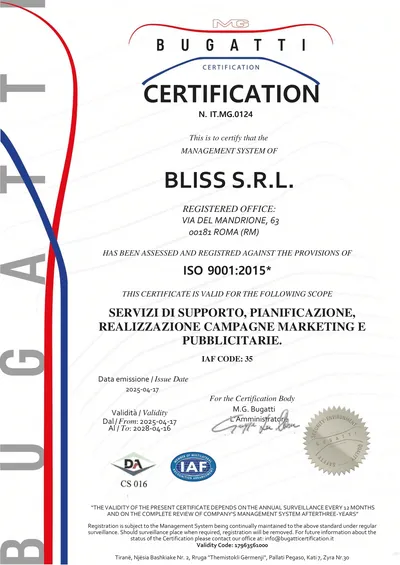
ISO 9001 – Process quality and work organisation.

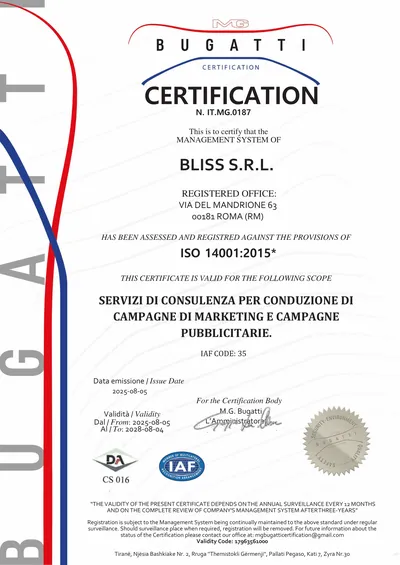
ISO 14001:2015 – Managing the environmental impact of business activities.

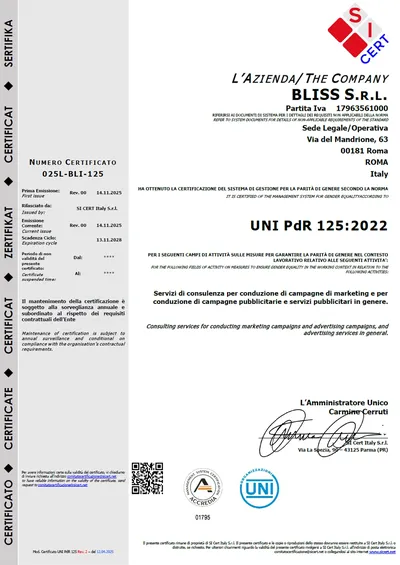
UNI PDR 125:2022 – Gender equality in processes, policies and organisation

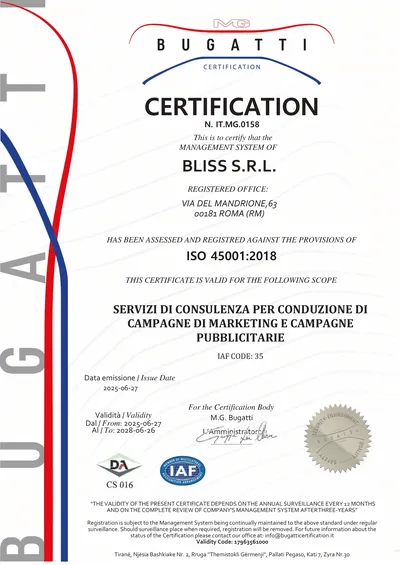
ISO 45001:2018 – Occupational health and safety.

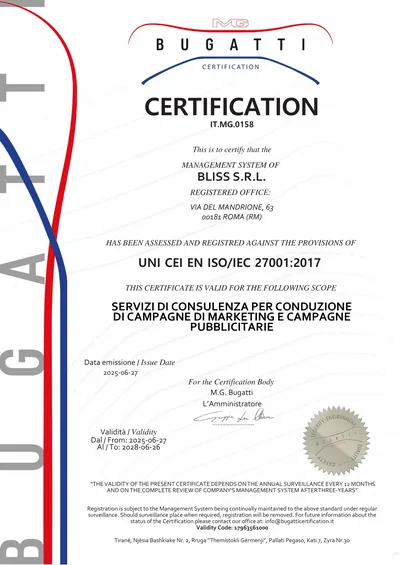
ISO/IEC 27001:2022 – Information, data and access security.
THE TEAM
Our voices
leading the way
Bliss’s SEO is managed by a team with experience of organisations with complex sales cycles in tech, manufacturing and professional services: sectors where the buyer is a decision maker with structured evaluation processes and long purchasing timelines.

Andrea Maso
HEAD OF SEO
International background, a data-driven mind and no intention of slowing down.

Mario Antonini
chief design officer (cdo)


Luca Maletta
Head of Copywriting

Sajjad Mazaherizaveh
Full stack developer
Combines front-end and back-end development with technical SEO and AI Search Optimisation.
Partner






























Blog & Trends 2026
SEO TRENDS & NEWS


SEO FAQ
Technical SEO FAQs
What is technical SEO?
Technical SEO is the branch of Search Engine Optimisation that deals with a website’s infrastructure: everything that is neither content nor link building, but that determines whether Google can correctly crawl, index and understand its pages. It includes crawl budget, URLs and canonicals, Core Web Vitals, structured data, H1 tags and meta titles, ALT attributes and the backlink profile.
Without a solid technical foundation, content and links don’t achieve the ranking they deserve. Technical SEO is the foundation on which every other organic positioning activity is built.
What are the most important technical SEO techniques?
The technical SEO techniques with the greatest impact on ranking are: crawl budget management (preventing Google from wasting resources on non-strategic pages), correct canonicals (preventing authority from being split across duplicate pages), Core Web Vitals (LCP, INP and CLS within Google’s quality thresholds), schema.org structured data (for rich snippets and AI visibility), H1 and meta title normalisation, image ALT attributes, and backlink profile audit and disavow.
The order of priority depends on the domain’s specific situation — there is no one-size-fits-all checklist.
What is crawl budget and why does it matter for SEO?
Crawl budget is the amount of resources Googlebot devotes to crawling a site over a given period. If the site has many low-value pages — parameterised URLs, filter variants, duplicate pages — Google crawls those instead of the strategic pages, which are then indexed late or not refreshed.
Managing crawl budget through robots.txt, canonicals, sitemaps and URL architecture is one of the technical interventions with the greatest impact on ranking, especially for sites with large catalogues or complex legacy architectures.
What are Core Web Vitals and how do they affect search positioning?
Core Web Vitals are the three user-experience metrics Google uses as a ranking signal: Largest Contentful Paint (LCP — loading speed of the main content, threshold: <2.5s), Interaction to Next Paint (INP — responsiveness to interactions, threshold: <200ms) and Cumulative Layout Shift (CLS — visual stability, threshold: <0.1).
Pages that exceed these thresholds gain a ranking advantage over pages with equivalent content but poorer performance. Bliss optimises them page by page, starting with the URLs that are strategic for search positioning.
What is structured data and how does it improve technical SEO?
Structured data is schema.org markup in JSON-LD format that describes to Google the type of content on a page: Organization, Service, Product, Article, FAQPage, BreadcrumbList, Event. It enables rich snippets in the SERPs and improves readability for generative AI systems.
A site without structured data is a site that Google and language models read less precisely. The llms.txt file, an emerging standard, adds a layer of direct communication with AI models about the site’s structure and strategic pages.
How is a technical SEO audit carried out?
A technical SEO audit maps the state of the domain across six areas: crawling and indexing (robots.txt, sitemap, GSC coverage), URL structure and canonicals, Core Web Vitals and performance (PageSpeed, CrUX), structured data, technical on-page optimisation (H1, meta, ALT) and backlink profile.
The output is a list of issues ranked by priority and expected impact — not an undifferentiated list of “things to do”. Bliss produces the audit before any operational proposal: you cannot build a plan without knowing where you are starting from.
How do Google's AI Overviews change search positioning?
Google’s AI Overviews (powered by Gemini) appear above traditional organic results for many informational and transactional queries. A site cited in an AI Overview gains visibility even from low organic positions. Bliss works on organic positioning and citability in AI Overviews as an integrated system: the semantic structure that improves organic ranking is the same one that increases the likelihood of being cited in generative answers.
How much does a Google ranking agency cost?
The cost of an agency for positioning on Google varies with the competitiveness of the sector, the current state of the domain and the objectives set. Bliss works on a monthly retainer model that includes an initial audit, a strategic plan, ongoing execution and monthly reporting. The cost is defined after a free preliminary assessment of the domain and the competitive landscape.