Asset mapping
A complete inventory of all intangible assets: brand, data, relationships, intellectual property, corporate culture. Undervalued assets and leakages that no one had ever detected almost always come to light.
Over 90% of your value is invisible.
Learn to govern it.
In 1975, 83% of the value of S&P 500 companies lay in factories and machinery. Today over 90% lies in something you cannot touch: data, relationships, reputation, brand.
Yet most companies continue to measure what is worth less and less, while underestimating what is worth more and more.
Bliss’s Intangible Asset Governance was created for exactly this: to give that 92% the same rigour that for decades was reserved for the 8%.


TABLE OF CONTENTS
/ɪnˈtændʒəbəl ˈæsɪts/
n. An economic resource without physical form, capable of generating value over time: brand, data, intellectual property, relationships of trust, corporate culture. Unlike a plant or a warehouse, its marginal cost of growth approaches zero. That is why the market values it more and more today.
Companies have rigorous systems for managing warehouses, plants and cash flow. Precise controls, for what today represents only a small fraction of a company’s real value.
The remaining 92% of what drives value in 2026 is, by contrast, managed in a disorganised way.
Ocean Tomo’s study of corporate value describes a radical transformation: in 1975 intangible assets accounted for 17% of the value of S&P 500 companies; today, over 90%.
A revolution completed within a single working lifetime.
Yet companies’ management systems have stayed as they were, and little thought is given to governing what is now worth the most.
That is why we created the BIG™ Framework.
If physical assets must be protected from deterioration, intangible ones must be protected from inconsistency.
And since almost no company has updated its management systems to this new reality, our priority with the BIG™ Framework was to provide direction, so as to avoid contradictory messages, value leakage and disgruntled communities.
The “Bliss Intangible Governance” Framework is the proprietary model that turns intangible assets into a governable system.
Every intangible asset goes through five phases. If even one is neglected, value tends to leak away progressively. Here is how we intervene.
Take stock of all intangible assets.
Assign value and risk indicators.
Define rules and responsibilities.
Turning assets into competitive advantage.
Track progress over time.
The intangible asset Governance programme follows a rigorous, well-structured process, designed to make the intangible measurable, in eight weeks.
A complete inventory of all intangible assets: brand, data, relationships, intellectual property, corporate culture. Undervalued assets and leakages that no one had ever detected almost always come to light.
For each asset: indicators of value, quality, consistency and risk. Scoring on Bliss's proprietary scale, compared against sector benchmarks. Intangible assets stop being a feeling and become a number.
Operating rules, management criteria and consistency protocols for every asset. Who decides what, through which process, and within what timeframe. The system that makes value grow instead of leaking away.
A complete diagnostic document with intervention priorities, presented to senior leadership in a dedicated session. The starting point for any future decision on intangible assets.
Periodic monitoring of assets, detection of deviations, updating of the system as the context changes. Intangible assets are not managed once: they are overseen every day.
Intangible Asset Governance exists to give that 92% the same rigour that for decades was reserved for the 8%.
That is why it is particularly useful for:
CRM, newsletters, social media, e-commerce: every channel collects data, but no one brings it together. Your information assets exist, but they are disorganised, and so worth less than they could be. We map what you really have and build the system that turns it into an asset, not an archive.
In a due diligence, tangible value is verified in a day. Intangible value (brand, data, community) has often never been measured, and risks being underestimated at precisely the moment it matters most. We get there before the negotiation uncovers it for you.
The website says one thing, social media another, the newsletters something else again. Every inconsistency is a small erosion of perceived value. We build the system that makes every channel part of the same asset base, not an isolated piece.
Customers who come back, who recommend you, who choose you even when you cost more. It is a real asset, but almost never measured. We build the indicators that make it visible, and defensible, when you need to prove it.
Intangible Asset Governance is entrusted to a team with experience of national and international brands, in sectors where intangible value determines the final price. Every project has a dedicated senior lead, from the initial inventory through to ongoing oversight.

Founded Bliss and leads its direction today.
At board level, works alongside CEOs and Boards of Directors on strategic decisions, overseeing their implementation.

The company’s metronome: coordinates its operations, manages partner relationships and improves internal processes, ensuring continuity across projects.

Interprets the Bliss vision and leads its visual expression. As CDO, coordinates identity, web architecture and VFX, giving ideas concrete form.

Head of SEO at Bliss, analyses the data that steers digital decisions. Supports clients from planning through to the optimisation of organic visibility.

Head of Video Production at Bliss, leads the audiovisual department and directs video production for advertising campaigns.
Much of your company’s value does not appear on the balance sheet. Do you know where it lies and what it is worth?
Tell us about your organisation. Every fee proposal will start from a clear mandate, defined together in a working session.
Many companies have no system for governing their intangible assets. They own them, use them, consume them, without ever measuring, protecting or making them pay. We have built our method around this. And the difference, over time, shows.
| Criterion | Without Governance | With Bliss |
|---|---|---|
| Asset knowledge | No inventory. Intangible assets exist, but no one knows exactly which they are, how many there are, or what they are worth. | A complete, up-to-date inventory. Every asset is mapped, classified and measured against specific indicators. |
| Value measurement | Valuation by gut feeling. Intangible value only surfaces during a crisis or a due diligence, and is often underestimated. | Numerical scoring on a proprietary scale, compared against sector benchmarks. Value is a number, not an opinion. |
| Data management | Data collected on separate systems that do not talk to each other. The information asset exists, but it is scattered and unused. | An integrated system with criteria for collection, management and use. Data becomes an asset that grows over time. |
| Brand consistency | Different messages on different channels. Every team interprets the brand in its own way, eroding perceived value without anyone noticing. | Shared operating rules for every channel and every team. Consistency depends not on who produces, but on the system. |
| Preparation for due diligence |
Intangible value is discovered during the negotiation, when it is too late to build it better. | Documentation ready, scoring up to date, a verifiable system. Intangible value is brought to the table, not discovered at it. |
| Ongoing oversight | No monitoring. Leakage builds up silently until the cost of misalignment exceeds the cost of intervening. | Periodic reports, detection of deviations, updating of the system as the context changes. |
Bee Lab
“Professional, dynamic team. They work around the clock and fully embrace the projects they take on, led by a highly skilled and visionary leader!”
5.0
Marco Contigiani
“A simply exceptional communications agency.
From the very first contact you sense professionalism, expertise and close attention to the client’s needs”
5.0
Nicole
“Thanks to Bliss Agency we doubled our quote requests and gained more visibility in our area. They proposed a clear editorial plan that was easy to follow and extremely effective.”
5.0
Anna Rossi
“Not just an agency, but a true partner. With Bliss Agency I felt listened to and understood from the very first meeting. They turned ideas into a concrete project”
5.0
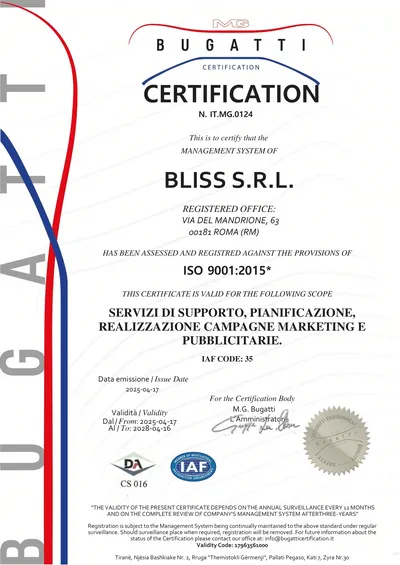
ISO 9001 – Process quality and work organisation.
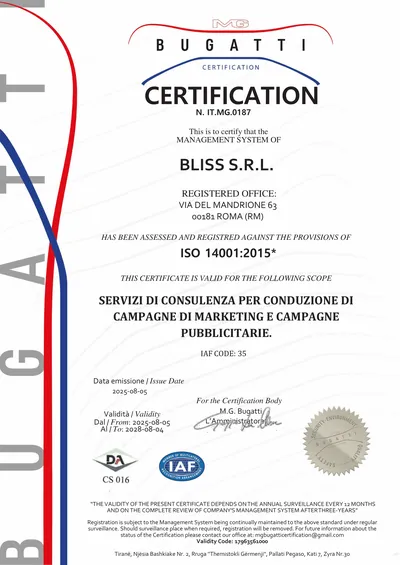
ISO 14001:2015 – Managing the environmental impact of business activities.

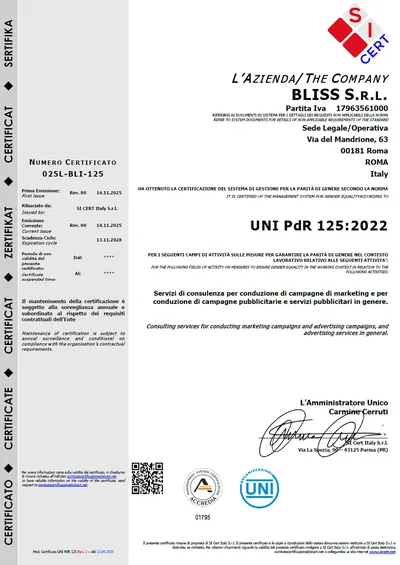
UNI PDR 125:2022 – Gender equality in processes, policies and organisation

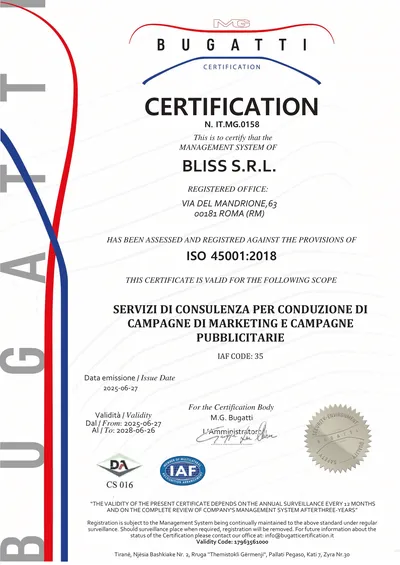
ISO 45001:2018 – Occupational health and safety.

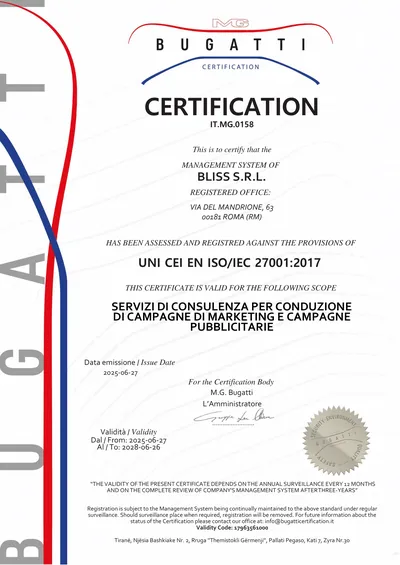
ISO/IEC 27001:2022 – Information, data and access security.
Intangible Asset Governance is the system through which an organisation identifies, measures, protects and enhances all the assets that generate its competitive advantage but do not normally appear on the balance sheet: brand, data, intellectual property, relationships, corporate culture and know-how. The aim is not to create new assets, but to govern those that already exist.
Every organisation has intangible assets. The more a company bases its growth on reputation, innovation, relationships or data, the greater the value it can generate through structured governance. The service is particularly useful for SMEs, growing companies, multi-brand groups and organisations going through expansion, investment or generational handover.
Branding deals mainly with the identity and perception of the brand. Intangible Asset Governance has a much broader scope: it encompasses the brand, but also data, intellectual property, relationships, corporate culture, processes and all the other assets that contribute to value creation. Its aim is not to communicate better, but to govern better.
Over recent decades, company value has shifted progressively from tangible to intangible assets. Today much of the market value of leading companies derives from elements such as brand, knowledge, data and relationships. Governing these assets means protecting the most strategic part of a company’s asset base.
You will receive a documented Intangible Asset Governance system: a complete asset inventory, asset scoring, a risk map, governance rules and a long-term monitoring plan. Not just an analysis, but an operational tool designed to guide future decisions.
The initial phase generally takes around eight weeks, during which the assets are mapped, their value is measured and the governance system is built. An ongoing oversight service can then be activated to monitor how the intangible assets evolve and to update the system as the context changes.
No. In most cases the programme initially involves management and those responsible for the main business functions. The aim is to gather the information needed to build a shared system, without disrupting day-to-day operations.
Not everything can be expressed as a precise economic value, but every asset can be assessed through objective indicators of quality, risk, maturity and consistency. Intangible Asset Governance exists precisely to turn what is normally perceived intuitively into a system that is measurable and comparable over time.
Traditional consultancy often addresses a single problem. Intangible Asset Governance, by contrast, builds a permanent system capable of guiding future decisions and preserving the value of assets over time. The aim is not to deliver an opinion, but to leave the organisation with a management method.
Because corporate governance systems still focus mainly on tangible assets, while company value depends increasingly on intangible ones. The Bliss Framework was created to close this gap and give organisations a structured tool for governing what is now the most significant component of their value.
Because the market values them even when the balance sheet does not reflect them. A recognised brand, a solid reputation, a reliable body of data or established relationships can determine the outcome of a negotiation, influence a due diligence or increase the perceived value of the company. Intangible Asset Governance exists to bring method and continuity to what, all too often, is left to intuition.
Audit
Corallo.Ai
Operations
Contact
06 86357195
contatti@blissagency.it
Place
Via del Mandrione, 63 RM
Via Brembo, 5 MI