




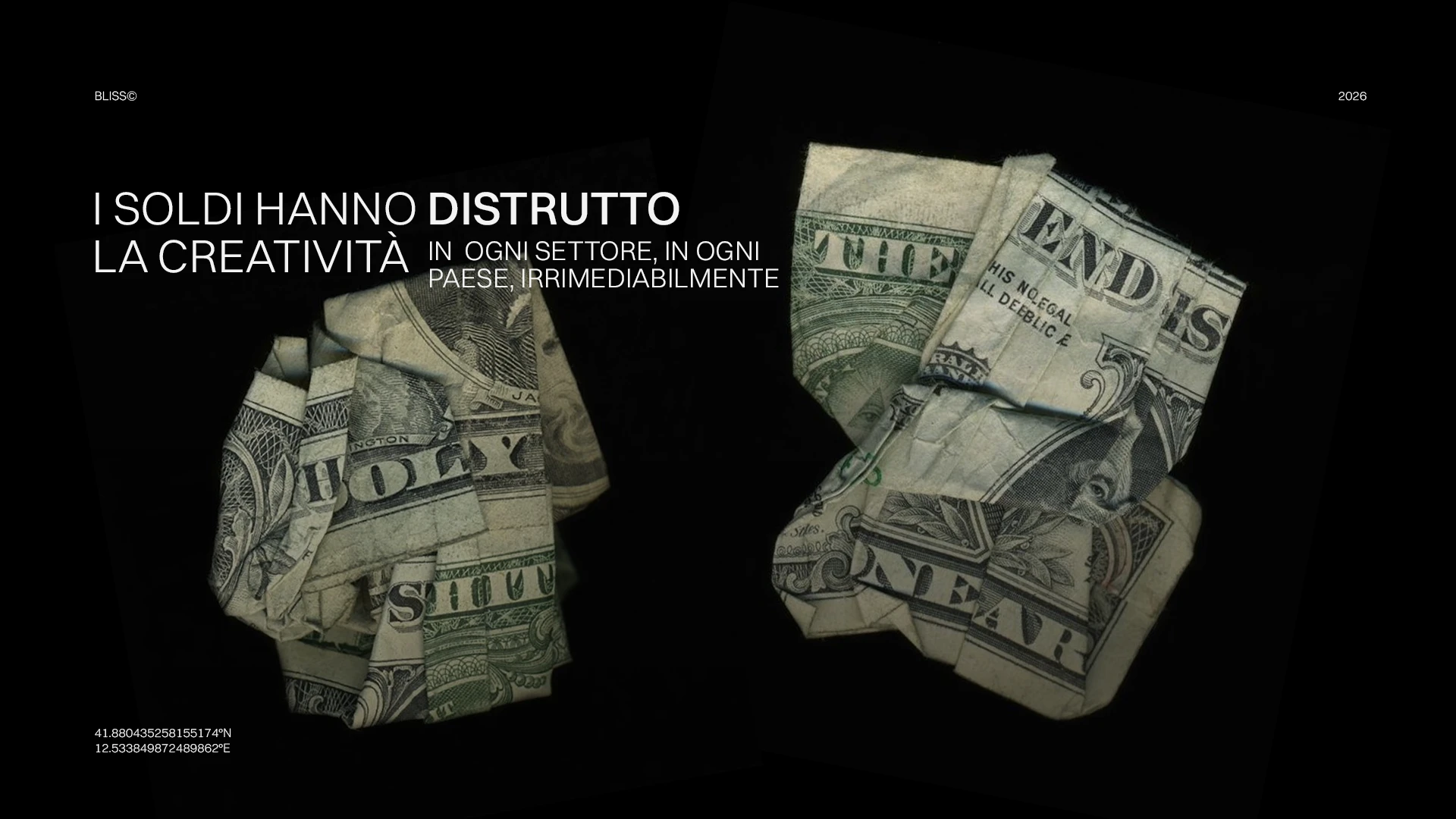
Let us pause for a moment and look at the state of the art world.
We could, if we wished, extend the thought to sport, gaming and social life as a whole but, for now, let us focus solely on the seven sisters and ask ourselves, together: why are cinema, music, publishing and television going through the same crisis, with the same symptoms, at the same time?
Different sectors. Different supply chains. Business models far removed from one another, and audiences that very often do not even overlap. And yet the disease appears to be the same: the progressive disappearance of creative risk. The concentration of investment on what has already been proven. The structural inability to bet on something that does not yet have a guaranteed audience.
This article will not complain about today’s culture.
That would be a simple answer to the complexity of the world. It would be a proposition that, all things considered, would even find an audience happy to read it with relish. But no: instead, we will analyse the economic mechanisms that have turned the cultural industry into a risk-management system. And what happens when that system takes control.
Because yes, for anyone who hasn’t grasped it yet: there is only one virus, and it is killing art.
Patient 1: cinema: and its sequels
Since 2000, the share of original films produced by Hollywood has fallen from 40.9% to 18.6%.
We could stop right here, because it means, put simply, that only one film in five is new and unseen; that only one proposal in five (in fact, fewer) attempts to offer something original.
But let us go on: of the twenty highest-grossing films worldwide in 2024, eighteen were sequels, prequels or adaptations of existing material. In 2025, every single film on the worldwide box-office list was a sequel or a remake, with the sole exception of F1: The Movie (not exactly the film with the most bewildering plot in the catalogue, let’s say…).
Mind you, I understand the reason.
When hundreds of millions are invested, you want the certainty of a return, and of a profit too. The problem, though, is that cinema was not born on these premises, but on creativity; on the desire to portray compelling, gripping stories.
With the birth of the film industry, this principle perhaps faded steadily, but it is only in recent years that the shift has become so systemic. As if cinema had now gone from art to merely an asset for portfolio diversification.
So, if a film guarantees strong box-office takings from the outset, the money goes in and it gets made.
If the film is uncertain, or carries too many risks, it does not even go into production.
A franchise with an established fanbase lowers the perceived risk. George Lucas had already told us:
“If you go to a studio saying ‘I’ve got something you’ve never seen before, and you don’t understand it’, it’s very hard to get a deal. The big studios want something similar to something they’ve already seen, because they have no imagination.”
The fact, however, is that this risk strategy is producing increasingly mediocre results.
Global box office in 2025 settled at around 360 million dollars, still below pre-pandemic 2019 levels. And so, in trying to risk less, cinema is proving that it earns less. Franchise loyalty is a form of rent that gets used up.
And so along come great examples such as Sinners: an original film by Ryan Coogler, shot on celluloid, written from scratch and set in 1932 Mississippi, tackling Jim Crow, the blues and vampire mythology in a single narrative gesture. $370 million at the worldwide box office. 16 Oscar nominations, an all-time record in the history of the Academy.
But we could give other examples, such as the recent Obsession and Backroom, by very young directors, which are posting extraordinary numbers.
Examples that show audiences respond better to original quality than to franchises.
No, the system has not stopped working. It has simply grown bored of the same old rubbish.

Patient 2: music and the algorithm as producer
Pop music has always had a commercial component. The difference from the past, here, is not that music built to sell exists: it is that the system deciding what sells has changed, and with it the nature of what gets produced.
Today, the music industry has two main engines: Spotify and TikTok. The first with its algorithm that builds culture; the second with the need to create tracks with perfect snippets to spark trends.
Today’s music revolves entirely around this.
Let us start with TikTok.
More than 80% of the tracks that enter the most important global charts (such as the Billboard Global 200) went through a moment of strong virality or strong engagement on TikTok before making the leap. This means that for the industry, TikTok is not just a promotional tool but a blueprint to adapt to. And that is because writing music for the algorithm gets results. Albeit with major consequences.
The first of these consequences is technical.
Music has changed to suit TikTok. Lyrics have become more visual (so they translate more easily into images), songs shorter (from the 3-4 minutes of a few years ago to 2 minutes) and intros more immediate. In the scroll, there is no time for long instrumental introductions. The catchiest part of the track must arrive within the first 10-15 seconds to stop the user skipping the video.
But all this is normal, right? After all, music also changed with the arrival of radio, and again with the birth of MTV.
Less normal, however, is the impact on musicians: the interdependence between music and social media has made artist burnout systemic (artists live under constant pressure to be “content creators” even before musicians), while also shortening the average life of a song. Today, it is saturated after just a few days.
Spotify’s impact on all this is no smaller.
Every scroll, every skip, every listener behaviour feeds systems that decide what the world listens to. This means the creative process has now bent itself around this logic. Not that music cannot be made any other way, but making it at the highest level means pleasing the algorithm as well as the human ear.
Not to mention AI. In July 2025, an entirely AI-generated band called Velvet Sundown racked up more than one million streams on Spotify before most listeners realised it did not exist. In November 2025, Xania Monet became the first AI artist to debut on a Billboard chart, reaching the top of the R&B Digital Song Sales chart with 44.4 million official streams in the United States.
The market rewarded these products because they delivered what the algorithm was looking for: measurable engagement, without the cost and risk of a human artist with a vision of their own.

Patient 3: a stagnant publishing industry
In the first six months of 2025, trade book sales fell by 2.8% compared with the same period in 2024.
Adult non-fiction lost 3.1%, with biography and memoir down 10.7%.
Nobody reads any more: or at least, adults read less and less. And although the most immediate blame might fall on the frantic pace of the world and on individual readers (Italians above all), it is also true that the major publishers now concentrate their marketing and distribution resources on an ever-smaller number of titles. Risk is increasingly contained, and young writers find it ever harder to get published without paying a fee.
A handful of guaranteed bestsellers absorb the system’s attention, while the average backlist is gradually abandoned.
All this at the expense of new ideas, which are now almost impossible to pitch.
Patient 4: TV and spin-offs
Television series went through an extraordinary period of creative expansion between 2010 and 2018.
House of Cards, The Wire, Breaking Bad, Mad Men, True Detective, Game of Thrones. Productions that treated the serial format as a space for complex, risky storytelling.
But today, with Netflix’s binge-watching logic and post-pandemic streaming, that moment has vanished.
Here too, the creative process bends around the logic of the algorithm: shorter trailers, opening episodes built to capture those who watch everything in a single sitting, content optimised for mobile attention spans, and dialogue that needs to recap the plot every few episodes, because whoever is watching is probably distracted and has their phone in hand.
The result is television that mainly produces extensions of existing narrative brands: spin-offs, prequels, expanded universes.
Or, at most, reality shows (which are, accordingly, very affordable to make).

The common virus
Cinema, music, publishing, television: by now it should be clear that the common denominator is not a lack of creativity but, rather, the system of capital allocation.
When investment decisions are made by people who must answer for them to financial structures with short time horizons, creative risk is penalised. A sequel with a fanbase of ten million people is defensible in a board presentation. An original project with a vision nobody has yet seen is not.
This means creativity has not disappeared. It has simply moved to the margins of the industrial system, where there is less capital but more freedom.
Sinners exists because Coogler negotiated terms that allowed him to shoot the film he wanted to shoot. The most interesting projects in contemporary music come from independent artists who do not depend on the majors’ algorithm. The boldest books come from small publishers that do not face the same performance pressures as Mondadori.
And yet the big players should remember that what they are enjoying today is a pure and simple annuity. And that every annuity was, at the outset, a bet that someone chose to make.
The mechanism that governs the cultural industry is not so different from the one that governs many large organisations. When decision-makers answer mainly to the logic of short-term returns, creative risk gets squeezed.
The brands that resist franchise logic, in culture as in any other sector, are those capable of defending their identity even when the market suggests giving way.
That capability is the condition that determines whether a brand will still exist ten years from now.
Art’s illness is serious, but sooner or later it will pass. If not thanks to the big industries, then simply because the survivors will be the immune: those that were able to look beyond quarterly returns.
New Connections (FAQ)
Is there still a cultural sector that manages to bet on the original?
Yes, but it sits at the margins of industrial systems, not at their centre. Long-form podcasts, independent fiction, self-produced music distributed directly, auteur cinema funded by European public money: these are spaces where the logic of immediate returns is less pressing and creative risk still has a place. The paradox is that those margins are almost always where the ideas come from that the industrial system will buy and turn into franchises over the following ten years.
Does this logic also apply to brands that sponsor cultural productions?
Even more so. A brand that ties its image to a safe franchise gets guaranteed visibility with a predictable audience. A brand that backs an original project gets something rarer: association with an authentic voice in a landscape saturated with voices optimised for the algorithm. The cost of creative risk is real, but so is the value of distinction. Brands that have built strong identities over time have almost always made at least one cultural bet that looked risky at the time.
Will AI applied to creativity improve or worsen this situation?
Probably both at once. AI further lowers the cost of the replicated franchise: it allows sequels and spin-offs to be produced faster and more cheaply, accelerating the drift towards standardisation. At the same time, it lowers production costs for independent creators, putting within reach production tools that once required industrial budgets. The likely result is an even sharper polarisation: on one side, standardised industrial content produced at scale; on the other, original voices armed with more powerful tools than any previous generation.