




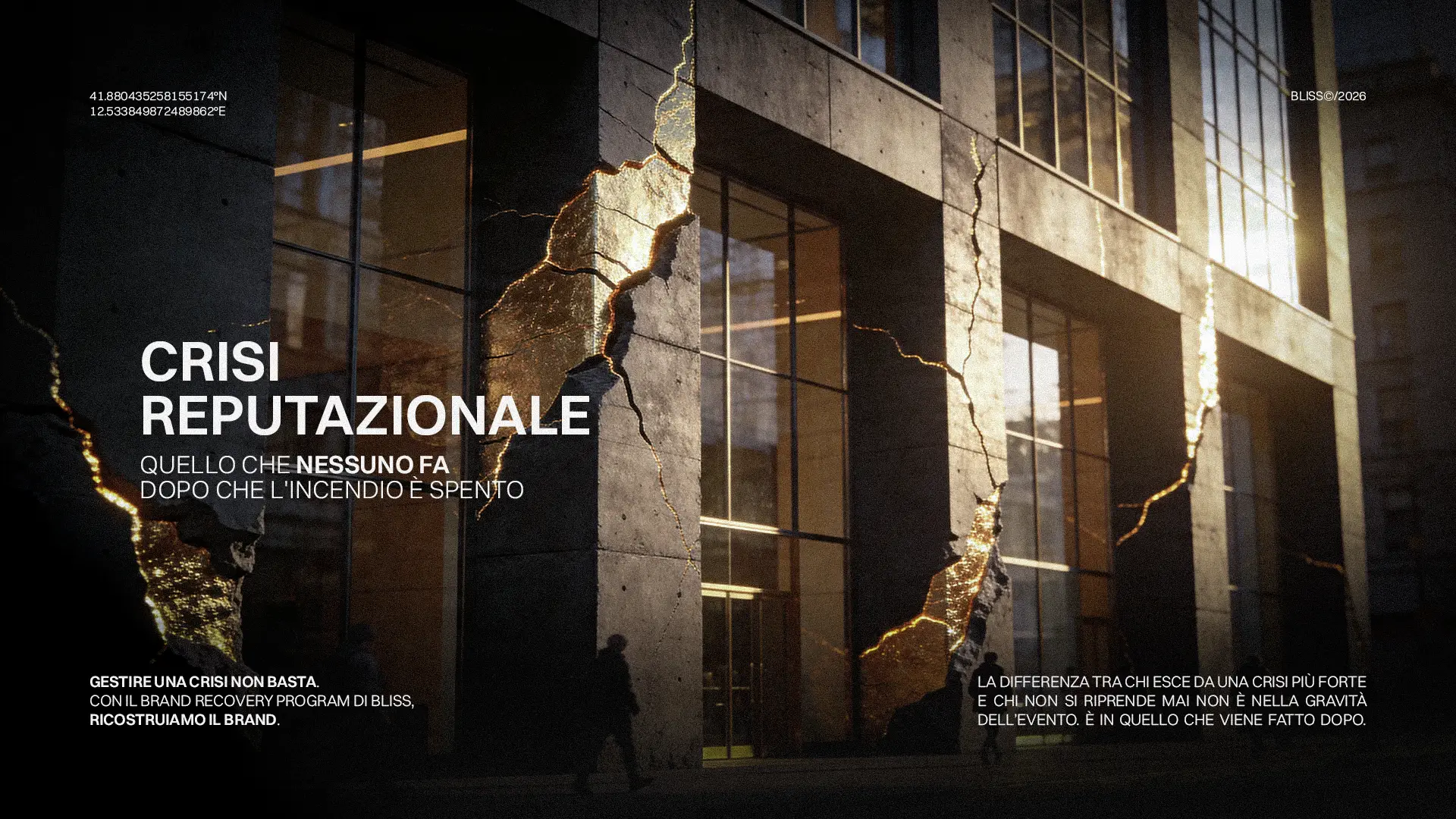
Even if the fire is out, the blaze has done its damage.
And a little water will not be enough to wash it all away.
Every reputational crisis is handled the same way: press releases, CEO statements, public apologies. Then comes media silence. And after a few weeks, everyone goes back to work as if nothing had happened.
The problem is that the brand has not returned to what it was.
Indeed, it may never do so.
What remains after a crisis only becomes visible in the months that follow. Inconsistent positioning, an ungovernable narrative. However much you want to put the crisis behind you, it does not seem possible: all because no one thought to rebuild the brand.
And so Bliss has created a new service, never conceived before: designed for a problem no one had ever noticed. The calm after the storm.
We interviewed Francesco Acri, CEO and founder of Bliss Agency, to understand how the Brand Recovery Program works.
The cases everyone remembers, for the wrong reasons
The Ferragni pandoro-gate has become a case study, though perhaps for the wrong reasons.
Most analyses, in fact, stop at emergency management: the Antitrust fine, the wrong response on social media, the months of silence. All true. But the deeper damage lay elsewhere.
“Take the Ferragni case,” our CEO tells us. “Over the years she had built a brand worth hundreds of millions, but out of the blue the pandoro affair redefined the limits of what Ferragni could say and do. Some partnerships became impossible, while certain messages stopped being credible. The narrative changed: those who tried to correct it focused on the immediate problem, without looking any further.”
The same could be said of the Volkswagen case, albeit on an industrial scale. Dieselgate struck the brand at its most strategic point: its credibility on sustainability collapsed at a time when the entire automotive sector was building its narrative on that very territory. The fines may have been recoverable, but the competitive territory lost to the crisis was less so.
“The most serious damage comes when the papers stop writing about it.”
The idea for the Brand Recovery Program stems from this realisation.
“This is an observation that seems obvious to me,” says Francesco Acri, “and yet no one has ever tried to turn it into a service. When a brand goes through a reputational crisis, it finds specialists for every stage: media management, legal risk, new content. But no one looks after the brand itself. The positioning that has shifted. The narrative. What Google and AI models are saying.”
Into that space, left empty for years, Bliss has now stepped.
“The most common mistake during a crisis is believing the talk will fade away. Yet the greatest damage comes when the papers stop writing about it. That is because there is an illusion that you can return to normal: resume communicating as before. The world does not reset. Negative content stays indexed for years. There is no going back: I believe instead that you should move forward. Find new territory that integrates the crisis as part of the story. Without hiding it.”
A structured programme
Bliss’s Brand Recovery Program is structured in three phases and covers both prevention and the management of current or past crises.
“We are ready to step in within 48-72 hours. We immediately analyse what has changed in the positioning, what appears when you search for the brand online, and what AI models say. Bliss always produces measurable data, which is essential in times of crisis.”
The analysis is followed by a strategic phase and then an operational phase, which together turn every crisis into a structured programme.
“We are not a marketing agency that happened to find itself managing a crisis”, Acri points out. “We have studied this problem for years. We created a process to address it. We built a method that integrates strategic advisory, brand governance and operations into a single system. Three areas of expertise that normally sit in three different firms, which do not talk to each other, and which in a crisis must instead work in perfect sync. A simple marketing agency, whether in-house or external, cannot handle certain dynamics with clarity. We can.”
A crisis is an event. Rebuilding is a choice
99% of companies consider reputational risk one of their main strategic issues.
A serious crisis can wipe out 30% of market value in a matter of days. 69% of brand executives have already been through a crisis in the past five years. Often, without recovering.
What the data do not show, then, is how much value keeps being lost quietly, while no one is watching any more.
“The difference between those who emerge from a crisis stronger and those who never recover“, concludes Acri, “lies not in the severity of the event. It lies in what is done afterwards. Those who manage only the emergency let the market write the story. Those who rebuild the brand decide for themselves which story to tell.”
If you are going through a reputational crisis, or want to prevent one, the first step is a conversation.
Discover Bliss Agency’s Brand Recovery Program service.
New connections (FAQ)
What is the difference between crisis management and a Brand Recovery Program?
Crisis management steps in during the most acute phase of the emergency. It handles immediate communication, press relations, public statements and legal risks. The Brand Recovery Program begins where this work generally ends. It analyses what the crisis has changed in the brand’s positioning, reputation and perception, in order to build a new direction capable of restoring trust and value over time.
When should a Brand Recovery process begin?
The process can begin during the crisis, immediately after it ends, or when reputational effects continue to surface months or years later. The sooner action is taken, the greater the chance of preventing negative content, inconsistent interpretations and new associations from becoming entrenched. The programme can also be used preventively, to prepare responsibilities, procedures and scenarios before a crisis occurs.
How do you measure a brand’s recovery after a reputational crisis?
Recovery is measured by tracking how online reputation, search results, AI-generated answers, sentiment, stakeholder trust and brand associations evolve. These indicators are complemented by commercial data, the quality of partnerships and the organisation’s ability to reclaim credible narrative territory. The end of media attention, on its own, does not prove that the brand has recovered.
BLISS®
© 2026. ALL RIGHTS RESERVED