




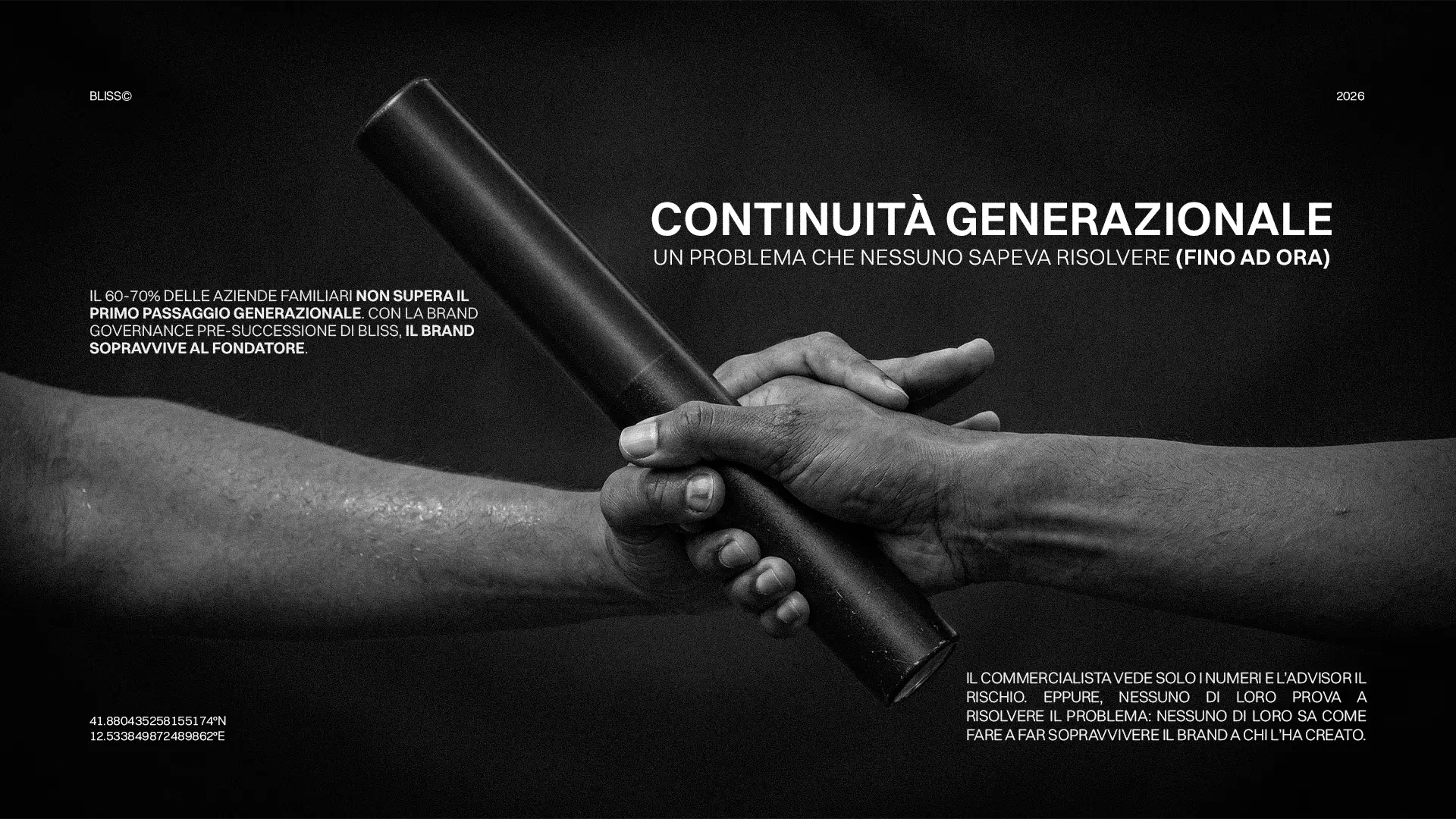
Francesco Acri, CEO e founder di Bliss, racconta come è nato un servizio che non esisteva. Per un problema che tutti conoscono, ma che nessuno aveva mai affrontato nel modo giusto.
60-70% of Italian family businesses do not survive the first generational handover.
The official cause is financial; the real one is that many organisations live in the founder’s mind. And when the founder is gone, the vision is lost.
Of course, there are accountants, notaries and advisors, yet none of them deals with the brand. And until now there has never been a structured counterpart able to do so.
This is how a service nobody had ever thought of came about, for a problem nobody had ever noticed: Generational Continuity.
We interviewed the CEO and Founder of Bliss, Francesco Acri, to discuss it.
When the company was Dad
When it comes to succession, before the numbers we need to talk about people – the families who find themselves running something they no longer know how to talk about. Because the person who knew how is no longer there.
The most frequently cited case in Italy is that of Leonardo Del Vecchio and Luxottica.
On his death in June 2022, the estate of the eyewear giant (an empire worth 30 billion dollars) entered a prolonged period of uncertainty. Three different wills, six children from three relationships, disputes over inheritance tax, governance hanging in the balance. Luxottica had already merged into EssilorLuxottica before the founder’s death, which partly cushioned the impact, but the affair revealed an alarming prospect.
What would have happened if Del Vecchio had not formalised the merger in time?
It may seem otherwise, but the answer does not concern Luxottica alone. If anything, it concerns all 820,000 family-owned businesses in our country, which make up 80.9% of Italy’s business landscape. Companies in which the founder is strategist, manager and public face, all at once.
And where, for that very reason, an exit (sudden or planned) would pose an immense risk.
This is why only 30% of family businesses ever come to be run by the second generation.
And only 12% beyond the third.
“I have seen entrepreneurs brought to their knees. And I understood what was missing.”
Our CEO started from a simple observation.
“Years of working with established companies,” our CEO told us, “have always shown me the same pattern. When a succession is planned, everyone thinks about tax and legal matters. Then comes the moment of the actual handover, which may be planned or perhaps sudden. That is where the problem arises, because the brand no longer knows how to exist on its own.”
“By professional habit, the accountant sees only the numbers and the advisor only the risk. Yet none of them tries to solve the problem: none of them knows how to make the brand outlive the person who created it.”
That is why Bliss launched its Generational Continuity service: a rigorous, structured process that never loses sight of the human side.
“Imagine losing a father who, for thirty years, worked every single day to build something important. Suddenly you have to deal not only with grief, but also with a company whose dynamics and logic are not your own. Clients ask you about him. Suppliers treat you differently. Even the narrative revolved around your father, not you. It is an enormous burden, one that nobody is ever ready to carry.”
Easing that burden is what this service is built on.
A service that did not exist
Bliss Agency’s Generational Continuity service is a structured programme that turns the brand from a personal dependency into a transferable asset.
“The idea,” Francesco continues, “is to speak to anyone who has built an organisation they want to last. From the sixty-year-old founder who knows the handover is approaching, to the heir who has just taken over a company and does not know where to start. But also, why not, to those who want to grow without having to be everywhere.”
To achieve this, the service occupies a space that no professional figure has ever tried to cover before.
“In all these cases, the problem is the same: the brand does not work without you. And that has a cost. Financial, operational, emotional. We want to free owners and successors from any such burden.”
The right moment is always earlier than it seems necessary
No one is ever ready for a succession.
We would rather never think about it, almost as if the very idea made it more imminent, and real. It is not a lack of will. It is not a lack of time. The hope is that the moment is as far off as possible. And yet, that is not always the case.
“Can your brand survive a succession?” Francesco concludes. “It is an uncomfortable question, I know, but sooner or later it has to be asked. It will certainly be a difficult transition: it always is. But the right time to act is now: tomorrow may already be too late.”
If you are thinking about the future of your company, or if that future has arrived sooner than expected, the first step is a conversation.
Discover the Generational Continuity service from Bliss Agency.
New connections (FAQ)
How do you transfer the founder’s authority without losing the brand’s identity?
By codifying what exists only in the founder’s head: positioning, decision-making criteria, tone of voice, operating values. The founder’s authority lies in the system they built, not, as one might think, in the person. When that system is documented and transferred, the successor can lead a brand that already has an identity of its own, recognisable and applicable regardless of who leads it.
What does a family business risk if it does not plan its generational handover?
It risks losing value silently. Without clear governance, every decision the new generation makes is perceived by clients, staff and the family itself as a threat to the company’s origins. Research by AIDAF-AUB Bocconi shows that fewer than 30% of Italian family businesses survive beyond the second generation. The main cause of this is the lack of a system that makes the handover governable.
What is the difference between generational handover and founder-independent branding?
A generational handover transfers ownership and leadership of the company. Founder-independent branding transfers the brand. They are different operations that almost always need to coexist. A generational handover without founder-independent branding leaves the successor with a functioning company and a brand that spoke its predecessor’s language, one that risks losing relevance with every day that passes without a system capable of updating it.
When is the right moment to start working on brand continuity?
Before you need it. With 18-24 months’ notice, you build a system that stands on its own. With less than six months, you produce documents, not structures. The difference between the two outcomes is proportional to the time available.