




La guida completa per Agenzie e Brand al palmares dei Cannes Lions, in questo nuovo numero della rubrica Gold Brief.
A Grand Prix at Cannes is a precise snapshot of what the industry has decided to treat as its standard for the following twelve months.
Among marketing awards and international digital awards, none carries the same symbolic weight in setting the industry’s direction.
As analysed in the strategic guide to the Cannes Lions, the Grand Prix is awarded only once per category, when the jury identifies work of absolute excellence. In some years it is not awarded at all. This rarity makes every Grand Prix a signal of direction: studying the winners of recent editions is not an exercise in nostalgia. It is one of the most useful and least expensive tools of competitive analysis available to anyone building entries for future editions.
In this new article in the Gold Brief column, we analyse the trends that have emerged in the Cannes Lions Grand Prix in recent years, what the winning projects have in common and what this suggests for anyone planning an entry for future editions.
Gold Brief is the category of the Bliss blog for those who want to understand how recognition in marketing really works. In this column you will find practical guides to the international awards that matter (creativity, strategy, performance, design, SEO, innovation and much more), with everything you need to enter. Because the perfect brief is not written in a day: if anything, it is built every day.

Why Studying the Grand Prix Pays Off
The make-up of the Cannes Lions juries changes every year, but the implicit criteria guiding their decisions move more slowly and follow identifiable trends. An agency that analyses the Grand Prix of the last three or four editions builds a map of what the industry rewards at this point in time, not of what it rewarded ten years ago.
This analysis has direct practical value. It allows you to calibrate your entry to the criteria juries are actually applying. This holds for every international marketing award, but at Cannes Lions, where the Grand Prix is the scarcest and therefore most meaningful signal, the analysis delivers the greatest return.
The Grand Prix remains the advertising award with the greatest ability to shape the judging criteria of the industry’s other digital contests.
Trends of Recent Years
| Period | Grand Prix trend | What It Signals |
| 2021–2022 | Growth of social-impact and purpose-driven projects | Juries reward cultural relevance as well as craft |
| 2023 | First wins for projects with integrated generative AI | Technological innovation enters the judging criteria |
| 2024 | Consolidation of data-driven, long-term projects | Juries reward systems, not just one-off campaigns |
| 2025 | AI criteria mature: integration is rewarded, not novelty | The bar for superficial use of AI is rising |
The Rise of Purpose-Driven Work
Between 2021 and 2022, a significant share of the Grand Prix went to projects with an explicit social or impact component. Campaigns addressing inclusion, sustainability or social justice carried greater weight in judging than in previous editions.
This does not mean that technical quality has become secondary: the winning projects maintained high standards of execution. It means that the jury began to weigh cultural relevance and social impact as an additional criterion, not a substitute for creativity and effectiveness.
The Arrival of Generative AI
Since 2023, the first projects with generative AI components have begun competing for the Grand Prix, particularly in the Digital Craft Lions and in some innovation categories. What these winning projects had in common was not the use of AI in itself, but the integration of AI into an experience or a system that produced a result that could not be replicated with traditional methods.
As explored in the article on artificial intelligence awards, the distinction between decorative AI and structural AI was already visible in the implicit criteria of the Cannes juries before it became an explicit criterion in other international awards.
The Consolidation of Systems
In 2024 a trend became established: the Grand Prix more frequently rewarded projects built as long-term systems rather than one-off campaigns. Brand platforms designed to outlast a single activation, strategic frameworks applicable across multiple contexts, content ecosystems that expand over time.
This reflects a maturing of the judging criteria in the Creativity Strategy Lions category, where structural thinking has begun to carry more weight than a single brilliant idea.
The Maturing of AI Criteria
In 2025 the bar for projects with an AI component rose noticeably. Projects that in 2023 could have competed on the novelty of their technological integration alone do not get past pre-selection in 2025 unless they demonstrate measurable differential impact.
This confirms the trajectory described in the article on AI awards: the field has taken shape quickly and judging criteria have been refined accordingly.
What Winning Projects Have in Common
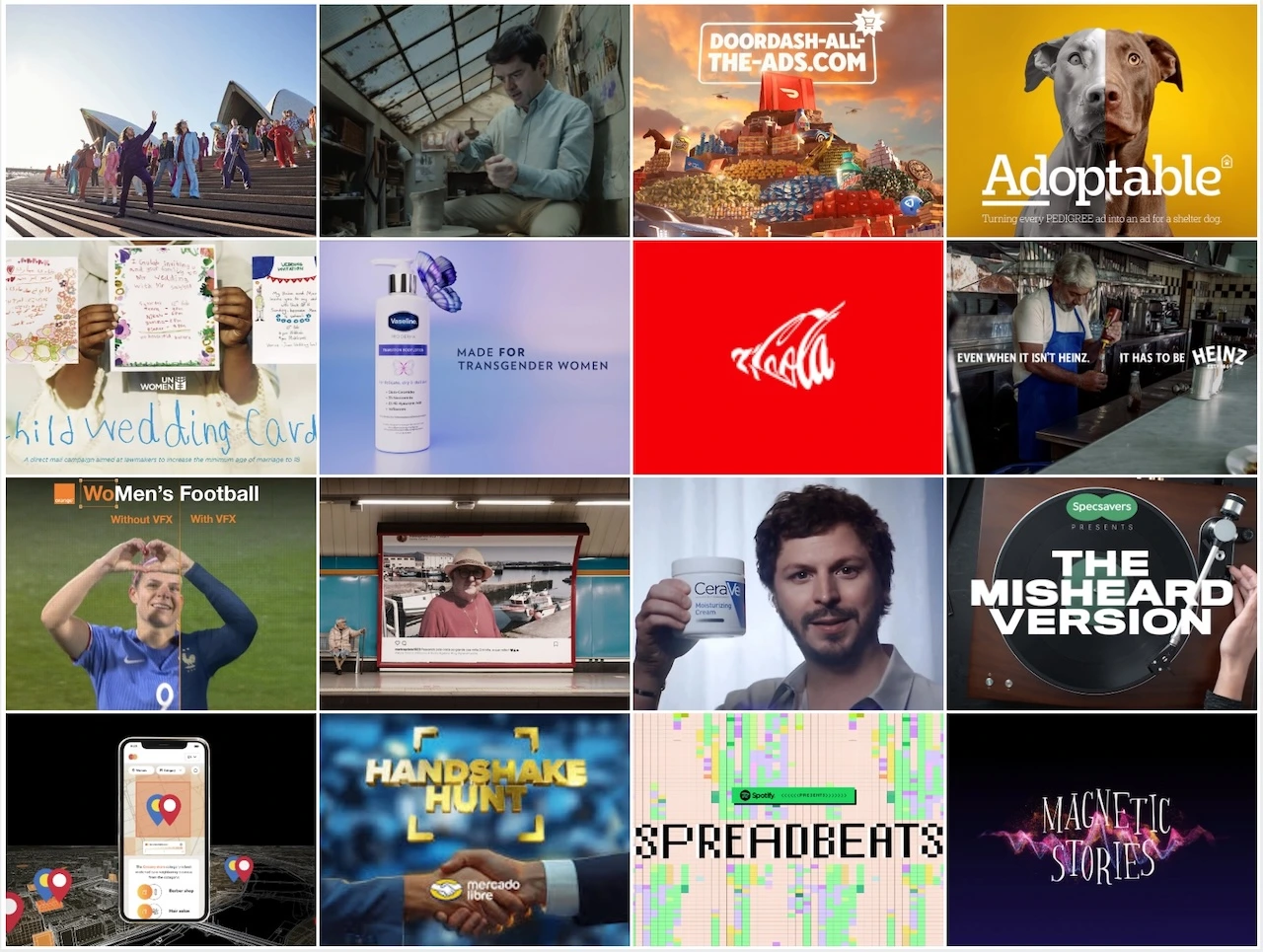
Beyond thematic trends, recent Grand Prix winners share four structural characteristics:
The first common element is clarity of insight. Every winning project can be summed up in one sentence that captures a truth about human behaviour or cultural context that had not previously been articulated with the same precision. Complex execution does not make up for a weak insight.
The second is coherence between the scale of the idea and the scale of execution. Winning projects are not necessarily those with the largest budgets, but those in which execution is proportionate to and consistent with the ambition of the idea. A small idea executed perfectly does not win a Grand Prix. Nor does a big idea executed incompletely.
The third is verifiability of results. Even in the categories most geared towards pure creativity, recent Grand Prix have gone to projects that could demonstrate concrete, measurable impact, not merely presumed impact. The industry’s broader shift towards demanding effectiveness, already dominant in awards such as the AME Awards, has also permeated the implicit criteria of the Cannes juries.
The fourth is relevance to the industry. Winning projects leave behind something other professionals can apply elsewhere: a technique, a format, an approach. Work that perfectly solved a specific problem without contributing to the industry’s language rarely reaches the Grand Prix, even when it wins Gold or Silver in its own category.
How to Use This Analysis for Future Entries
Juries penalise the repetition of formulas that have already been rewarded. For this reason, the analysis of the Grand Prix we have just carried out will not serve to replicate the themes or techniques of past winners. At most, it can help to understand the direction in which judging criteria are moving.
Anyone planning an entry for upcoming editions of the Cannes Lions should ask whether their project shares the same structural characteristics: an insight not yet articulated with that degree of precision, a scale of execution consistent with the ambition, a verifiable result, and relevance that extends beyond the individual client. As described in the article on how to build a case study video, the ability to communicate these elements clearly in the first few seconds of the entry is what determines whether the project receives the attention needed to be judged on its merits.
New Connections (FAQ)
Does studying past Grand Prix really help build a better entry?
Yes, but not in the way many agencies interpret it. It is not about replicating themes or techniques that have already won, which juries tend to penalise as repetition. It is about understanding which structural characteristics, clarity of insight, coherence of scale, verifiability of results, relevance to the industry, juries are actually rewarding right now. It is an exercise in analysing criteria, not imitating content.
Has AI made it easier or harder to win a Grand Prix?
Harder, in a specific way. In the first editions featuring AI projects, technological novelty alone could capture the jury’s attention. In more recent editions the bar has risen: to compete, an AI project must demonstrate structural integration and measurable differential impact, not the mere presence of the technology. This has made the field more competitive for those using AI superficially and more accessible for those who have integrated it systemically.
Do the Grand Prix always go to the biggest brands or agencies?
No, not systematically. Budget scale is neither an explicit nor an implicit judging criterion for the Grand Prix. Projects with modest budgets but coherent execution and a precise insight regularly compete with productions by global brands. The decisive factor is the quality of thinking and the coherence of execution relative to the scale available, not scale itself.