


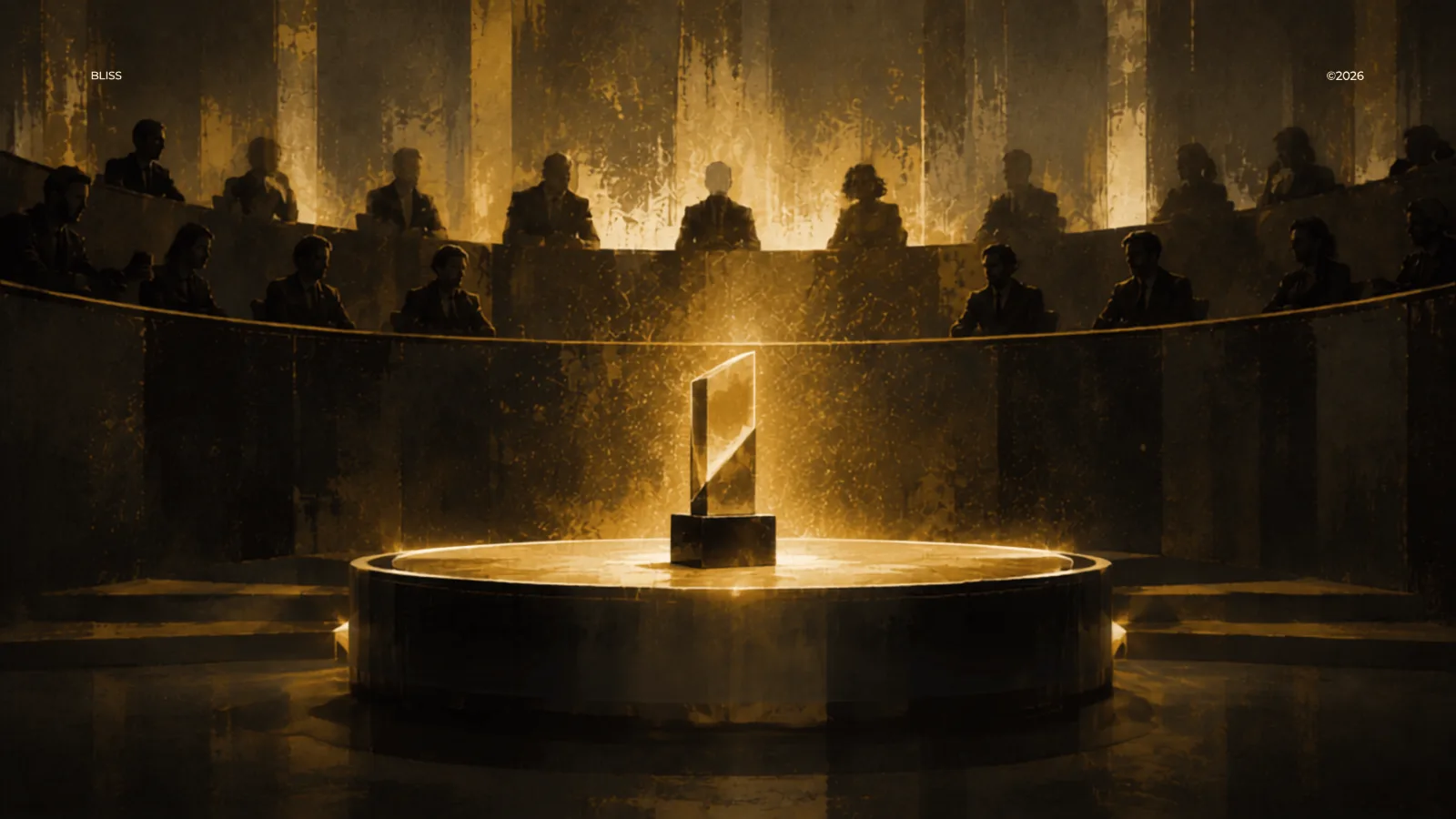
A jury’s verdict influences the industry for years. Yet the award is decided in just a few days.
When an advertising campaign wins something, it immediately finds its way into presentations, articles, lectures, pitches and creative meetings. It is studied by agencies, shown to clients and used as a reference to explain what excellence looks like at that moment.
And so, an award recognises work that has already been produced. It signals the direction in which many others will try to move. This holds for every digital contest, whether a local advertising award or one of the most authoritative international marketing awards on the planet.
The point, however, is that this direction, this new turn for the industry, does not depend solely on the industry. After all, nothing in the world is objective, since everything passes through people’s eyes. That is why the make-up of a jury matters more than it seems.
The Gerety Awards build their benchmark through an international all-female jury. The Epica Awards entrust judging to journalists. The Effie Awards look above all at the relationship between strategy and results.
The difference lies not in the work being observed but in the meaning attributed to the quality of the campaign, which changes along with the eye that judges it.
In this article we analyse the power of juries in marketing awards and international digital awards, the way they help define creative standards and the consequences each verdict has on the future work of agencies and brands.
Who Sits in the Room Changes the Outcome
The quality of a project is viewed through a professional culture, a system of expectations and a set of priorities. It does not exist in a vacuum.
A creative director recognises the difficulty of an execution and the risk contained in the idea. A marketer focuses on the relationship between the campaign and the business problem. A journalist identifies the narrative strength. None of these perspectives is enough on its own to define the universal value of a piece of work, because each one brings a different part into view.
The composition of the jury is one of the most important pieces of information to look at when deciding to enter an award (or when analysing one).
Cannes Lions: Creativity Judged by Creativity
As analysed in the Gold Brief guide to who wins Cannes Lions and why, the Grand Prix point to the language the industry will begin to watch more closely. It is therefore a hugely important award, where the jury plays a crucial role in the market.
The Cannes Lions assign each section to international juries made up of professionals whose expertise matches each territory. The process involves an initial assessment of entries, the building of the shortlist and a subsequent collective discussion to award the metals. Winning a trophy requires a qualified majority of the jury.
A piece of work must score highly in the individual evaluation and then be able to hold its own in the discussion in the room.
The most influential campaigns are those that force the jury to redefine the boundaries of the category, because when a piece of work that is hard to classify receives the highest recognition, the award signals that the discipline has just expanded.
Gerety Awards: Changing the Jury to Change the Benchmark
The Gerety Awards stem from the decision to build an international all-female jury to view creativity through a historically under-represented perspective.
The award openly states its aim of creating a benchmark for creativity relevant to a female audience, and of using this perspective to help redefine the future of advertising.
The principle is clear. When who judges changes, the ideas that emerge change too.
The role of the Gerety Awards goes beyond handing out trophies. The award challenges the idea that the creative standard is neutral. Every standard originates with someone who had the power to define it.
As explored in the guide to the Gerety Awards, the value of the award lies in its ability to view the same work through a different distribution of perspectives.
Epica Awards: When Journalists Are the Judges
The Epica Awards are the only global creative award judged by journalists working for publications dedicated to marketing, communications, design and technology. The jury brings together jurors from numerous international markets, changing the nature of the evaluation.
A journalist’s job is to recognise what has sufficient reason to be told.
In front of a jury of this kind, the campaign must answer a further question. Why should anyone stop at this story?
The idea may be technically excellent. The execution may be flawless. The project must also have a legible form, an element of novelty and a relevance capable of extending beyond the brand.
The Epica Awards reveal another power of juries. To award is also to distribute attention.
The selected work comes into contact with professionals who help shape the industry’s public narrative every day. As analysed in the guide to the most prestigious international marketing awards, the pyramid certifies the quality of the project. The jury helps turn it into a story capable of circulating.
Effie Awards: When Creativity Has to Prove It Worked
The Effie Awards entrust judging to professionals from across the marketing disciplines and use a framework built around effectiveness.
Jurors score each component separately, assessing the challenge, objectives, insight, strategy, execution and results. The Effie network involves thousands of marketing leaders worldwide.
The creative standard is shifting. The question concerns not only the originality of the idea but its capacity to produce a consequence.
A campaign admired by the industry loses force when its link to the objectives looks weak. A less spectacular project stands out thanks to the precision with which it interpreted the problem and delivered results.
Effie juries remind the market that effectiveness is part of a project’s quality.
This kind of verdict also influences the way agencies and brands design future campaigns. Objectives, measurement tools and attribution systems must be defined before execution, because the evidence cannot be fully reconstructed at the time of entry.
The award changes the work upstream. Campaigns must now be designed so that their impact can be demonstrated.
Webby Awards: Who Decides the Future of Digital
The Webby Awards are judged by the International Academy of Digital Arts and Sciences through a two-stage process.
Associate Members take part in the first round of judging, while Executive Academy Members select nominees and winners. The system involves a large body of professionals with creative, technical and digital expertise, and includes rules on conflicts of interest.
Among international digital awards, the Webby has a distinctive feature: as we have seen, its judgement follows the evolution of the Internet in real time.
The jury does not simply choose the best digital campaign; it helps establish what digital quality means at that moment.
When an AI agent, a creator business or an immersive experience makes it onto the list of winners, the award signals that the format has reached sufficient maturity to be judged as a discipline in its own right.
The category turns a trend into a recognised territory. The verdict helps turn it into a standard.
The Problem of Homogeneity
A jury of outstanding professionals will still produce a narrow view when the experiences in the room are too similar. Every judgement inevitably carries with it experiences, references and cognitive biases that shape how a project is interpreted.
Homogeneity reduces the number of perspectives through which the work can be read. Diversifying a jury does not mean making the judgement less rigorous, but increasing the number of elements the room is able to recognise.
The value of the Gerety Awards also stems from this principle. Epica introduces another form of distance through a journalistic perspective. International juries seek to connect different cultures and markets.
Each new perspective reshapes the question capable of bringing to light work that had previously remained invisible.
Juries and Artificial Intelligence
The arrival of artificial intelligence makes the issue even more complex.
Juries must distinguish between a decorative use of technology and a structural role for it. They must assess the human contribution, the quality of the outcome, the origin of the data, the transparency of the process and the value created for the audience. It is, on a small scale, an AI Governance problem: setting criteria, responsibilities and limits before technology takes part in decision-making.
Epica has been experimenting with artificial intelligence in the judging process since 2023: first with a test run in parallel with the official jury, then with AIJE Advisor, an optional support tool for jurors. In both cases, the verdict remains human.
The most interesting point concerns the future.
An algorithm trained on past award-winning work would risk learning exactly the standards the industry ought to be able to surpass.
A human jury brings with it biases, experiences and limitations. An algorithmic jury would bring with it the statistical memory of every previous verdict.
The Invisible Power of Juries
As we have seen, juries determine what gets awarded. Awards help define standards. Standards influence the work that agencies and brands will try to produce in the years that follow.
It is a silent chain.
It starts in a closed room and ends in the briefs, budgets, presentations and campaigns the public will see. Choosing a jury means deciding which experiences will shape the judgement, which questions will be asked and which forms of creativity will stand a better chance of being recognised.
Every award tells the story of the work that won. Its jury tells the story of the future that award is willing to imagine. Gerety Awards: A Guide to the Award That Changes How We See Creativity
Domande frequenti
Do award juries really influence future campaigns?
Yes, indirectly. Winning work finds its way into agencies' benchmarks, brands' briefs and professional training, increasing the legitimacy of the languages and techniques that have been rewarded.
Can a jury decide not to give an award?
It depends on the competition's rules. At some awards, the jury leaves the top prize unawarded when no project meets the required standard.
Could artificial intelligence replace juries?
It supports certain stages of analysis and organisation, but judging creativity requires cultural interpretation, debate and the ability to recognise ideas with no established precedent. An algorithm trained on previous verdicts would learn exactly what the industry ought to move beyond.
Fonti e riferimenti
- Cannes Lions, How Judging Works
- Gerety Awards, About Us
- Gerety Awards, Jury 2026
- Epica Awards, About Epica Awards
- Mark Tungate, The Epica Awards Welcomes Its First AI Juror
- Mark Tungate, The Ultimate AI Assistant Joins the Epica Awards Jury
- Effie Worldwide, Judging
- The Webby Awards, Judging Process
- The Webby Awards, Reviewer Guidelines