


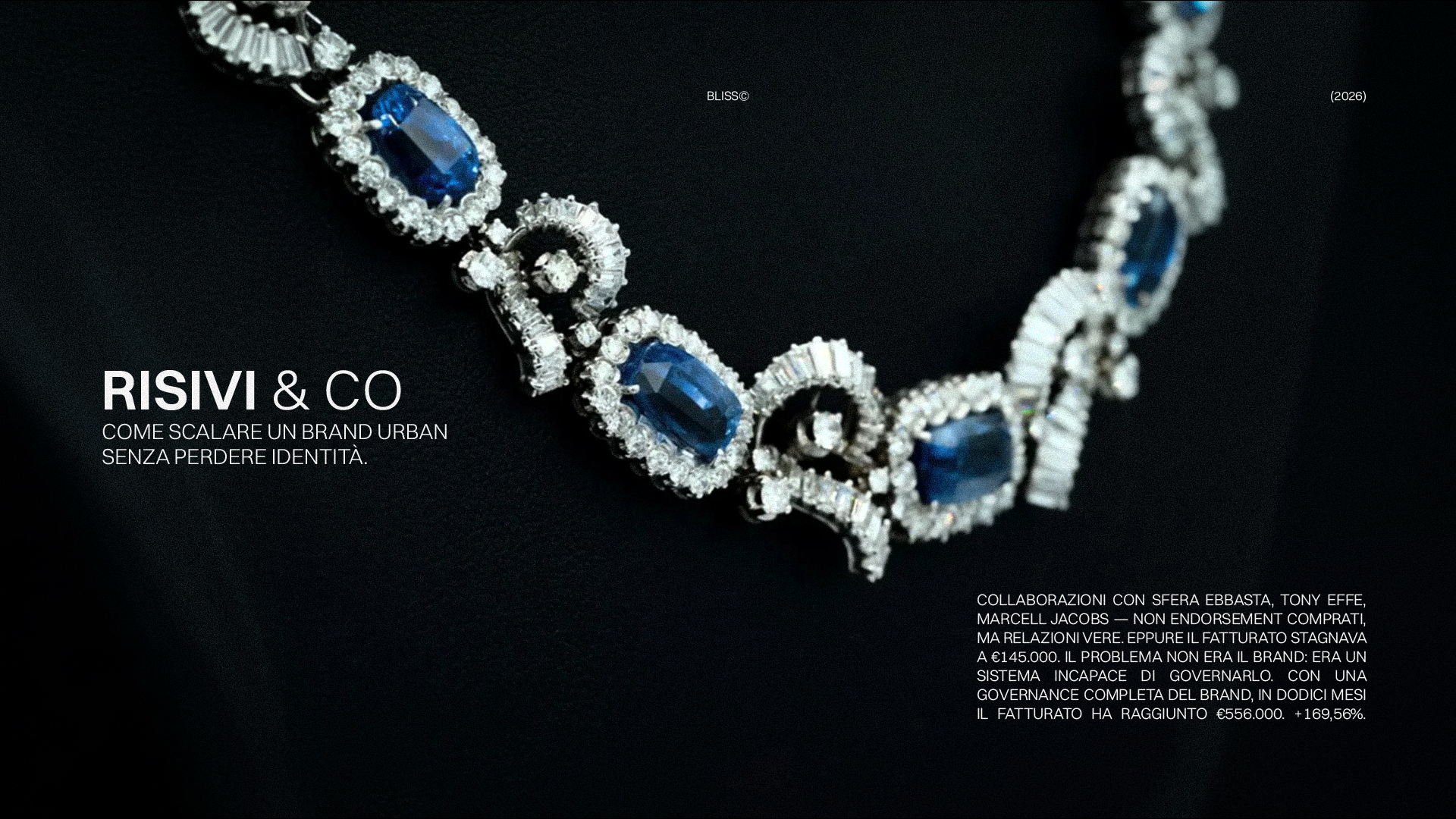
Some brands shine like precious stones.
Within them lies a spark: a precious, rare light that cannot be engineered on paper or simulated artificially.
Like its jewellery, that is what Risivi & Co was.
An artisan jeweller from Rome with deep roots in the Italian urban scene, the company could count on a reputation built piece by piece through collaborations with real artists and a strong product.
Recognisable identity. Evident potential.
Yet in 2022 revenue had stalled at around 145,000 euros. And it was actually falling.
The problem, then, was not the brand, but a system unable to govern it.
Showcasing Risivi’s value called for a vision capable of setting it like a stone.
How value leaks away when direction is missing
From the outset, Risivi & Co had everything a brand could wish for to break through in the Italian market.
This was an authentic business with a strong cultural identity, impeccable in terms of product quality, and over the years it had built genuine relationships with much of the Italian music scene.
And yet, present as it was, this value tended to dissipate.
With consequences for identity and business results.
Communication, product and market simply did not speak the same language. As a result, the brand’s activities were scattered. Although visibility was high, it did not always translate into demand.
Though present in mass culture, its positioning in the market remained undefined.
This is nothing new. It is a dynamic that often recurs in brands with a strong personal identity. The more central the founder is to a company’s image, the more the system ends up depending on them. And when that happens, scalability suffers.
Scaling an urban brand without losing its identity is a genuine governance challenge. The hardest part, perhaps, is building a system that amplifies what already exists without distorting it. For Risivi & Co, that is what we did: we gave the brand’s voice direction and, at last, a structure.
Governance as a multiplier
Bliss came on board in September 2023 with a clear mandate: full brand governance for twenty-four months. A continuous, meticulous presence, and therefore present at every key touchpoint.
The first piece of work was positioning.
The idea was to define precisely where Risivi & Co stood in the jewellery landscape, who its real audience was, and which visual and narrative language best fitted its identity.
There was no need to reinvent the brand. What needed doing was making what was already there legible to anyone.
From there, each line of work took shape naturally. Editorial plans, photo and video production, the e-commerce site, artist activations, events, SEO work. All led by a single direction, and all moving the same way.
And so content began to support the paid campaigns; the collaborations with artists helped strengthen organic reach. When a brand scales coherently, every piece reinforces the others. Positioning then lowers the cost of acquisition.
And the system feeds itself.
The scene as an asset
One of the most common mistakes in managing urban brands is treating the artistic scene as an aesthetic to imitate.
When this happens, brands slip into fashionable language and references. And the result is always the same: it feels forced.
Something audiences always sense instinctively.
Risivi & Co had the opposite advantage. The scene was already its natural habitat. Its many collaborations with Guè Pequeno and other artists on the scene were not bought endorsements but relationships built over time, grounded genuinely in the quality of the product and the credibility of the brand.
Working on cultural credibility, then, was unnecessary. That was already there.
If anything, Bliss’s work was to structure every collaboration so that it produced measurable value, with content built to last and narratives that extended the brand’s impact and awareness at the right moment.
Today the Risivi necklace for Tony Effe is as iconic as he is.
The diamonds Marcell Jacobs wore around his neck when he triumphed in the hundred metres at the Tokyo Olympics are already history.
And the crucifix of diamonds, sapphires, rubies and topazes made for Sfera Ebbasta has transcended mere aesthetic (and economic) value, becoming a visual symbol.
By steering every collaboration through coherent direction, even cultural moments were turned into brand assets.
Numbers that tell the whole story
In September 2023, when Bliss took over the governance of Risivi & Co, revenue for the previous year stood at 145,000 euros. A figure that described a brand with potential, still unable to turn visibility into structured growth.
Yet as early as 2024, after the first year of full governance, revenue reached 556,000 euros, marking +169.56% in twelve months.
Official figure, verifiable from the financial statements filed with the Rome Chamber of Commerce.
The perfect illustration of what happens when a system takes shape. But perhaps the most remarkable outcome is intangible, and incalculable, because these results required no overhaul of Risivi & Co’s identity.
It simply sharpened its image. More recognisable. More scalable.
What remains when governance works
+15,000 followers gained on the managed channels.
SEO presence on strategic keywords tied to the market and the relevant scene.
Sales generated both online and in physical stores.
Significant increase in requests for custom jewellery.
Editorial coverage in GQ, Vogue, Vanity Fair, La Repubblica.
And above all, a consistency that no longer wavers.
When a brand speaks the same language at every touchpoint, value does not disperse; on the contrary, it is channelled.
Risivi & Co had its value. It had its identity.
What it lacked was direction. Today that direction exists. And its value, at last, no longer leaks away.