




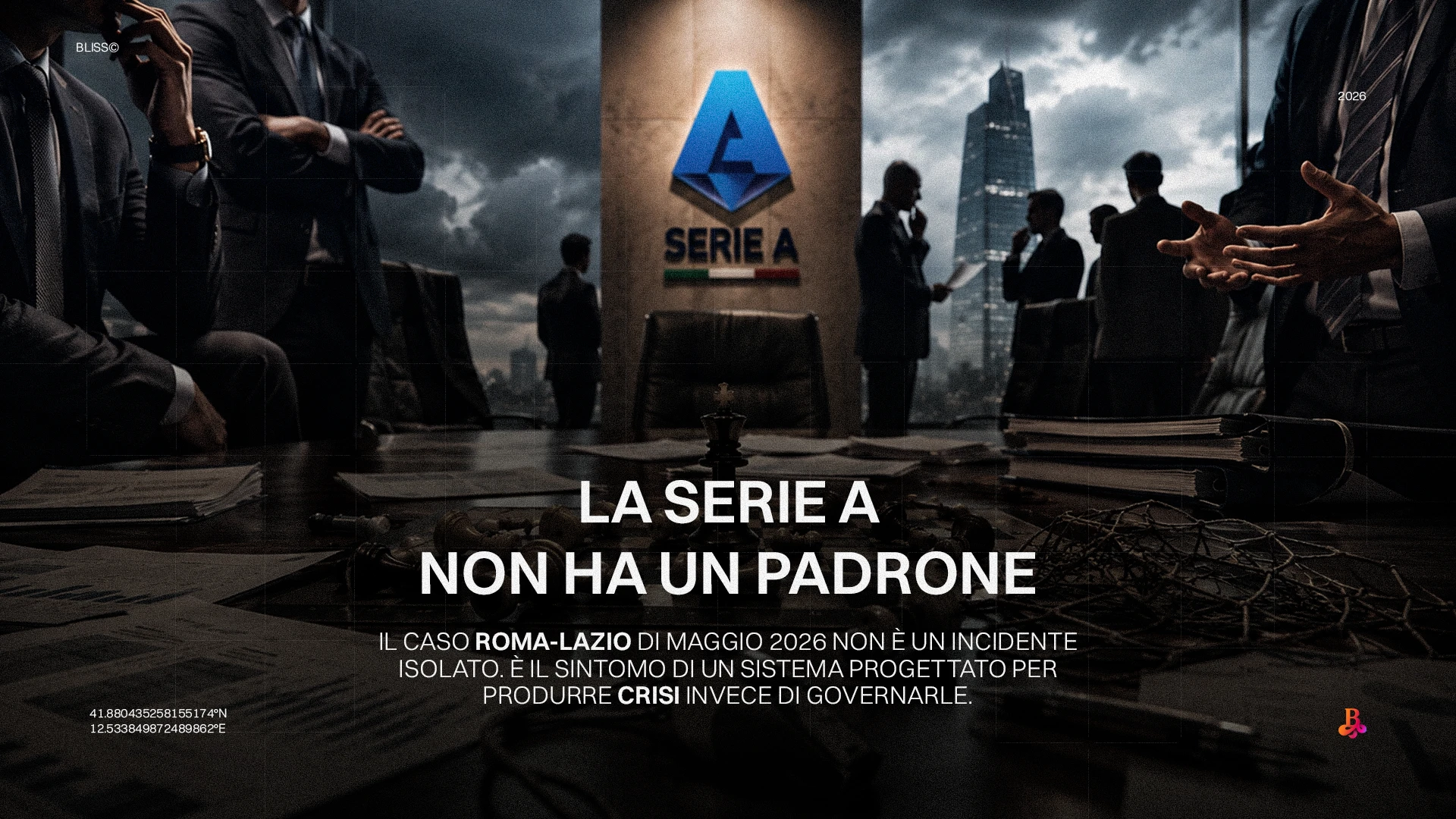
On Tuesday 12 May, five days ahead of one of the most important matches of the season, the Rome Prefecture issued an order moving Roma-Lazio from Sunday 17 to Monday 18 May. The final of the Internazionali di Tennis at the Foro Italico was scheduled for Sunday afternoon, and the two events coinciding posed risks to public order.
And yet we are at a critical point in the season: four teams are competing for a place in Europe. Simultaneous kick-offs are a necessary requirement for the integrity of the league. So Lega Serie A lodged an urgent appeal with the Lazio TAR. But on Thursday 14 May the TAR decided not to decide.
The solution only came later. Roma-Lazio will be played on Sunday at 12:00, thirty minutes earlier than planned. At the same time, the Lega asked the Internazionali di Tennis to move the final to 17:30. There is no certainty that it will.
This is the outcome of a week of institutional crisis.
Thirty minutes, and a hope.
A league that distributes 900 million euros in television rights to its clubs cannot establish, five days before kick-off, when the capital’s derby will be played.
Sports Minister Andrea Abodi hit the nail on the head.
“Couldn’t this have been considered earlier? The time to assess these things is before the fixture list.”
A sentence that describes the football system perfectly.

A pattern, beyond the single episode
This is not the first time failures like this have happened.
This season Serie A had planned to take Milan-Como to Perth, Australia, to become the first European league to play an official match outside the continent. The plan collapsed after what the official statement called a series of “unacceptable demands” from the Asian confederation. Project announced, visibility generated, public humiliation.
Before that, for years, the management of TV rights produced repeated crises. Expired contracts, regulatory vacuums, broadcasters entering and leaving the system, confused subscribers. Piracy is estimated to wipe out around €300 million a year in rights value.
Every crisis has the same structure. Something happens. The institutions ask themselves who has jurisdiction. A solution is sought in a hurry. The solution arrives late or not at all. The product takes the damage.
An embarrassing comparison
The Premier League distributes €3.4 billion a season in TV rights to its clubs. Serie A distributes €900 million. The ratio is almost four to one. Southampton, bottom of the Premier League in the 2024/25 season, received €130 million. Inter, top of Serie A, received €82 million. A relegated club in England earns 60% more than the Italian champions.
The most convenient explanation is the market. English football is more popular abroad, invested earlier and has commercial stability.
All true.
The most realistic explanation, however, lies elsewhere. The Premier League is governed by an operational structure that Serie A has never built. The fixture list is finalised 18 months in advance, with all stakeholders involved. Clashes between events are identified and resolved before they become public emergencies. A prefect’s order five days before a season finale does not exist, because the conditions that would make it possible do not exist.
The gap is structural before it is economic.

What a product without governance produces
Serie A has the raw material to be one of the most valuable sporting products in the world. The clubs with the richest history in Europe, the most passionate fan bases, the country with the most deeply rooted football culture. Naples, Milan, Rome, Turin, Florence: benchmark destinations for international tourism. Yet the product is worth less than it could be, and the gap with the Premier League widens every season.
The principle behind the phenomenon is simple. A product that is not governed produces crises. Crises do not destroy the product immediately (Italian football is too loved to disappear), but they erode it over time. Every episode like this week’s causes a loss of confidence among international investors, broadcasters, sponsors and the neutral fans who might choose it as a product to follow.
The Serie A brand identity is extremely strong. Its governance is weak.
Identity holds in the short term. In the long term, governance wins.
Meanwhile, the TAR has no answer
The TAR did not rule because the issue was not legal but organisational.
No administrative court can replace the decision that should have been taken when the fixtures were scheduled. No prefectural order can do the work that belongs to a governance structure capable of coordinating events, calendars, security and commercial interests before they become emergencies.
The question Serie A has never asked itself seriously enough is the same one that every organisation growing without governing itself eventually confronts. Who decides what, when, with what authority, and through what shared process?
Without a documented, operational answer to that question, the answer is always the same.
Someone else decides. Often at the last minute.
Usually, badly.
The derby will be played. Serie A will go on. But every week like this one builds the case for those who argue that Italian football is a great product, badly governed. And that analysis is correct.

The paradox that holds the system together
Serie A is one of the few products in the world capable of surviving its own governance. Fans’ passion is so deeply rooted that the system can function badly without anyone being motivated enough to change it. Every crisis is absorbed by love for the product. And that love is precisely why the system does not change. As long as the fans are there, nobody pays the price visibly enough to make reform urgent.
The price is real. It is paid by the fans who on Thursday did not know whether to buy a ticket for Sunday or Monday (when, incidentally, Rome will be brought to a standstill by a general strike), and by the broadcasters who cannot plan their coverage. It is paid by the sponsors who cannot activate event-linked initiatives and by the small and mid-sized clubs that keep losing ground to their European competitors because the collective product is worth less than it could be.
The cost of this week will not appear on any balance sheet.
It will build up, quietly, and in the long run it will acquire a precise name.
Value that was never built.
New Connections (FAQ)
Why doesn’t the Premier League have Serie A’s problems?
For a precise structural reason. The Premier League is governed by a body with genuine authority over the clubs and real operational capability. The fixture list is built 18 months in advance with all stakeholders involved. Clashes between events are identified and resolved before they become public crises. The difference is neither cultural nor geographical. It is one of institutional architecture.
Is the problem Lega Serie A or the individual clubs?
Both, but not equally. Clubs tend to maximise their own short-term interests at the expense of the collective product. This is normal and predictable in any system. The problem is that the League has not built a system that makes this behaviour less damaging to the common product. Effective governance does not depend on the goodwill of individuals. It depends on rules, processes and structures that produce the right outcome even when individuals pursue divergent interests.
What should Serie A do to become a serious league again?
Build what it lacks. A fixture-list editorial plan developed over 18 months with all institutional stakeholders involved. A coordination protocol with the prefectures and local authorities of cities hosting major events. A chain of responsibility that prevents the current situation, in which an operational decision is handed to an administrative court five days before the match. This is a matter of brand governance applied to Italy’s most-watched product. The problem has no footballing solution. It has an organisational one.
BLISS®
© 2026. ALL RIGHTS RESERVED