




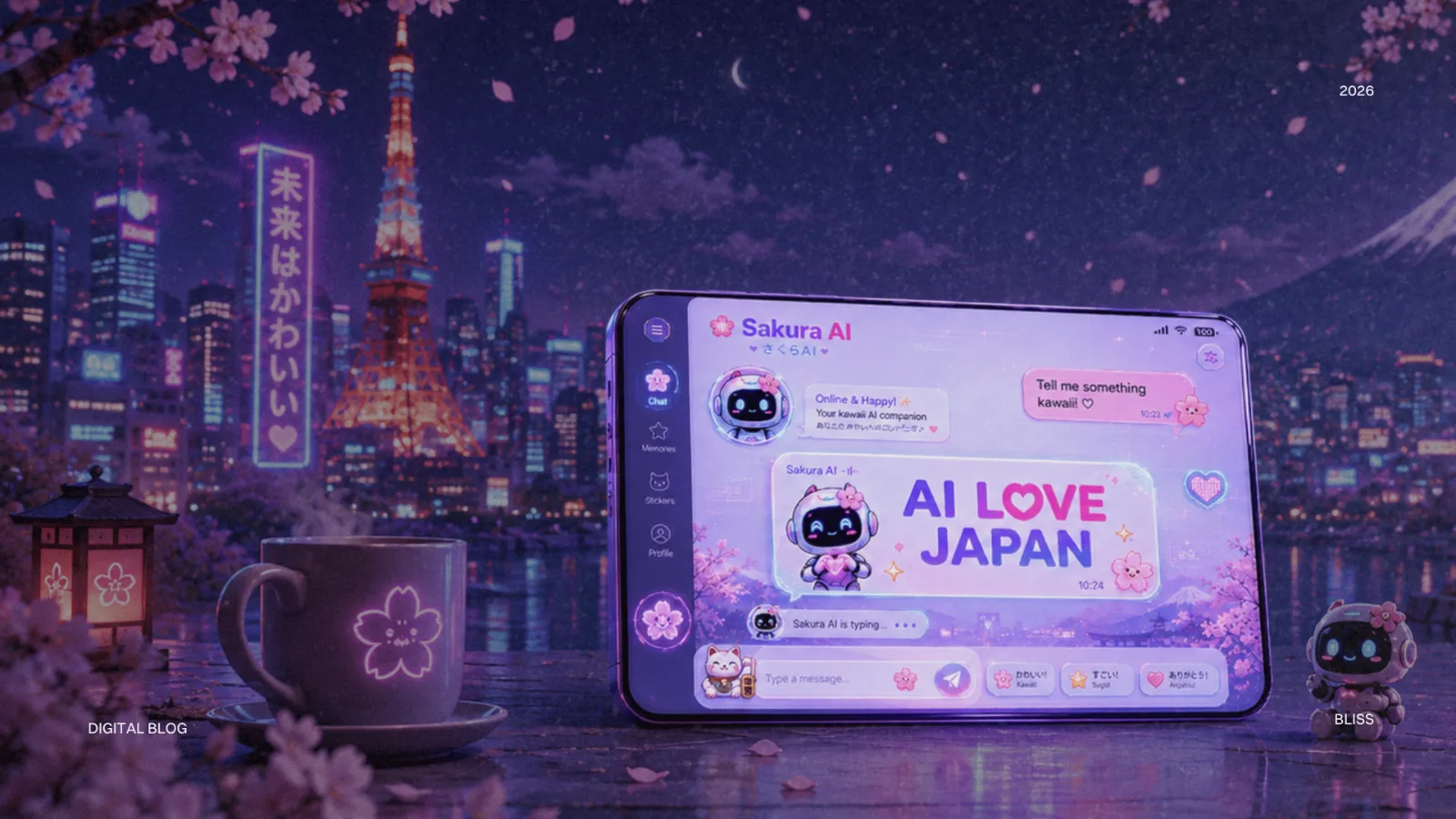
Values, social life, wellbeing, culture, entertainment.
Japan is famous for all of these things. Perhaps that is why we like it so much. But the surprising news is that we are not the only ones.
Artificial intelligence, too, loves the Land of the Rising Sun.This was discovered by three researchers from the University of the Basque Country and Cardiff University, who in April 2026 published a study entitled Why are all LLMs Obsessed with Japanese Culture?.
To measure the models’ cultural preferences, the researchers built CROQ: a dataset of open questions on values, legends, food, dance, education and some sixty other topics. No question specified a location. The model was free to choose. And it did.
The eight models analysed (GPT, Gemini, Claude, Llama, DeepSeek and Qwen) initially responded predictably: each tended towards the country associated with the language used (so, if the conversation was in Italian, the most beautiful beach was Italian, to give an idea).
The real surprise was the country that emerged once this coordinate was removed.
In those cases, Japan and the United States dominated completely. Japan, in particular, appeared consistently across different languages, topics and systems. India, China and France followed, but a very long way behind. Most of the world remained absent. Why was this happening? And what does this tell us about the relationship between AI and brands?
When the obsession begins
To find the origin of the phenomenon, the researchers compared the models in their base version with the versions trained to follow users’ instructions.
In the base version, the geographical distribution was more balanced. After instruction tuning, however, the models mentioned a greater number of countries but concentrated a growing share of their answers around Japan and the United States. The average number of regions mentioned rose from 116 to 149. The distribution index fell from 0.73 to 0.65.
This means that, on the surface, the world was becoming broader: and yet the range of recurring answers was narrowing. The more of the world AI knew, the narrower its answers became (or at least, its preferences).
But were these preferences really its own? Of course not.
Quite simply, the machine was learning to answer better. In doing so, it was learning which places seemed the best answers for us.
Why Japan, of all places
The research was unable to identify the ultimate cause of this phenomenon.
Admittedly, it is not hard to imagine. Few countries have symbols as immediate as Japan’s. Sushi, cherry blossoms, kimono, manga, Zen, katana, Tokyo, bullet trains. Not many countries have managed to tell their story in such an iconographic way.
What is more, Japan manages to represent tradition and the future, discipline and creativity, precision and harmony all at once. The meeting point of so many opposites: and therefore, the perfect shortcut. Distant enough to appear distinctive, well known enough to feel familiar, rich enough to fit almost any narrative.
We can verify this through its inverse. The cultures least represented in the data returned by AI tend to be those with fewer symbols. And therefore those least digestible by a database.
When preference finds its way into brands
Organisations now use artificial intelligence to generate naming, visual concepts, strategies, scenarios and communications. Governing these tools, however, also means questioning the biases and choices embedded in AI systems.
Ask for a portrayal of precision, and Japan appears. Ask for an example of harmony between tradition and innovation, and Japan appears. Ask for an experience of understated luxury or a culture geared towards improvement, and Japan may turn up yet again.
Each answer works, but this repetition risks creating a strategic problem too. When different brands work from the same references, their moodboards end up resembling one another until everything blurs together.
An organisation convinced it is exploring infinite possibilities may be moving within a repertoire already selected by the model. The risk is not using AI: it is entrusting it with choosing the world through which the brand decides to speak, rather than tracing every reference back to a brand strategy defined upstream.
AI love Japan
And so the brand uses a reference because the model suggested it. The model suggests it because it has encountered it often in answers deemed valid. The brand’s new output enters its digital footprint and reinforces that association, in turn feeding the way generative systems interpret and represent a brand. The machine and the organisation begin to confirm each other.
For now the subject is Japan, and all things considered (especially for those of us who love the Land of the Rising Sun) we are fine with that. Yet the same phenomenon could happen again: perhaps it already is, on themes and values we have not yet identified as recurring.
What would happen if, in future, AI came to favour another country? Could entire nations one day undertake operations aimed at winning over language models? And amid all this, what guarantee of complete transparency will users have?
These are all questions of Governance. And while we wait for the answers, all we can do is compare the references we receive against our strategies, always bringing each output back to the real context of the people our brand wants to speak to.
Every technology carries with it the world it learnt from. Artificial intelligence, however, is doing something more: it is handing that world to us, making it seem as though we were the ones who imagined it. For now, we are fine with that. Tomorrow, who knows.
Domande frequenti
Why does artificial intelligence mention Japan so often?
The study identifies the preference without proving a definitive cause. Japan, however, has an exceptional number of globally recognisable symbols, which allow models to build immediate answers around tradition, innovation, harmony, discipline and creativity. The research also shows that the concentration increases during instruction tuning: the phase in which models learn to produce useful and appropriate answers can reinforce certain cultural references until they become recurring choices.
How can AI's cultural bias influence a brand?
It can narrow the cultural repertoire used to build identity, communication and strategy. When the same references are offered to different organisations, their output starts to look alike. Some cultures receive disproportionate visibility, while others appear only through stereotypes or are absent altogether. The risk grows in international projects: an output that seems global may reflect an imaginary concentrated around a handful of countries and prove of little relevance to the markets the brand genuinely wants to address.
How do you govern cultural bias in AI-assisted creative processes?
The check begins with systematic observation. The same prompts are put to different models and in different languages, recording the references that appear most often and identifying what is left out. The outputs are then compared against the brand's strategy, the market's culture and the judgement of people able to recognise simplifications invisible to the system. The aim is to retain the speed of artificial intelligence without handing AI the choice of the world through which the brand communicates.
Fonti e riferimenti
- Joseba Fernandez de Landa, Carla Perez-Almendros, Jose Camacho-Collados, Why are all LLMs Obsessed with Japanese Culture? On the Hidden Cultural and Regional Biases of LLMs
- Junho Myung et al., BLEnD: A Benchmark for LLMs on Everyday Knowledge in Diverse Cultures and Languages
- Yu Ying Chiu et al., CulturalBench: A Robust, Diverse and Challenging Benchmark for Measuring LMs’ Cultural Knowledge Through Human-AI Red-Teaming