



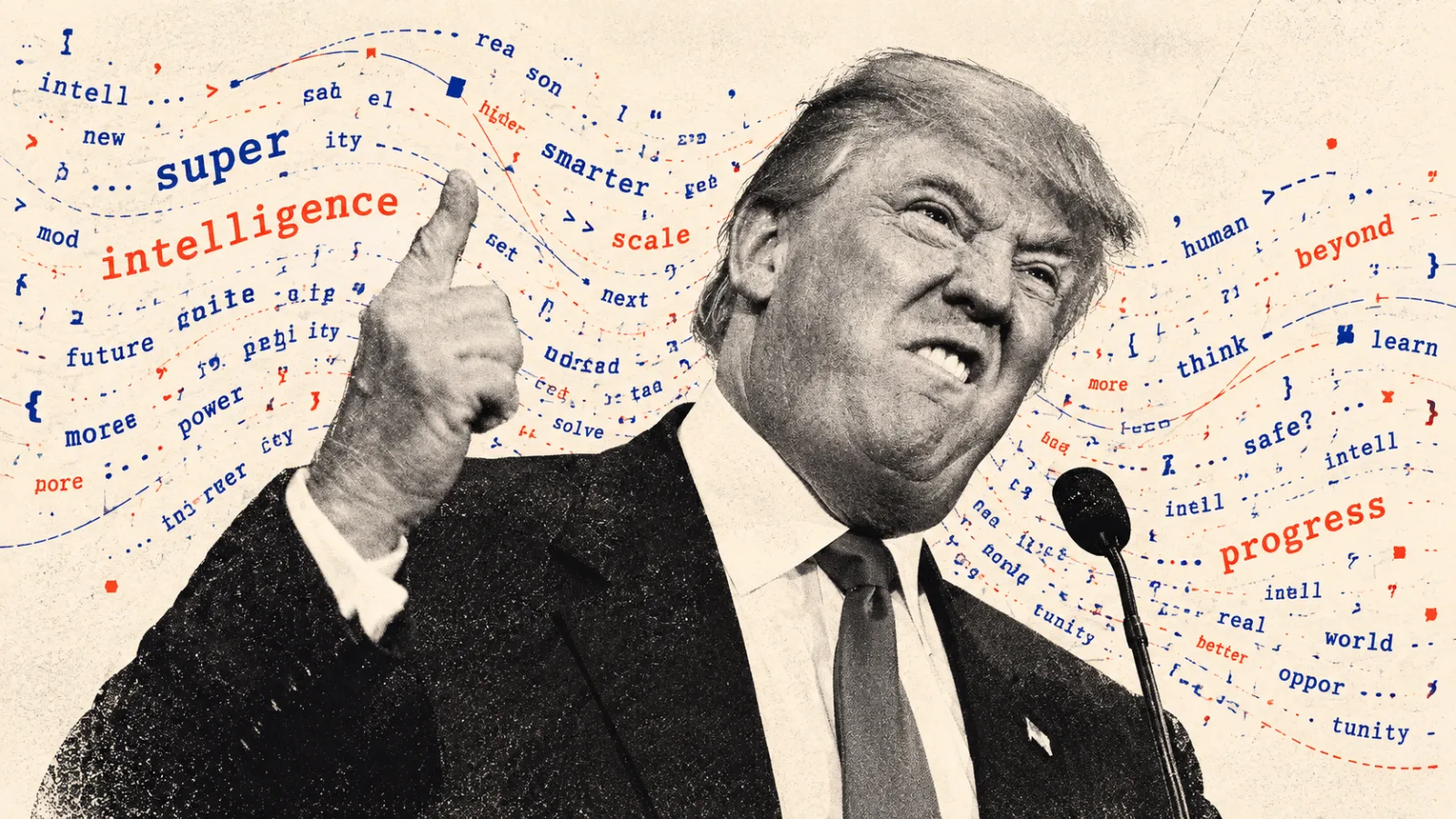
Stop calling it artificial intelligence: the new name is superintelligence. Donald Trump announced it yesterday during his speech to the UN General Assembly.
Be careful, though: the name has changed, not the technology.
Despite the great recent progress (from the release of Astra to Opus 5.5, through to MidJourney Medical), Trump’s move can and must be regarded as purely a political choice. Propaganda, if you like.
From today, according to the president, US government documents should speak of super intelligence, or SI, instead of artificial intelligence, AI. Quite a difference in the impact it creates. Because, as we know, in the beginning was the Word, and when the name we give something changes, so does the way we perceive it.
What happened at the UN General Assembly
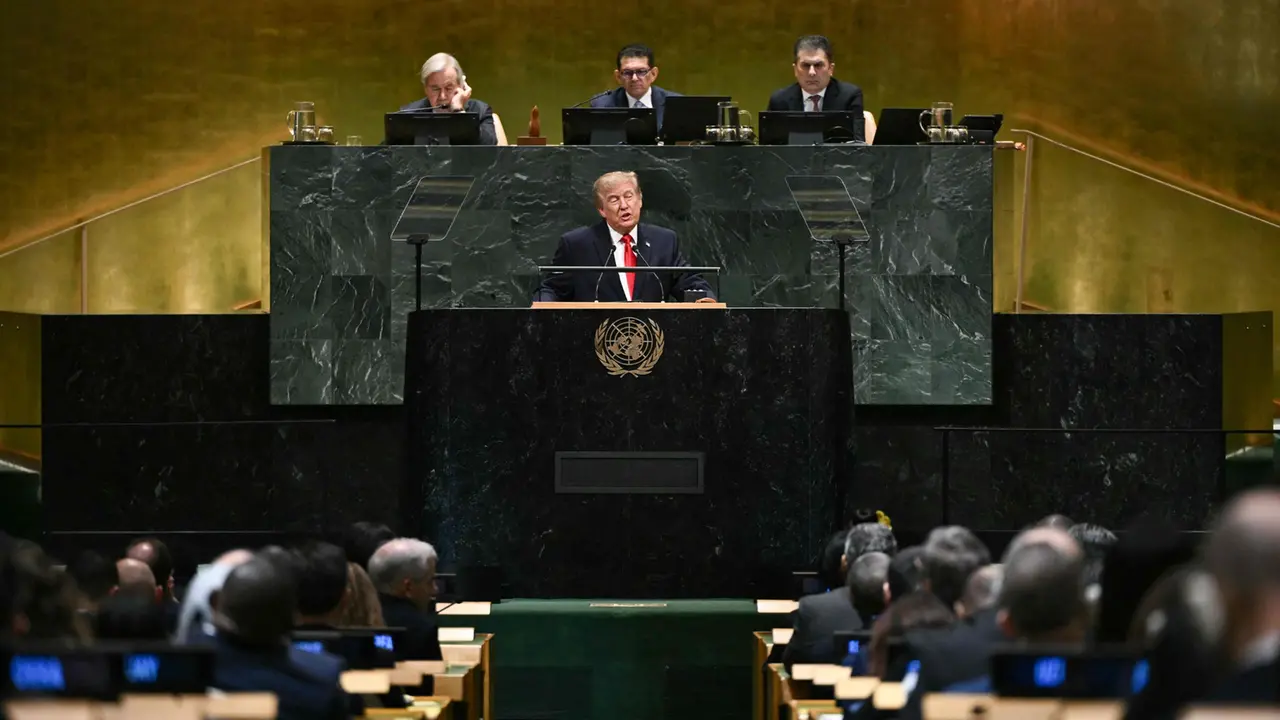
In his speech of 22 September, Trump explained that he does not like the word artificial.
In his view, it makes AI seem fake, something to be suspicious of. On the contrary, the technology of Anthropic and OpenAI is real, useful and extraordinary. For this reason, he announced that in United States documents the term will be replaced, with immediate effect, by super intelligence.
But his speech did not stop there.
He then immediately linked AI to international competition and claimed American supremacy over China, promising to encourage its development and rejecting any prospect of governing its evolution. In short, the new name for AI became part of a speech about US power and a claim over who will lead the next technological phase.
A pure exercise in digital sovereignty.
That is what happened. All that remains is to study the documents the government publishes over the coming months to see how far the administration adopts the new abbreviation SI.
In the meantime, the declaration has already had its first effect: forcing everyone to ask what superintelligence really means.

Does superintelligence already exist?
In research terminology, artificial superintelligence, abbreviated to ASI, refers to a hypothetical system capable of exceeding human cognitive abilities across multiple domains. It is a different concept from the AI we use today to write, code or complete tasks.
The accurate term would be AGI, or artificial general intelligence. This is the phase we are in. More broadly, it denotes the idea of a system able to tackle diverse intellectual tasks with a flexibility comparable to that of humans. The definitions and criteria for recognising it are still debated, but one thing is certain: true (artificial) superintelligence transcends people. And we are not there yet.
Today, no available system is recognised as superintelligence in the technical sense of the term. Some models deliver remarkable results in specific tasks; this, however, does not mean they surpass us in every field, or in a broader sense. Calling all current AI “superintelligence” does not mean ASI is here. If anything, it is misleading.
And so, as usual, Trump’s words divide and create confusion (here are 50 more times it has happened). This is because the same expression would end up referring both to systems already present in companies and to a future technology whose possibilities and risks are still being debated.
For decision-makers, keeping these meanings distinct is essential. Assessing software that accesses company data today is one thing; preparing for the open scenarios of near-science-fiction systems is another.
The growth of artificial intelligence
Time →
Why change the name right now
The timing is no accident.
Nor, of course, is the word.
It is well known how (and how insistently) various leading figures in AI development have, in recent weeks, called for time to study and contain the risks of advanced models.
Since this summer’s Hugging Face breach, there have been many calls for “technological de-escalation”. Dario Amodei, CEO of Anthropic, proposed slowing the pace at which system capabilities grow, so that safety measures can keep up. OpenAI argued that model development and release should be able to slow down or stop when sufficient safeguards are not in place. Even Elon Musk said he agreed.
Two positions with different nuances, which nonetheless show how central the question of speed has become, even for those building the technology. And it inevitably shapes public opinion.
At the UN, Trump chose to focus on growth and American leadership. He acknowledged that every new technology brings challenges, but treated the most serious warnings about AI with scepticism.
Within this frame, super is an effective word. It suggests strength, possibility, competitive superiority. It certainly helps Trump present AI as a resource to be conquered and developed, rather than as a weapon to be handled with caution. A deliberate linguistic choice.
It is not the first time.
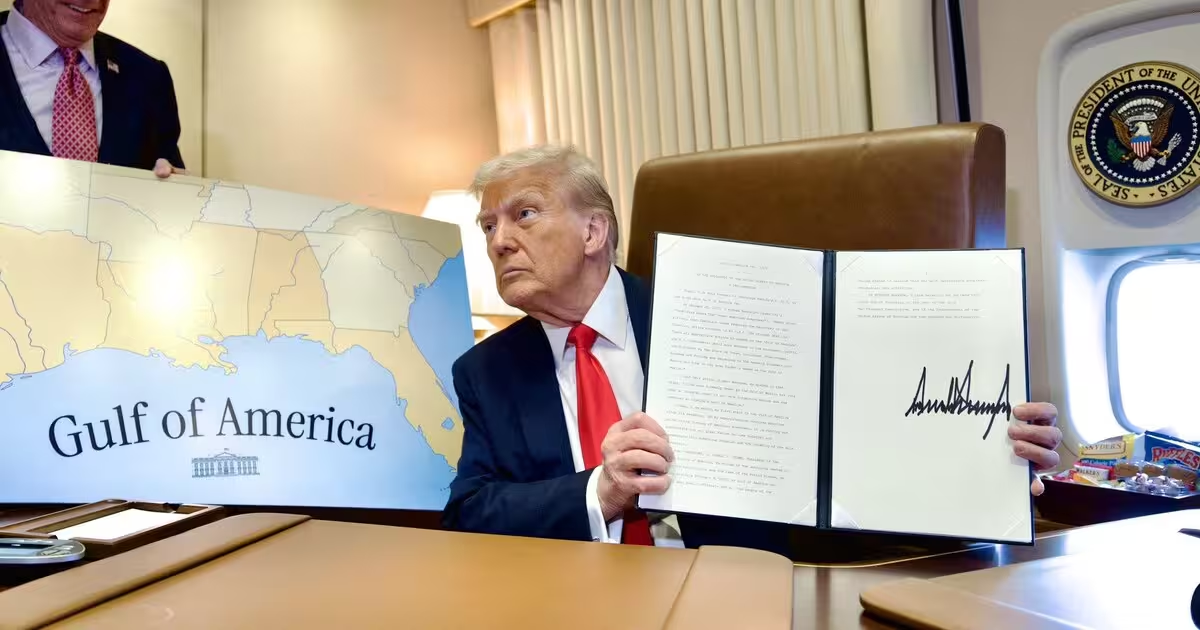
The Gulf of Mexico precedent helps to explain the method. Trump ordered the name “Gulf of America” for federal use. The sea stayed where it was: even international maps still show it under the “old” name. What changed was the name the US government chose to represent it.
The same is happening with AI. A word repeated in documents, speeches and news bulletins quickly becomes the frame through which millions of people understand an issue.
What changes for businesses
For a company, the announcement does not call for immediately replacing AI with SI in presentations or strategic plans. Rather, it invites recognition of a risk that is already present: making decisions on the basis of labels that are too broad.
Under the words artificial intelligence sit tools with very, very different functions and consequences.
Who governs them? This is where a business must start today.
What problem does SI solve? What information does it work on? Can it only suggest an action, or can it carry it out? Who checks the results, and who steps in if something goes wrong?
All useful questions today, with the technologies available. And ones that will become even more relevant if model capabilities keep growing, and overtake us.
The debate on superintelligence deserves attention, but it must not distract from immediate decisions. A board of directors can discuss future scenarios and, at the same time, ask for a precise map of the tools already in use across its departments. It can assess opportunities without giving up on setting responsibilities, limits and controls.
Trump wants to remove the word “artificial” from our vocabulary. Others will keep using it, because it describes where these systems come from. The debate over names will go on for a long time. Artificial or super, AI is already inside organisations. What we decide to do with it, and how we choose to govern it, should not depend on its name.
Master AI
Whether “super” or “artificial”, governance is key
Before superintelligence come concrete choices: which activities AI may inform, recommend or carry out, who checks the outputs, what data leaves the company and who is accountable for an error. Align with the AI Act with the Bliss team, defining the boundaries together before the tool sets them.
Domande frequenti
Why does Trump want to call artificial intelligence “super intelligence”?
In his speech to the UN General Assembly on 22 September 2026, Donald Trump argued that the term artificial intelligence makes this technology appear “fake” and said he wanted to use super intelligence, abbreviated to SI, in US government documents. The choice fits the way the president has presented AI as a strategic technology for American leadership, but it does not mark the birth of a new technological category. In technical language, artificial superintelligence refers to something far more specific than the AI systems available today.
Are AGI and artificial superintelligence the same thing?
No. AGI, Artificial General Intelligence, generally refers to a system capable of handling very different intellectual tasks with a flexibility comparable to that of humans. ASI, Artificial Superintelligence, instead describes a further scenario in which the system's capabilities would far exceed human ones across numerous domains. The definitions remain under discussion in research, and no system is currently universally recognised as ASI. For this reason, using *super intelligence* as the new name for artificial intelligence as a whole can conflate two concepts that, technically, remain distinct.
What changes for companies if AI is called “super intelligence”?
The change in terminology announced in the United States does not, in itself, alter what a system can do, the data it accesses or the risks arising from its use. For a business, it therefore remains more useful to classify tools by use case, permissions, data processed and the level of autonomy granted. This is the principle underpinning a corporate AI Policy: knowing which tools are being used, by whom, for which activities and under what supervision. The transparency obligations introduced by Article 50 of the AI Act likewise depend on the characteristics and uses of systems, not on the name under which they are presented. For a board, then, the useful question remains the same: what can this system actually do within our organisation, and who is accountable for it?