SEO Advisory
Positioning as a margin lever


Definition
What SEO advisory is: meaning, scope and strategic value
SEO, Search Engine Optimization, is the systematic set of activities that improve a site’s position in search engines’ organic results. Organic means unpaid. Positioning is built over time through three classes of signals: technical, content and authority.
Professional SEO advisory analyses these three levels in an integrated way, identifies the gaps against the competitors dominating the SERP, sets priorities and governs execution with measurable criteria and realistic timeframes.
Reducing SEO to an operational task to be outsourced is the costliest mistake. Every month without an organic presence is a month in which a competitor consolidates an advantage that no advertising budget can erase.
Technical SEO
Core Web Vitals, crawlability, indexation, structured data, mobile-first. The infrastructure Google reads before any content.
On-Page & Content
Keyword research as a map of demand. Pillar-cluster model, semantic internal linking, semantic density for every page.
Link Authority & E-E-A-T
Expertise, Experience, Authoritativeness, Trustworthiness. Digital PR, quality link building, online reputation management.
THE TEAM
Our voices
leading the way
Bliss’s SEO is managed by a team with experience of organisations with complex sales cycles in tech, manufacturing and professional services: sectors where the buyer is a decision maker with structured evaluation processes and long purchasing timelines.
Andrea Maso
HEAD OF SEO
International background, a data-driven mind and no intention of slowing down.
Mario Antonini
chief design officer (cdo)
Luca Maletta
Head of Copywriting
Sajjad Mazaherizaveh
Full stack developer
Combines front-end and back-end development with technical SEO and AI Search Optimisation.
Method
The pillars of professional SEO advisory
SEO audit: the strategic X-ray
Every serious SEO engagement starts with an audit. Not an automated report: an in-depth reading of the site’s technical, editorial and authority status, assessed against the competitors that dominate the target SERP.
The audit analyses more than 200 parameters: loading speed, URL structure, crawl errors, index coverage, backlink profile, content quality, structured data, E-E-A-T signals. The result is a priority map with the estimated impact of each intervention.
Why the board needs to know
A poorly configured site hit by an algorithmic core update can lose 40–60% of its organic traffic in 72 hours. Identifying points of vulnerability in advance is a management responsibility, not merely a technical one.
Technical SEO: crawlability, Core Web Vitals and architecture
Technical SEO is the foundation on which everything else is built. A site with excellent content but technical problems does not rank: Google cannot read, index and assess it correctly.
Core Web Vitals
LCP (loading), INP (interactivity), CLS (visual stability).
Crawlability
robots.txt, XML sitemaps, redirect chains, broken links, 4xx/5xx errors.
Canonical strategy
duplicate content management, canonical tags, hreflang for multilingual sites.
Schema Markup
structured data for FAQ, breadcrumb, Article, Product, Organization, SERP features and AI citability.
Mobile-first indexing
Google treats the mobile version of the site as the primary one.
Crawl budget
for large sites, optimising what Google crawls and how often.
Content Architecture: from keyword research to pillar-cluster
Keyword research is the strategic starting point: before a single character is written, the entire market demand is mapped. Volume, difficulty, CPC, search intent, seasonal trends. A keyword with 2,400 searches/month, a CPC of €3.00 and commercial intent is worth far more than a purely informational keyword with 10,000 searches.
The pillar-cluster model organises the site as a topical authority: a pillar page covers the main topic exhaustively; cluster pages explore the sub-topics in depth and link back to the pillar with semantically coherent internal links. Google recognises this pattern and rewards topical authority built over time.
AI content vs strategic content
In 2026, Google penalises content generated entirely by AI without editorial supervision and without verifiable E-E-A-T signals. Bliss's SEO content is written by strategists and validated by sector experts — not generated in bulk.
E-E-A-T: Google's authority framework
Since 2022, Google has added the E for Experience to the EAT framework. The four elements are not a checklist: they are the logic Quality Raters use to assess sites before the algorithm is updated.
Expertise
Do the authors have verifiable credentials? Bios are real, linked to LinkedIn profiles, with a documented professional history.
Experience
Does the content demonstrate first-hand experience? Real case studies, original data, verifiable testimonials.
Authoritativeness
Is the domain cited by authoritative third-party sources? Editorial backlinks, mentions in trade publications.
Trustworthiness
Is the site secure (HTTPS), with clear privacy policies, verifiable contact details and genuine reviews?
Link Building and Digital PR: authority as an asset
Link building in 2026 is not about acquiring backlinks in volume: it is strategic digital PR. Editorial links from trade media, citations in studies and research, mentions from universities and institutions. A single backlink from an authoritative source is worth more than 1,000 links from low-quality directories, which in fact attract penalties.
Strategy
SEO vs Google Ads: asset or operating cost?
The question boards rarely frame the right way is: are we building an asset or paying rent?
Paid
Google Ads
Immediate traffic. When the budget runs out, the traffic stops. Paid visibility leaves nothing structural behind. Every €1,000 invested produces a temporary result. Ongoing variable cost.
Asset
Organic SEO
A longer initial investment. Once built, positioning becomes a balance-sheet asset that generates qualified traffic at a declining marginal cost over time. A year of SEO creates a moat that cannot be bought. ROI that compounds.
OUR SEO RESULTS
Success stories
These results show what happens when SEO, content and AI Search are turned into a genuine growth engine. Leads, sales, qualified traffic and revenue growth: every case study presents concrete data, verifiable results and performance built to generate real business.
Valle D'Aosta
Bliss supported the Aostæ 2025 project in building an institutional digital ecosystem designed to enhance the region, its events and public communication.
Frontier
Beyond the traditional SERP: SEO in the age of artificial intelligence
Since March 2025, Google AI Overview has also been live in Italy. It is not an algorithm update: it is a structural change in the way users receive information. Generative engines, Google AI Overview, ChatGPT Search, Perplexity, Bing Copilot, answer queries directly without requiring a click. The sources cited gain top-tier visibility. The sources ignored become invisible. The relevant question is no longer just: where do we rank on Google? It is: are we cited as an authoritative source by the automated answer systems our stakeholders and clients use?
Generative Engine Optimization
Optimisation for generative engines: question-answer structure, semantic density, source citability. Bliss has integrated GEO as a standard component of its SEO advisory since 2024.
AI Overview Optimization
Google AI Overview selects sources based on E-E-A-T signals, structured data and structural clarity. A site optimised for E-E-A-T is already partly optimised for AIO — but that is not enough.
Answer Engine Optimization
Optimisation for position zero and featured snippets: structured answers extracted directly into the result. Tables, lists, concise definitions, FAQ markup.
Voice & Conversational Search
Voice searches via Google Assistant, Siri and smart devices are predominantly in natural language. Optimising for conversational intent is part of SEO advisory in 2026.
Method
The Bliss method: visibility governance
Most SEO agencies manage activities. Bliss Agency builds systems. An SEO system delivers stable, measurable and scalable search positioning because it is rooted in a strategic architecture that governs every operational decision.
Reading the context and strategic roadmap
Analysis of the brand, the sector, the competitors dominating the SERP, the target keyword portfolio and the technical structure. The result is an SEO roadmap built on the company's specific context — not a template. It includes gap analysis, content strategy, link strategy and a technical plan with estimated impact for each phase.
Criteria, processes and quality control
SEO gains are lost without governance. We define operating criteria that keep positioning consistent through growth: SEO-brand editorial guidelines, technical validation processes for releases, content approval workflows, migration rules. Can be integrated with in-house IT, marketing and content teams.
Technical, editorial and authority execution
Technical optimisation, content production, digital PR and link building, advanced monitoring — executed within the frameworks defined in the previous phases. Monthly reporting that measures business impact (conversions, organic revenue, organic CAC), not just visibility KPIs.
Analytics, testing and continuous optimisation
SEO is not set-and-forget. Google releases multiple Core Updates every year. Continuous monitoring includes: ranking tracking by keyword cluster, impressions and CTR from Search Console, conversion attribution in GA4, crawl log analysis, competitor monitoring. Test & Learn on content and technical variables.
Bliss Agency is the only firm in Italy that integrates SEO advisory within a system of brand advisory and communications governance. SEO content is validated for organic performance and for consistency with the brand’s strategic identity.
Enterprise
SEO advisory for established companies
SEO advisory for a local SME and SEO advisory for an industrial group operating across multiple markets are two radically different problems. Same discipline, same technical principles, entirely different complexity.
Multi-market and international SEO
Hreflang architecture for multiple markets, ccTLD vs subdomain vs subfolder structure, localised keyword research for each target market, link building for separate domains. Every technical decision has impacts that propagate across all markets simultaneously.
The first mistake in international SEO is applying Italian keyword research to foreign markets through direct translation. Search demand in German, French or Spanish has a different semantic distribution: each market requires native research.
SEO and brand governance
SEO content must respect the brand’s tone of voice, narrative architecture and communication criteria. Content optimised for Google but inconsistent with the brand causes measurable reputational damage.
Bliss Agency is the only partner that validates SEO content both for organic performance and for consistency with the brand system — because the same team runs the Brand Advisory.
SEO and investor relations
The branded SERP shapes the perception of analysts, investors and institutional stakeholders. Managing what appears when searching for the company’s name, its executives and its key products is an element of reputation management that the board should oversee with the same attention it gives to financial communication.
Enterprise SEO: scale, CMS and crawl budget
Thousands of pages, extensive catalogues, editorial portals: crawl budget optimisation, content pruning, canonical strategy, duplicate content management, integration with enterprise CMSs (Salesforce Commerce Cloud, SAP Commerce, Adobe AEM, Sitecore). Bliss has direct experience with Miele, Würth and Coca-Cola HBC on enterprise-level sites.
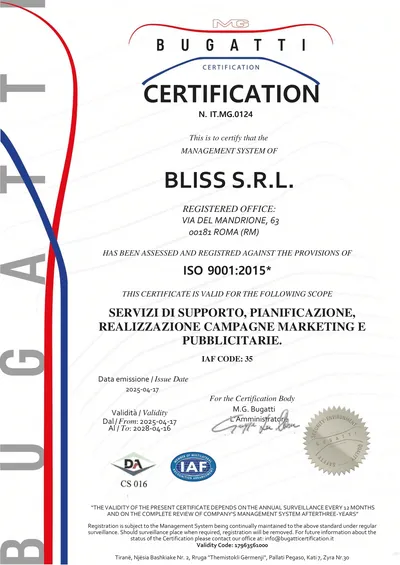
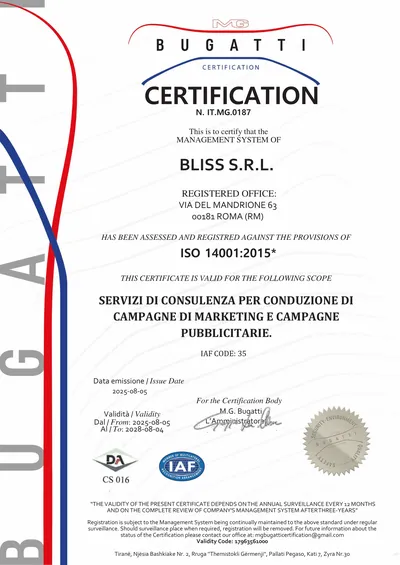
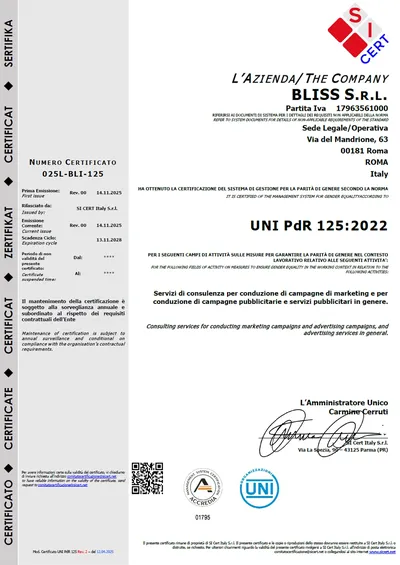
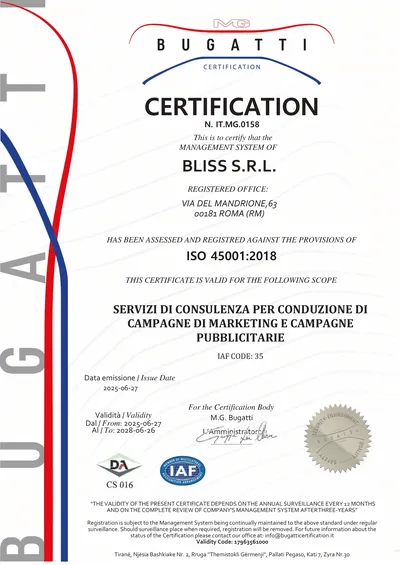
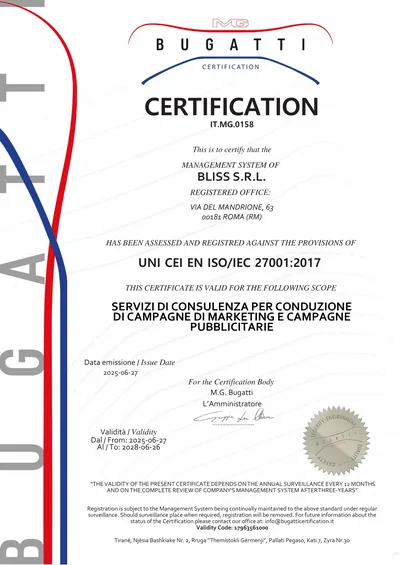
Certified Agency
Certifications
Blog & Trends 2026
SEO TRENDS & NEWS
SEO FAQ
SEO | Frequently Asked Questions
What is Search Engine Optimization?
Search Engine Optimisation is the structured process through which a website gains organic visibility in search engines. It operates on three levels: the site’s technical architecture, the structure and quality of its content, and domain authority as measured by inbound links. Unlike paid advertising, the organic traffic generated by SEO does not depend on continuous budgets and represents a long-term capital asset for the organisation.
How long does SEO take to deliver results?
The first signs of improvement become visible within 60–90 days for technical interventions on sites that are already indexed. Stable positioning on competitive keywords generally takes 6–12 months, depending on the starting domain authority, the competitiveness of the SERPs and the continuity of the work. For new sites or sites with a history of penalties, timescales are longer. SEO is a system of progressive capitalisation: results grow over time rather than running out.
What is the difference between SEO and Google Ads?
SEO produces lasting organic assets: positioning that retains value over time and does not reset when a budget ends. Google Ads generates immediate but intermittent traffic, which stops as soon as advertising spend ends. For structured organisations, the two levers are complementary: paid search covers high-conversion queries in the short term while SEO builds long-term visibility infrastructure. The organic cost per click tends towards zero as positioning consolidates.
What is an SEO audit?
An SEO audit is a systematic analysis of the technical, content and authority status of a website at a specific point in time. It identifies the critical issues limiting search positioning, crawl problems, indexing errors, keyword cannibalisation, toxic backlinks, insufficient speed, and sets intervention priorities according to expected impact. A well-conducted audit is the founding document of any SEO strategy: without a precise diagnosis, subsequent interventions risk addressing the consequences rather than the causes.
What is meant by technical SEO?
Technical SEO covers every aspect that affects search engines’ ability to crawl, render and index a website correctly. The main areas of intervention include: loading speed and Core Web Vitals, URL structure and redirect management, canonical tags and duplicate handling, robots.txt and XML sitemaps, JavaScript rendering, crawl budget architecture. Technical interventions produce rapid, measurable effects because they act on the fundamental prerequisites of indexing.
What does an SEO consultant do?
An SEO consultant defines the organic visibility strategy, coordinates technical and content work, monitors algorithm changes and integrates SEO into the organisation’s business system. Unlike an agency delivering packaged services, a consultant works at the level of decision-making architecture: setting priorities, assessing options and supporting the in-house team in choices that have a structural impact on positioning. The advisory mandate complements internal resources rather than replacing them.
Does SEO work for B2B companies?
B2B SEO has specific characteristics that set it apart from B2C: generally lower search volumes, more precise commercial intent, a long sales cycle and multiple decision-makers. Positioning on low-volume but highly qualified commercial keywords produces higher-value leads than generic high-traffic keywords. In B2B, SEO is integrated with the thought leadership strategy: authoritative editorial content generates both organic traffic and sector reputation, with a multiplier effect on commercial acquisition.
What is link building?
Link building is the process of acquiring editorial backlinks from authoritative third-party sites. Inbound links are the main authority signal for search engines: a domain cited by reliable sources, such as news outlets, sector portals and institutions, gains a reputation that is reflected in the positioning of the entire site. Effective link building is always editorial: it is earned by producing valuable content, through digital PR and media relations, never by buying links or using artificial site networks. The quality of the backlink profile is decisive; quantity is secondary.